




Few vrats in the Hindu calendar carry the emotional weight that Vatsa Savitri does. Observed by married women across India, this sacred fast is not just about ritual. It is a declaration of love, an act of devotion, and a lived prayer rooted in one of the most powerful stories ever told. Whether you are performing it for the first time or have observed it for years, this guide covers everything you need: the correct dates for 2026, step-by-step puja vidhi, the inspiring katha behind it, and practical tips to make the day meaningful.
What is the Vat Savitri Vrat?
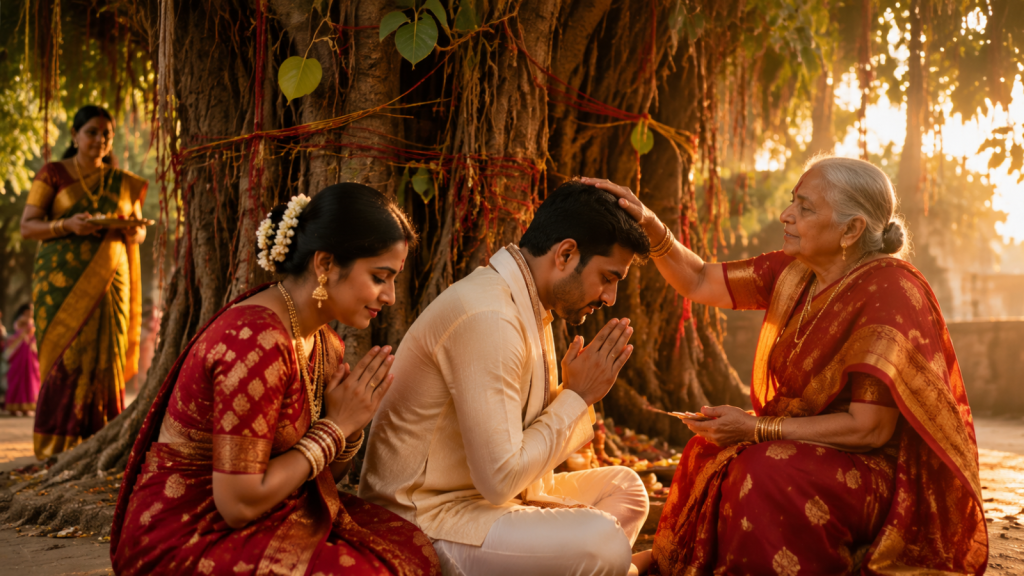
Vat Savitri Vrat is a sacred fast observed by married Hindu women for the long life, health, and prosperity of their husbands. “Vat” refers to the Banyan tree, a symbol of longevity and spiritual power, while “Savitri” honors the devoted wife from Hindu mythology who famously outwitted death to save her husband, Satyavan.
Women celebrate this vrat by fasting, worshipping the Banyan tree, tying sacred threads, reciting the katha, and performing circumambulations, a ritual that blends devotion, intention, and mythological depth in a single, meaningful observance.
When and How to Celebrate Vat Savitri in 2026

One of the most common sources of confusion around this vrat is the date. Vat Savitri is actually celebrated on two different days in India, depending on which lunar calendar a region follows.
Vat Savitri Vrat 2026 (Amavasya — North India)
Observed in: Uttar Pradesh, Bihar, Jharkhand, Delhi, Madhya Pradesh, Punjab, Haryana, Odisha
- Date: Saturday, 16 May 2026
- Tithi: Jyeshtha Amavasya (New Moon)
- Amavasya begins: 16 May 2026, approximately 5:11 AM.
- Amavasya ends: 17 May 2026, approximately 1:30 AM.
- Note: This day also coincides with Shani Jayanti, making it additionally auspicious
Vat Purnima Vrat 2026 (Purnima — Maharashtra, Gujarat, South India)
Observed in: Maharashtra, Gujarat, Goa, parts of Karnataka
- Date: Monday, 29 June 2026
- Tithi: Jyeshtha Purnima (Full Moon)
- Purnima begins on 29 June 2026 at approximately 3:06 AM.
- Purnima ends: 30 June 2026 at approximately 5:26 AM.
The reason for two dates lies in regional calendar traditions. North India follows the Purnimanta calendar, where the vrat is observed on Amavasya. Maharashtra and Gujarat follow the Amanta calendar, where the same month ends on Purnima. The difference is roughly 15 days, but the legend, the spirit, and the rituals remain identical.
In Odisha, the festival is known as Sabitri Brata and follows the Amavasya date. In Nepal, too, married women observe this vrat with similar customs on the same Amavasya tithi.
Auspicious Muhurat and Shubh Yogas
| Detail | Timing (IST, Amavasya — 16 May 2026) |
| Amavasya Tithi Begins | 16 May 2026, ~5:11 AM |
| Sunrise | ~5:30 AM (Delhi region) |
| Best Puja Muhurat (Pratahkal) | Sunrise to ~8:00 AM |
| Shubh Muhurat (Morning) | After sunrise, during Amavasya |
| Avoid | Rahu Kaal (check local panchang) |
| Amavasya Ends | 17 May 2026, ~1:30 AM |
| Detail | Timing (IST, Vat Purnima — 29 June 2026) |
| Amrit Muhurat (Morning) | 5:26 AM – 7:11 AM |
| Shubh Muhurat | 8:55 AM – 10:40 AM |
| Char Muhurat | 2:09 PM – 3:54 PM |
| Labh Muhurat | 3:54 PM – 5:38 PM |
| Amrit Muhurat (Evening) | 5:38 PM – 7:23 PM |
The most favored time for performing vat savitri puja is in the early morning, after sunrise, during the Pratahkal. This is when the atmosphere is considered most sattvic — calm, clean, and spiritually receptive. Always cross-check with your local panchang for city-specific variations, as sunrise and Rahu Kaal timings differ across locations.
The Inspiring Story of Savitri and Satyavan
The Vatsa Savitri Vrat Katha is more than a religious narrative. It is a study in conviction. Here is the story as it unfolds in the Mahabharata’s Vana Parva.
King Ashvapati of Madra had longed for a child and performed intense penance to the Sun God, Bhagwan Savitra. His devotion was rewarded when Goddess Savitri appeared and granted him a daughter, who grew into a woman of exceptional beauty, intelligence, and spiritual strength.
When the time came to choose a husband, Savitri selected Satyavan, an exiled prince living in the forest with his blind father, Dyumatsena. The sage Narada warned that Satyavan was destined to die within a year. Savitri, unwavering in her choice, replied, “Whether his life is long or short, he is my husband.” She married Satyavan in a forest hermitage and began preparing for the fated day with devotion and foresight.
On the destined day, Satyavan collapsed while chopping wood under a Banyan tree. Yama, the god of death, arrived to claim his soul. Savitri courageously followed Yama, refusing to abandon her husband. Impressed by her composure and devotion, Yama offered her boons, with the restriction that she could not ask for Satyavan’s life. Savitri cleverly asked for her father-in-law’s eyesight, his lost kingdom, and the promise to bear a hundred sons with Satyavan. Granting these, Yama realized he must restore Satyavan’s life to honor his word.
Through her intelligence, faith, and unwavering devotion, Savitri not only saved her husband but also exemplified the power of love and righteousness. This story forms the spiritual heart of Vat Savitri Vrat, inspiring women to honor devotion, courage, and marital commitment.
Step-by-Step Guide: Performing Vat Savitri Puja
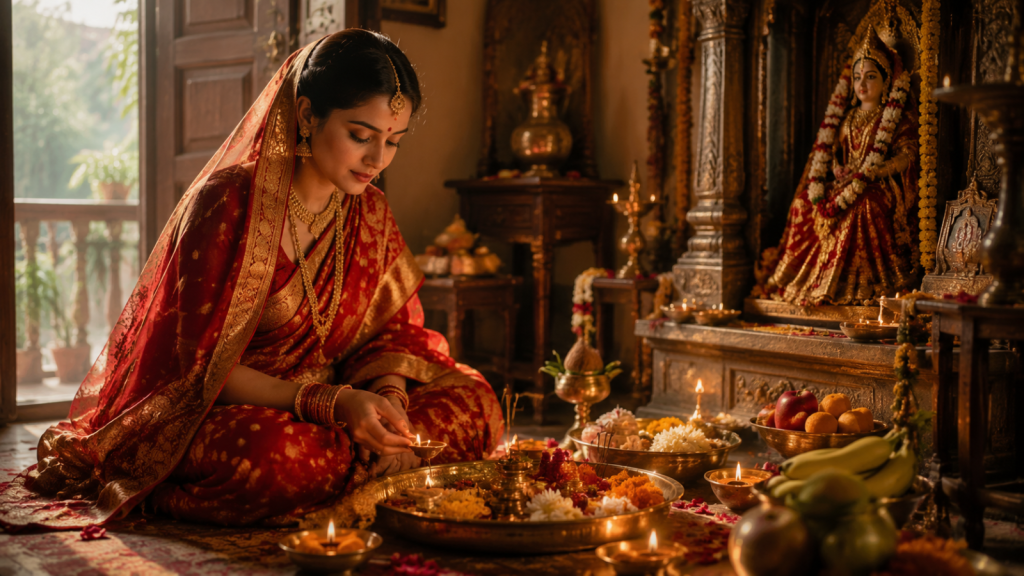
The Vatsavritri Puja Vidhi follows a clear sequence. Knowing each step in advance lets you perform it with focus rather than confusion.
Preparing for the Fast
Begin the night before by planning your sankalpam. Wake up before sunrise on the day of the vrat. Take a holy bath, which is considered an act of purification for both the body and mind. After bathing, dress in traditional attire; red, yellow, or another auspicious color is preferred. Apply sindoor, wear bangles and jewelry, and complete your solah shringar if your tradition includes it. Women are considered to embody Savitri herself on this day, and the dressing reflects that reverence.
Decide in advance the nature of your fast. Some women observe a nirjala fast (without water), while others take fruit or milk. Choose based on your health and tradition. Both forms of the fast are considered valid. If you are pregnant, elderly, or have a health condition, a partial fast is entirely acceptable.
Setting Up Your Puja Space
If you are going to a Banyan tree in your neighborhood or temple, carry your puja thali with you. If no Banyan tree is accessible, set up a small altar at home using a Banyan branch or a picture of the Vat Vriksha.
Your puja thali should include:
- Moli (sacred red thread)
- Roli, sindoor, and kumkum
- Akshat (unbroken rice grains)
- Fresh flowers and leaves
- Seasonal fruits (mango, banana, and other available fruits are traditional)
- Soaked chana (chickpeas)
- Sweets like peda or mishri
- A small diya and incense sticks
- A copper vessel with water (for offering arghya)
- A small idol or picture of Savitri, Satyavan, and Yamraj (optional but traditional)
Arrange the altar neatly. Light the diya and incense before beginning prayers. This creates a focused, sacred space.
Worshipping the Vata Tree
The Banyan tree is the central point of the vat savitri puja. Approach it with the puja thali. Begin by offering water to the roots. Then apply roli, kumkum, and akshat to the trunk.
Take the moli (sacred thread) and wind it around the trunk of the tree seven times while walking clockwise. This circumambulation, or parikrama, is one of the most important parts of the ritual. Each round represents a prayer, a reaffirmation of commitment, and an invocation of the tree’s divine energy. As you walk, chant prayers for your husband’s long life and well-being.
The number seven is significant; it mirrors the seven vows (saat pheras) taken during a Hindu marriage ceremony, symbolically renewing those promises each time the vrat is observed.
After completing the parikrama, offer flowers to the tree and bow in reverence.
Offerings and Mantras
Place your offerings before the tree or the Savitri idol. Offer soaked chana, fruits, and sweets as prasad. Light the diya and incense, and then recite or listen to the vat savitri vrat katha.
Key mantras recited during the puja:
For the Banyan tree:
ॐ वट वृक्षाय नमः
(Om Vat Vrikshaya Namah)
For Lord Vishnu (for protection of the husband):
ॐ नमो भगवते वासुदेवाय
(Om Namo Bhagavate Vasudevaya)
Savitri prayer:
सावित्र्यै नमः। सत्यवते नमः। यमाय नमः।
(Savitriyai Namah. Satyavate Namah. Yamaya Namah.)
After the katha recitation, offer copper coins and remaining akshat to the tree. Seek blessings by placing your hands in pranam and offering a heartfelt prayer.
The fast is traditionally broken after sunset, with a sweet meal shared with the family. Some women first take the blessings of their husbands and then eat. In many communities, women fan their husbands gently after returning home, a symbolic gesture of the devoted wife, mirroring Savitri’s care for Satyavan.
Spiritual Benefits of Vat Savitri Vrat
Vat Savitri Vrat is more than a prayer for a husband’s long life it strengthens commitment, patience, and intentional love in marriage. Worshipping the Banyan tree is believed to invoke blessings from the Trimurti- Brahma, Vishnu, and Shiva and protection from Yamraj, ensuring family stability and spiritual grace.
Fasting and focused devotion bring clarity of mind, heightened spiritual sensitivity, and a sense of inner discipline. When women gather for the puja, it fosters collective strength, honoring past generations and inspiring future ones. According to the Skanda Purana, sincere observance brings marital happiness, prosperity, fulfillment of righteous wishes, and longevity for the husband.
Regional Traditions and Unique Customs
One of the most interesting aspects of Vatsa Savitri is how differently it is experienced across India, even though the core story and intention remain the same.
North India (UP, Bihar, Jharkhand, Delhi, Haryana, Punjab, MP)
In these states, the vrat is observed on Jyeshtha Amavasya. It often coincides with Shani Jayanti, and women observe either a nirjala fast or a partial fruit-based fast. The ritual of tying the moli around the Banyan tree and performing seven parikramas is central. The katha is recited in the afternoon, typically by a pandit or elder woman. The Vatsavritri puja kab hai is a frequent question here — the answer for 2026 is 16 May.
Bihar and Jharkhand
Locally known as Bar Puja or Vat Puja, the festival is observed with particular enthusiasm. Women adorn themselves in bridal-style clothing and gather at Banyan trees in large groups. A special custom involves wearing a Banyan leaf in the hair as a symbol of connection to the Vat Vriksha.
Odisha (Sabitri Brata)
In Odisha, the festival is called Sabitri Brata and is observed on the same Amavasya tithi. A distinctive custom here involves a three-day fast, not just a single-day observation. Women also read the Savitri Brata Katha from a specific Odia-language sacred text. Offerings include nine types of fruits, wet pulses, and flowers.
Maharashtra and Gujarat (Vat Purnima)
Observed on Jyeshtha Purnima (29 June 2026), the celebration here is more elaborate in some ways. Women perform the rituals over three days, fasting, reciting the katha, and drawing pictures of the Vat tree, Savitri, Satyavan, and Yamraj with sandalwood paste on the floor or walls of the home. Golden figurines of the couple are placed in a tray of sand and worshipped. Women greet each other with the phrase “Janm Savitri ho” — meaning, “May you be a Savitri in every birth.”
Nepal
Married women in Nepal observe this vrat with great devotion, following the Amavasya date. The customs closely mirror those of Bihar and UP, with particular emphasis on the parikrama and katha recitation.
Communities combining other rituals
Some communities observe Satyanarayan Katha alongside the vat savitri puja on the same day, treating both as complementary observances. Others incorporate the worship of Shani Dev due to the day’s coincidence with Shani Jayanti.
Also Read
Ganga Dussehra 2026: Date, Rituals, & Significance
5 Powerful Astrological Mantras for Stress Relief | Astrological Remedies
Elevate Your Vat Savitri Vrat with Astrolive

Can’t make it to a temple or sacred Banyan tree this year? Astrolive brings the spiritual essence of Vat Savitri right to your home. Align your home puja with traditional rituals while enjoying the convenience of digital guidance.
Celebrate Smarter with Astrolive:
- Traditional Offerings (Daan): Honor the vrat by sponsoring essential puja items like flowers, rice, sweets, or ceremonial threads—directly through the app. Your offerings reach holy sites while staying true to the sacred tradition.
- Precision Panchang: Get real-time Tithi, Muhurat, and planetary timings customized for your location to perform your puja at the most auspicious moments.
- Personalized Astrology Insights: Understand how this year’s Vat Savitri energy influences your zodiac sign, with guidance for devotion, blessings, and spiritual focus.
[Explore Astrolive Features] | [Check Today’s Panchang]
Tips for a Smooth and Meaningful Puja
Plan the night before. Gather all puja items the evening before the vrat. Rushing on the morning of the fast disrupts the calm you want going into the day.
Start early. The Pratahkal immediately after sunrise is the most auspicious time. The quietness of early morning also lends itself to genuine, unhurried prayer.
Locate your Banyan tree in advance. If you plan to go to a temple or a public tree, know the location beforehand. Some popular trees get crowded, and arriving early helps you perform the rituals peacefully.
Know your katha source. Whether you read from a book, listen to a pandit, or use a reliable audio recording, prepare your katha source in advance. Many women find that listening to the story slowly, with attention, deepens the experience significantly.
Do not rush the parikrama. Seven rounds around the tree while winding the moli is a meditative act. Slow down. Recite a simple prayer in your mind with each round.
Avoid common mistakes: Do not use synthetic thread; raw cotton moli is traditional. Do not break the fast before sunset. Do not perform the puja without first offering water to the tree’s roots. And do not skip the katha recitation; it is considered an essential part of the vrat, not an optional addition.
Involve your family. While the fast is primarily observed by married women, the katha recitation is something elders and children can participate in. Sharing the story makes it a living tradition, not just a private ritual.
Adapt thoughtfully when needed. If you are traveling, unwell, or cannot reach a Banyan tree, placing a Banyan branch or picture on your home altar and performing the puja there is entirely acceptable. Intention and devotion matter more than physical perfection.
FAQ:
vat savitri puja kab hai
In North India (UP, Bihar, Delhi, Jharkhand, MP, Punjab, Haryana), the vrat is observed on Saturday, 16 May 2026 (Jyeshtha Amavasya). In Maharashtra and Gujarat, it is celebrated as Vat Purnima on Monday, 29 June 2026 (Jyeshtha Purnima).
Why is the Banyan tree worshipped on this day?
According to Hindu tradition, the Banyan tree is believed to be the abode of the Trimurti (Brahma, Vishnu, and Shiva). It also holds direct significance in the story: Satyavan collapsed and died beneath a Banyan tree, and Savitri placed his body in its shade. The tree witnessed her devotion and Yama’s blessing. Worshipping it on this day invokes those same protective energies.
Can unmarried women observe this vrat?
Yes. Unmarried women may observe the vrat with the intention of seeking a virtuous and long-lived life partner or for the general blessings of marital happiness in their future.
What is the difference between Vat Savitri and Vat Purnima?
They are the same festival, rooted in the same story and rituals. The difference is only in the date. North India observes it on the new moon (Amavasya) of Jyeshtha; Maharashtra and Gujarat observe it on the full moon (Purnima) of the same month, calling it Vat Purnima.
What do women eat to break the fast?
The fast is traditionally broken after sunset with a meal that begins with something sweet. Fruits offered during the puja are eaten as prasad first. The full meal is then shared with family.