



A nakshatra list usually becomes relevant when zodiac signs start feeling too broad to be useful. Signs categorize. Nakshatras refine.
Zodiac placements describe temperament in general terms. Nakshatras go further. They focus on emotional wiring rather than surface personality. That difference matters if you want your birth chart to feel specific instead of vaguely relatable.
At some point, you may have read your Moon sign description and thought, “This sounds like me, but not entirely.” That small hesitation is important. It is often where nakshatras step in. They narrow the lens. They explain why two people with the same zodiac placement can handle stress, ambition, or intimacy in completely different ways.
In Vedic astrology, the nakshatra reveals what the sign alone cannot. It highlights emotional reflexes, underlying motivations, and recurring life themes that feel surprisingly accurate. It can shed light on why you react quickly in certain situations, why you feel drawn to particular types of people, or why similar challenges appear in different forms over time.
When you start viewing your chart through the nakshatra framework, the pieces tend to connect. Choices you made years ago may begin to make more sense. The timing of major shifts might not feel random anymore.
This guide will show you how to use the nakshatra list as a practical tool inside your birth chart. Not as abstract symbolism, but as a structured way to interpret emotional patterns, life cycles, and personal tendencies with greater clarity and confidence.
What a Nakshatra Actually Represents
Let’s keep this straightforward.
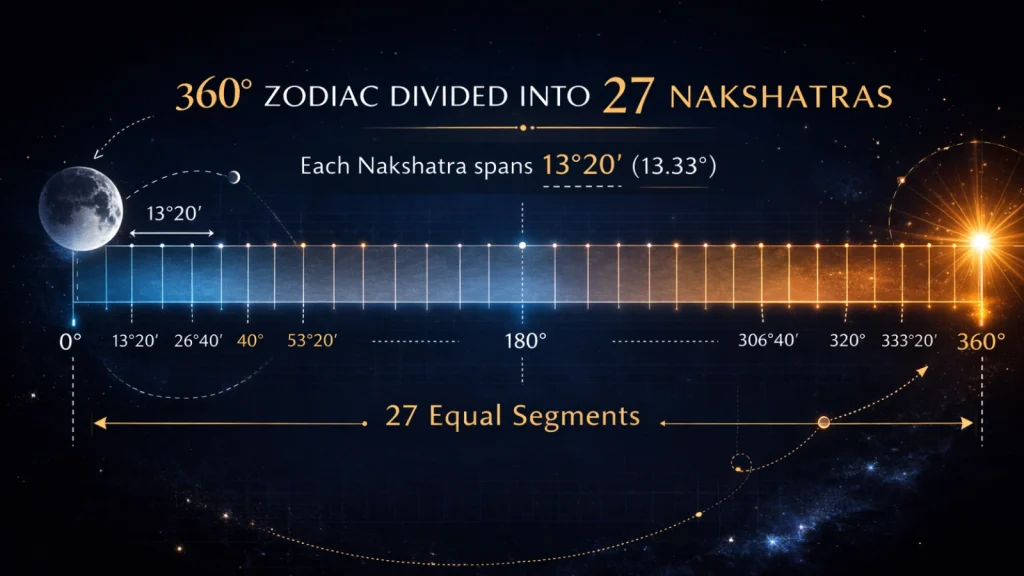
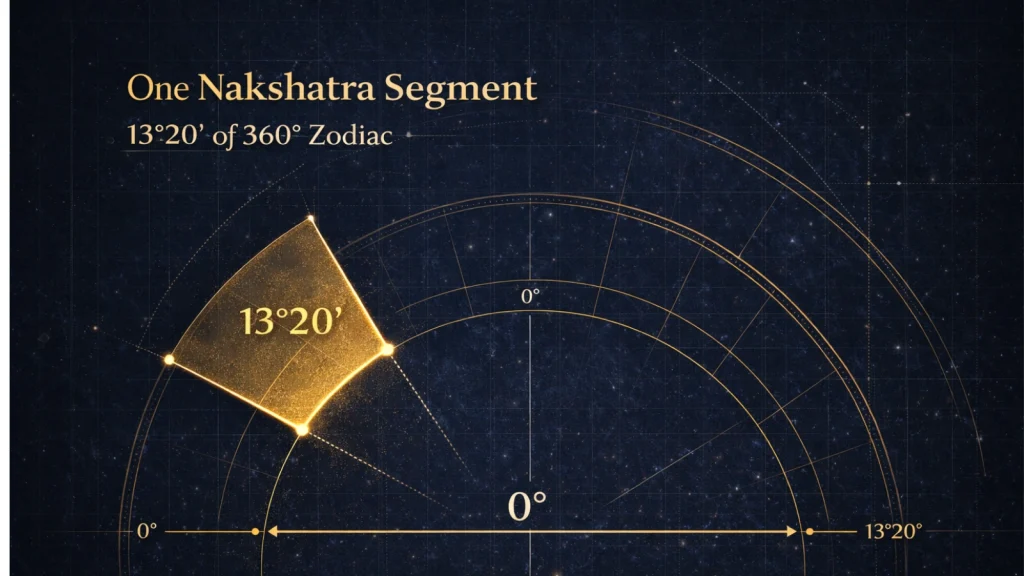
The zodiac contains 360 degrees. Vedic astrology divides those degrees into 27 equal segments of 13 degrees and 20 minutes each. These segments are the nakshatras.
If you are wondering how many nakshatras are there, the answer in standard practice is 27. Some traditions include a 28th, Abhijit, but it is rarely used in modern chart calculations.
Each nakshatra has a ruling planet, a symbolic theme, a deity reference, and four smaller subdivisions called padas. That structure is not decorative. It is functional.
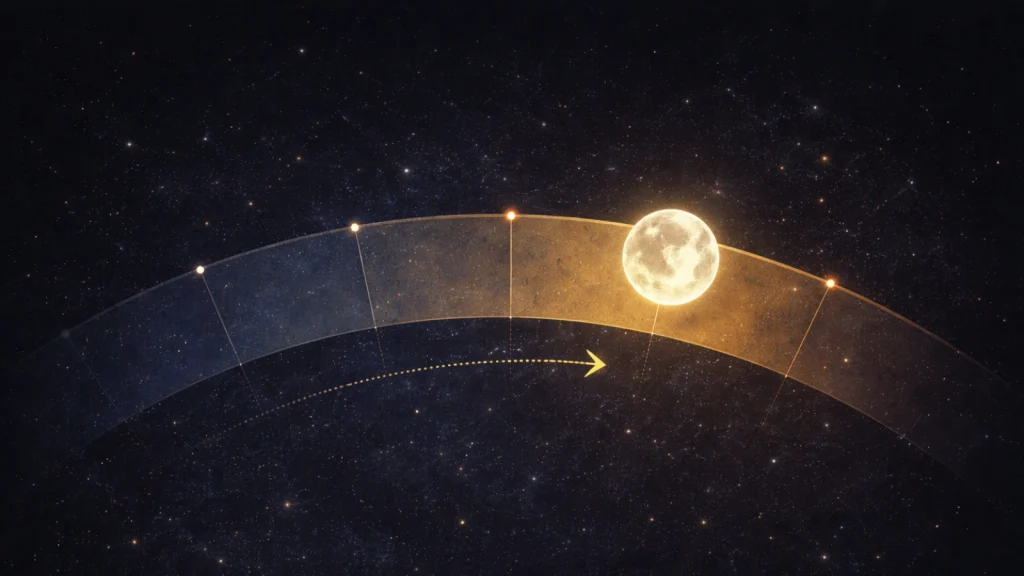
The Moon moves through one nakshatra roughly every day. Because the Moon reflects emotional patterns and instinctive reactions, your Moon’s placement within this structure becomes highly personal.
A zodiac sign describes the general atmosphere. A nakshatra narrows it down to how you actually operate inside that atmosphere.
The Complete Nakshatra List in Order
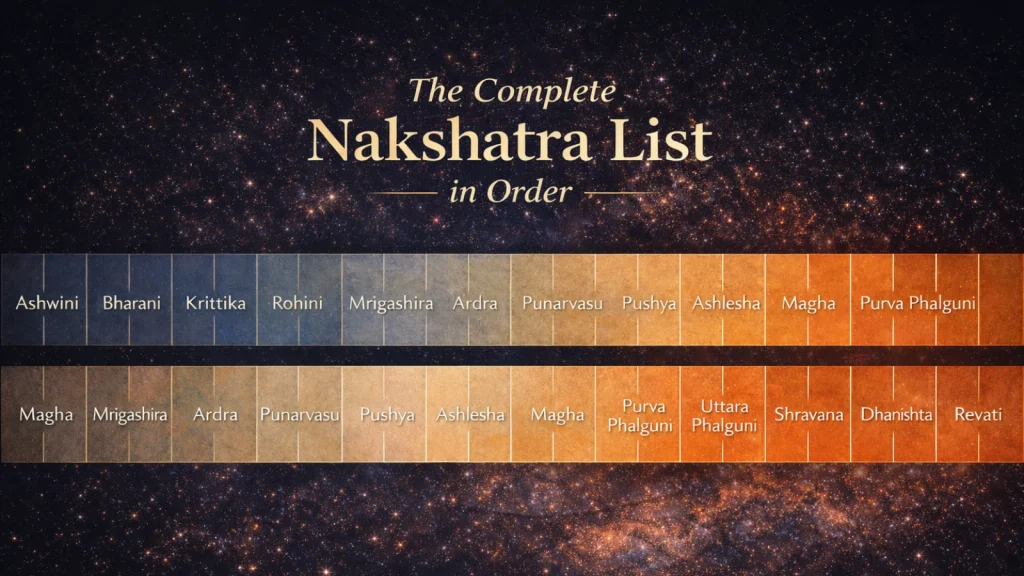
A proper nakshatra list follows the zodiac from the beginning of Aries to the end of Pisces.
Here is the traditional sequence:
- Ashwini
- Bharani
- Krittika
- Rohini
- Mrigashira
- Ardra
- Punarvasu
- Pushya
- Ashlesha
- Magha
- Purva Phalguni
- Uttara Phalguni
- Hasta
- Chitra
- Swati
- Vishakha
- Anuradha
- Jyeshtha
- Mula
- Purva Ashadha
- Uttara Ashadha
- Shravana
- Dhanishta
- Shatabhisha
- Purva Bhadrapada
- Uttara Bhadrapada
- Revati
On paper, this list of nakshatra looks simple. In practice, each one carries a distinct psychological signature.
The order matters because planetary timing cycles, known as dashas, follow this sequence. So the nakshatra list is not just a classification. It drives life timing.
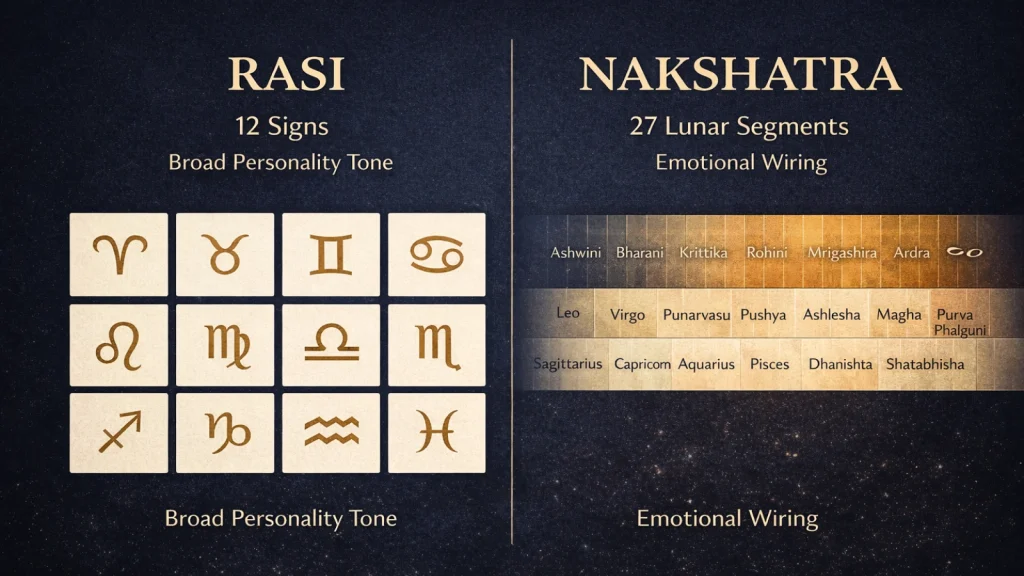
Rasi and Nakshatra: The Overlooked Distinction
People often confuse rasi and nakshatra. The confusion is understandable.
A rasi is your zodiac sign. A nakshatra is a lunar segment within that sign.
For example, Aries contains Ashwini, Bharani, and part of Krittika. Two individuals with an Aries Moon can express themselves in dramatically different ways depending on which nakshatra the Moon occupies.
This is why rasi and nakshatra must be read together.
The rasi sets the broader personality tone. The nakshatra describes how that personality behaves emotionally and instinctively.
When someone says, “I am a Taurus Moon,” that tells you something. When you add the specific nakshatra, the description becomes far more precise.
How to Read a Nakshatra Chart Without Overcomplicating It
A nakshatra chart can look technical at first glance. It does not need to be.
Start with the Moon. Identify its exact degree. That degree determines the nakshatra and the specific pada.
Next, examine the ruling planet of that nakshatra. Then look at where that planet sits in your chart.
This is where interpretation begins to feel real.
If your Moon falls in a nakshatra ruled by Mars, but Mars is weak or challenged in your chart, emotional expression may feel reactive or inconsistent. If the ruler is strong, the same nakshatra can express itself confidently and constructively.
Context changes everything. That is why a nakshatra chart must be read as part of the whole chart.
Why the Nakshatra List Is Not Just Symbolism
Many websites present the nakshatra list as personality summaries. That approach feels neat but shallow.
Nakshatras reflect underlying motivations. They show how you seek security, how you pursue goals, and how you respond when under pressure.
For example, some nakshatras push toward independence and initiative. Others prioritize stability and nurturing. Some are driven by transformation and intensity.
If you look honestly at your life patterns, you will likely see those themes repeating.
This is not mystical exaggeration. It is a structured pattern recognition.

The Central Role of the Moon in Nakshatra Astrology
Western astrology often emphasizes the Sun. Nakshatra astrology revolves around the Moon.
The Moon governs habits, memory, attachment, and daily emotional processing. It reflects how you internalize experience.
Because nakshatras divide the Moon’s path, they describe your emotional architecture in detail.
A skilled nakshatra astrolog does not stop at traits. They evaluate house placement, planetary aspects, the strength of the ruling planet, and timing cycles.
Without that context, the nakshatra list remains theoretical. With it, life events begin to align with observable patterns.
Read More!
Love Compatibility Astrology: Calculate Your Match Using Date Of Birth
Nakshatra Calculator: What Does Your Birth Star Mean?
Real World Applications of Nakshatra Analysis
This is where most people lean forward.
Marriage and Compatibility
Traditional compatibility systems compare Moon nakshatras. Emotional rhythm often determines long-term stability more than surface attraction.
Two people may share strong chemistry but struggle emotionally if their nakshatras clash at a fundamental level.
Career Tendencies
Some nakshatras naturally gravitate toward leadership and initiative. Others excel in research, counseling, communication, or artistic work.
This does not lock you into a single path. It highlights where effort feels natural versus forced.
Timing of Life Phases
Dasha periods begin from the Moon’s nakshatra. When the ruling planet activates, themes associated with that nakshatra tend to surface more strongly.
It is less about prediction and more about understanding the tone of a life chapter.
Five Tools That Make the Nakshatra List Practical
Information alone is not enough. Application requires the right tools.
1. Accurate Birth Time Calculator
Precision matters. Even small timing errors can shift the nakshatra pada.
2. Detailed Nakshatra Chart Generator
Look for a clear breakdown of degrees, rulers, and house placement.
3. Dasha Timeline Calculator
This helps you track when specific planetary periods become active.
4. Rasi and Nakshatra Mapping Table
This clarifies how lunar segments overlap zodiac signs.
5. Structured Interpretation Platform
A system that translates symbolic language into real-life guidance saves considerable time.
Applying the Nakshatra List with AstroLive

AstroLive simplifies the process of interpreting your nakshatra without stripping away depth.
It offers:
- Precise Moon nakshatra identification
- Clear nakshatra chart visualization
- Insight into ruling planets and their strength
- Dasha period analysis
- Compatibility insights based on lunar placement
Instead of presenting raw data, it organizes information in a practical sequence. That structure prevents common misinterpretations.
For someone who wants clarity without spending years studying classical texts, this approach makes sense.
Common Misinterpretations to Avoid
One frequent mistake is treating the nakshatra list as fixed personality labeling. Emotional tendencies are not rigid identities.
Another oversight involves ignoring the pada. Each nakshatra contains four subdivisions, and they significantly modify expression.
People also overlook planetary conditions. If the ruling planet is debilitated or heavily afflicted, the expression of that nakshatra shifts.
Finally, nakshatras show tendencies, not destiny. Personal choices still matter.
A Practical Step-by-Step Approach
If you prefer structure, here is a clean process:
- Identify your Moon’s nakshatra
- Study its ruling planet
- Evaluate that planet’s strength and house placement
- Review your current dasha period
- Reflect on recurring emotional themes
This method transforms the nakshatra list from static information into a working interpretive tool.
When Nakshatra Analysis Is Most Reliable
Nakshatra insights are especially useful for understanding emotional dynamics and long-term life phases.
They work well for examining relationship patterns and internal motivations.
They are less suited for short-term event timing. For that, planetary transits and house triggers provide clearer signals.
Recognizing this distinction prevents unrealistic expectations.
The nakshatra list is not just an ancient catalog of stars. It is a structured framework for understanding emotional rhythm, life timing, and recurring behavioral themes.
When you apply it thoughtfully within your full birth chart, it becomes less abstract and far more personal.
Frequently Asked Questions
1. How many nakshatras are there in total?
There are 27 primary nakshatras used in most Vedic birth charts. Some traditions mention an additional one, but it is not standard in regular chart interpretation.
2. Is the nakshatra more influential than the zodiac sign?
They serve different roles. The zodiac sign describes general temperament. The Moon’s nakshatra often reveals deeper emotional wiring.
3. Can two people share the same rasi but different nakshatra?
Yes. Each zodiac sign contains multiple lunar segments. This explains why individuals with the same Moon sign may respond differently emotionally.
4. What is the difference between a nakshatra list and a nakshatra chart?
A nakshatra list simply presents the 27 lunar segments in order. A nakshatra chart shows how those segments align within your personal birth chart.
5. Do I need a professional nakshatra astrolog to interpret my chart?
Not always. Structured tools can provide solid foundational insight. For complex life questions, deeper analysis may be helpful.