



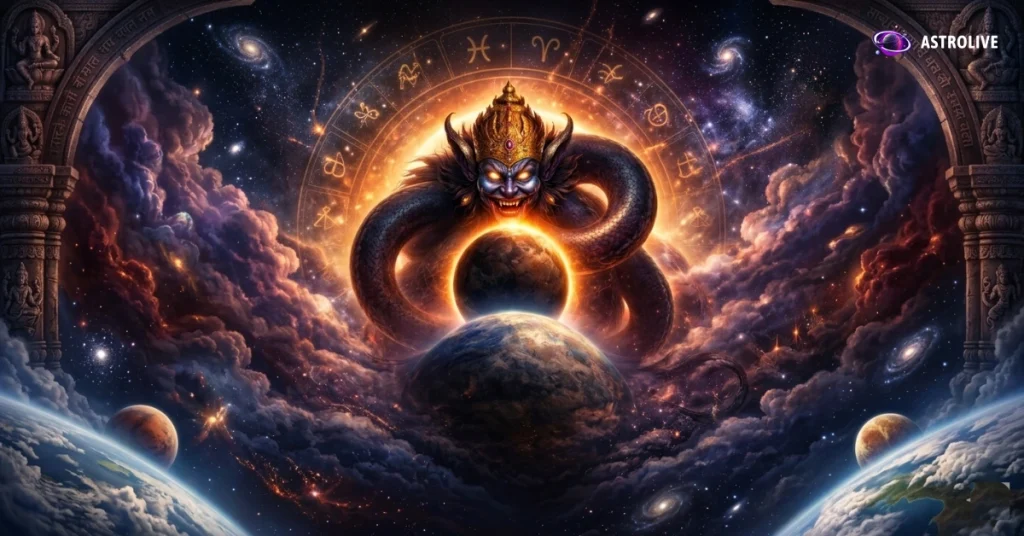
What is Rahu, exactly? It does not show up in any telescope. It has no physical mass, no surface, and no light of its own. Yet in Vedic astrology, it is treated as one of the most consequential forces in a person’s entire chart.
Career astrologers return to it constantly. Business professionals ask about it more than almost any other planet. It is a fair question with a surprisingly deep answer.
This article breaks it down clearly, without drowning you in classical terminology or reducing it to superstition. You will walk away with a practical understanding of what Rahu means and what to do with that knowledge.
What Is Rahu? Definition and Astronomical Basis
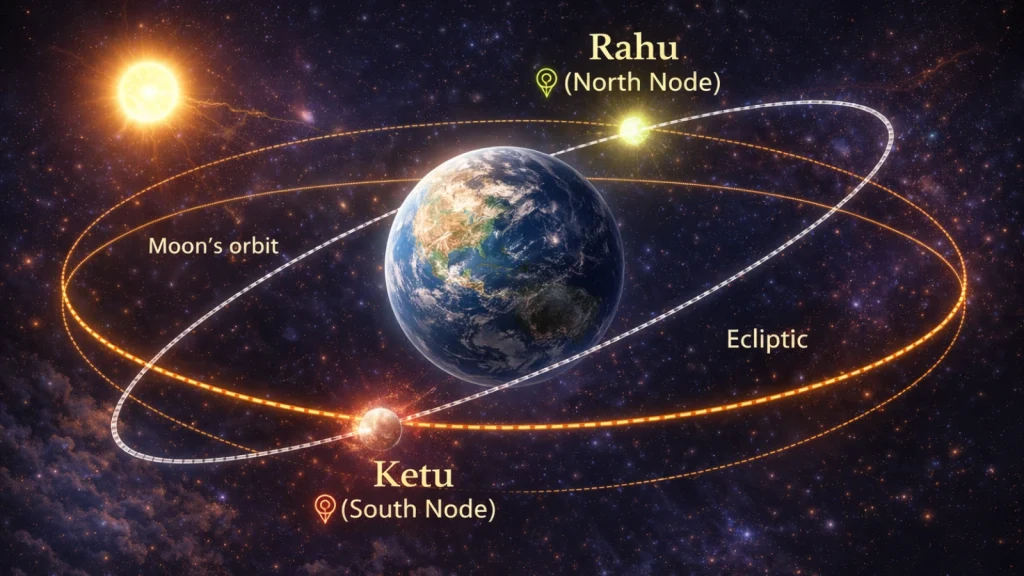
To understand Rahu, you need to picture two paths in space. One is the Moon’s orbit around Earth. The other is Earth’s orbit around the Sun, as seen from our perspective. These two paths do not line up perfectly. They are slightly tilted, and they cross each other at two points.
Rahu is one of those crossing points, specifically where the Moon moves upward through the Sun’s orbital path. That is it. No planet, no physical object, nothing you could photograph through a telescope. Just a location in space with a name and a long history of being taken very seriously.
The reason ancient astronomers cared about it is straightforward. When the Sun and Moon come close to this intersection, eclipses occur. People noticed this connection thousands of years ago and built an entire framework around it. Rahu became one of the nine Navagrahas, the celestial forces that Vedic astrology considers most influential over human life.
Its Sanskrit title, Chhaya Graha, means “shadow planet.” It has no light of its own and no physical presence, but it moves steadily through the zodiac in reverse. In every birth chart ever drawn, Rahu sits exactly opposite Ketu at 180 degrees. They are two ends of the same axis. Rahu represents the pull toward wanting, ambition, and the material world. Ketu represents the pull toward letting go. Every person carries both somewhere in their chart.
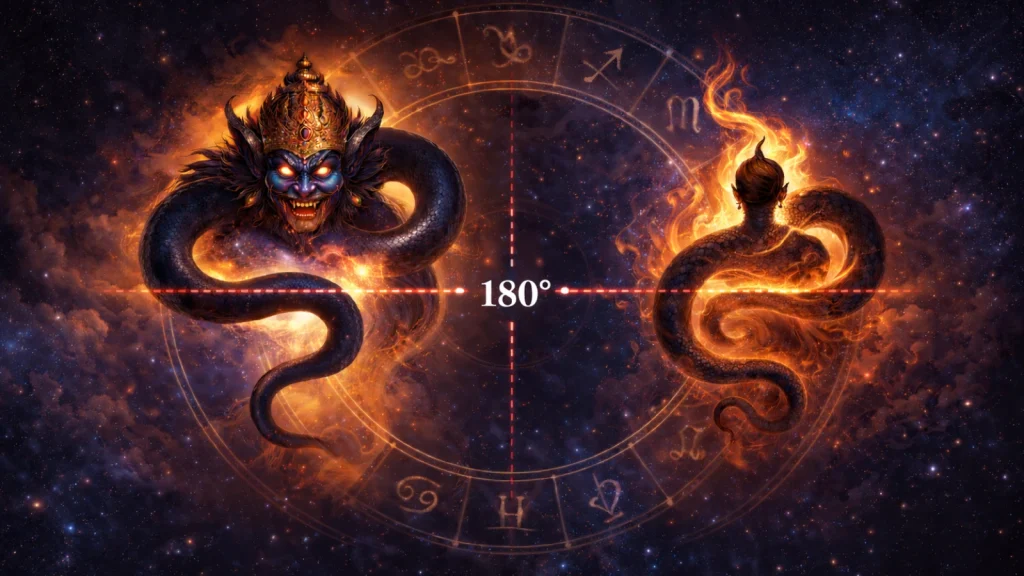
Rahu vs. Ketu – Two Sides of the Same Axis
| Dimension | Rahu (North Node) | Ketu (South Node) |
| Orientation | Future-facing | Past-facing |
| Core drive | Desire, acquisition | Detachment, liberation |
| Career theme | Ambition, disruption | Introspection, spiritual work |
| Psychological trait | Obsessive focus | Analytical detachment |
| Strength | Material world, innovation | Research, spirituality |
| Modern equivalent | The disruptive entrepreneur | The quiet expert |
| Exaltation sign | Taurus | Scorpio |
| Remedy focus | Grounding, discipline | Letting go, acceptance |
When people ask which planet Rahu corresponds to in modern terms, the clearest answer is the North Node of the Moon. In Vedic astrology, it functions with the full weight of a planet. It shapes how ambition, obsession, and fate unfold across an entire lifetime.
The Myth of Rahu – Why the Story Still Matters for Leaders

This origin story is not just religious folklore. For anyone who manages people or operates in competitive professional environments, it reads like a case study with a very clear ending.
During the Samudra Manthan, the churning of the cosmic ocean, a demon named Svarbhanu spotted his opportunity. When the nectar of immortality finally surfaced, he disguised himself as a god and slipped quietly into the line.
He was moments away from drinking it when the Sun and Moon recognized him. They alerted Lord Vishnu immediately. The Sudarshana Chakra came down before the nectar could fully take effect. His head survived as Rahu. His body survived as Ketu. Both became immortal, but neither was ever whole again.
The moral is not difficult to find. Ambition that bypasses the real work creates a permanent fracture. Intelligence survives the severing. Integrity does not.
Any experienced HR professional has seen a version of this story. The high-performer who fabricates results just enough to earn the next promotion. The executive who builds a reputation faster than a track record. The founder who raises a round on a vision that the product cannot yet support.
Rahu’s energy does not arrive with a warning label. It is simply the force of relentless wanting. What it produces depends entirely on the foundation beneath it and the judgment brought to its most active periods.
Rahu’s Influence on Career, Ambition, and Professional Success
The Professions Rahu Rules in the Modern World

Classical astrological texts associate Rahu with outcasts, traders, and those who operate outside society’s accepted structures. The core principle still holds. Rahu favors those who break established patterns rather than follow them.
The industries where that energy concentrates today include artificial intelligence and deep tech, digital media and the creator economy, cryptocurrency and financial technology, and venture-backed startups. It also governs political strategy and high-stakes public relations.
These are fields where conventional credentials rarely decide outcomes. Speed, originality, and the ability to thrive in uncertainty matter far more. That is Rahu’s territory.
Rahu in the 10th House – Leadership and Public Reputation
The 10th house governs career, public identity, and professional reputation. When Rahu is placed here, it often creates a strong drive for recognition and influence in the public sphere.
Individuals with this placement tend to follow unconventional career paths, frequently stepping outside traditional systems or hierarchies. Their rise may appear unpredictable, as they are drawn toward opportunities that others overlook or avoid.
Rahu in the 10th does not guarantee success, but it intensifies ambition and visibility. At its best, it can produce individuals who redefine industries or gain widespread recognition through non-traditional means. At its challenging end, it may lead to instability, controversy, or ethical dilemmas in the pursuit of status.
Rahu in the 11th House – Networks, Mass Gains, and Organizations
The 11th house governs large networks, institutional gains, and what you accumulate through collective structures. For HR leaders and business developers, this is a particularly important placement to understand.
Rahu here sharpens the ability to build relationships at scale. It amplifies returns that flow through communities, coalitions, and shared goals. People with this placement rarely succeed in isolation. Their most significant professional gains tend to come through who they know and how skillfully they activate those connections.
Rahu’s Impact by House – Career Focus
| House | Career Theme | Modern Roles |
| 1st | Personal brand, charisma | Founders, public figures |
| 2nd | Wealth accumulation | Finance, banking |
| 6th | Competition, service | Law, healthcare, and military |
| 7th | Business partnerships | Consultants, negotiators |
| 10th | Public career peak | Corporate leaders, politicians |
| 11th | Network gains | HR, community builders, VCs |
The effects of Rahu in 7th house on your life are most visible through business partnerships, collaborations, and how you navigate long-term professional relationships.
How to Know If Rahu Is Powerful in Your Rashi Chart
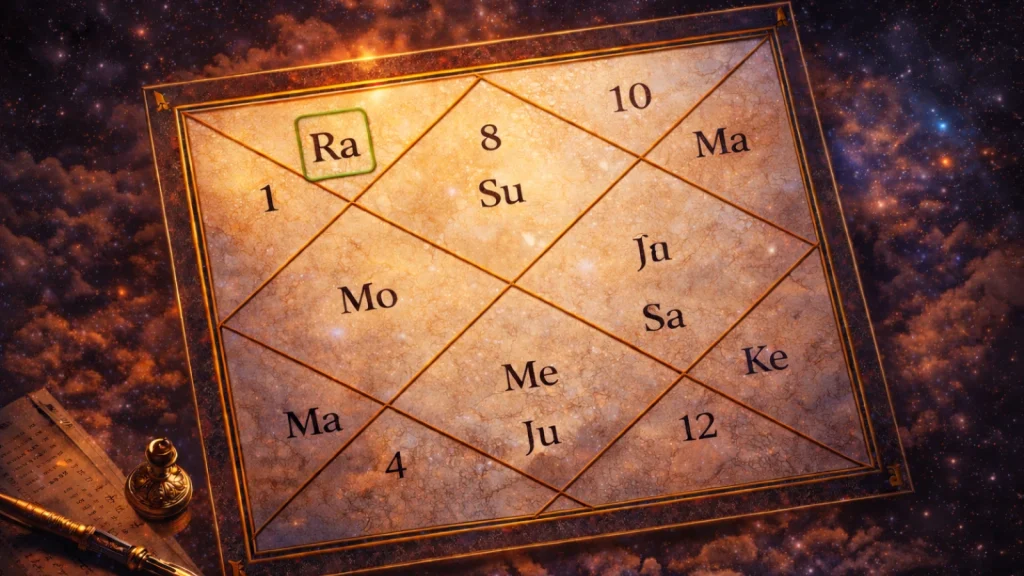
Knowing where Rahu sits in your chart is just the starting point. Knowing whether it is functioning as an asset or a complication is the more useful question. Most astrology content skips past this entirely.
Signs of a Powerful Rahu
Several chart conditions indicate that Rahu is operating with strong influence:
- Placement in signs that support expansion and adaptability—particularly Gemini, Libra, and Aquarius, and in some cases Taurus or Virgo, depending on the broader chart context
- Occupation of Rahu-ruled nakshatras, such as Ardra, Swati, or Shatabhisha, where its expression becomes more pronounced and direct
- Position in upachaya houses (3rd, 6th, 10th, or 11th), which tend to amplify ambition, competitiveness, and growth over time
- Association with other planets, which can enhance Rahu’s capabilities but may also introduce distortion or imbalance depending on the nature of the combination
- Activation during Rahu’s Vimshottari dasha or antardasha, when its themes become more dominant in life events
A strong Rahu does not automatically produce favorable outcomes.
It intensifies desire, amplifies ambition, and increases visibility often pushing individuals toward unconventional paths. Whether this results in breakthrough success or instability depends on the overall chart and how that intensity is directed.

The 18-Year Rahu Mahadasha – Three Career Phases
Rahu’s Mahadasha runs for 18 years. Almost nobody moves through it in a straight line. The period tends to break into three distinct phases, each with its own recognizable character:
| Phase | Duration | Typical Career Pattern |
| Opening (Years 1–6) | 6 years | Disruption, confusion, sudden opportunities mixed with instability |
| Rising (Years 7–12) | 6 years | Accelerated growth, unconventional breakthroughs, foreign connections |
| Culmination (Years 13–18) | 6 years | Peak recognition or major reckoning, depending on overall chart quality |
To find Rahu in your own chart, generate a Kundali using your exact birth date, time, and place. Look for “Ra” or “Rahu” marked in one of the twelve houses. Note the sign it occupies and cross-reference with the tables here. AstroLive handles the entire process automatically, including your Mahadasha timeline, without requiring any prior knowledge of Jyotish.
Understanding Your Rahu with AstroLive

Most working professionals are not looking to study Vedic astrology for months. They want a clear, reliable reading of what Rahu is doing in their chart, explained in language that connects to real life.
AstroLive was built with exactly that in mind. It brings chart generation and personalized interpretation together in one place. The platform works for people with demanding schedules and no background in Jyotish.
Here is what it provides:
- Personalized Kundali generator – input your birth details and receive a complete birth chart with Rahu and Ketu placements clearly marked and explained
- Mahadasha and Antardasha tracker – see precisely where you are within your Rahu period and which sub-period is currently running
- Rahu Kaal daily alerts – daily notifications of the Rahu Kaal window so you can plan meetings, signings, and key decisions with full awareness
- Live astrologer consultations – direct access to practitioners who can connect your chart to your actual professional situation
- Remedy guidance – personalized recommendations for mantras, gemstones, and rituals drawn from your specific chart, not a one-size-fits-all list
Explore your Rahu placement on AstroLive and get a clearer picture of the force that has been shaping your professional life all along.
Powerful Remedies for Rahu – Mantras, Rituals, and Practical Steps
The Powerful Durga Mantra for Rahu
Goddess Durga holds a central place in Rahu’s remedy tradition. She is associated with piercing through illusion and dissolving the shadow energy that a difficult Rahu tends to generate. That includes its pull toward deception, compulsive desire, and poor judgment under pressure.
The mantra most consistently recommended for this purpose is:
Om Aim Hreem Kleem Chamundaye Vichche
This powerful Durga mantra for Rahu draws in protective and clarifying energy. It works to counterbalance what Rahu, at its most disorienting, tends to amplify. The standard practice is 108 repetitions on Saturdays, ideally timed within the Rahu Kaal window.
The number matters less than the intention behind it. Come to the practice with something specific in mind. Name the pattern you want to release or the clarity you are genuinely seeking.
Rahu Beej Mantra
For a shorter practice that fits into a daily routine, the seed mantra offers a more direct option:
Om Bhram Bhreem Bhroum Sah Rahave Namah
Chanting this 18 or 108 times each morning works less as appeasement and more as daily orientation. Think of it as consciously acknowledging the energy you are working with, rather than trying to suppress it.
Practical Remedies for Modern Professionals
Mantra practice is not for everyone, and there is no reason to force it. Several practical approaches carry genuine weight within the tradition and translate naturally into a modern lifestyle:
- Charitable giving or volunteer work on Saturdays, particularly directed toward elderly individuals or orphaned children
- Fasting on Saturdays if your health allows it
- Choosing dark blue or black clothing on Saturdays as a small act of conscious alignment
- Pausing deliberately before any significant decision that falls within the daily Rahu Kaal window
These practices share a common logic. Conscious restraint during Rahu’s active periods sharpens judgment. It also reduces the kind of impulsive action that Rahu, when left unexamined, tends to encourage.
Hessonite (Gomed) Gemstone
The gemstone associated with Rahu is Hessonite, known in Sanskrit as Gomed. It suits individuals whose Rahu is strong and well-supported, meaning it is exalted, in a friendly sign, and free from difficult planetary company.
For someone with a weakened or afflicted Rahu, wearing Gomed can make things considerably worse rather than better. This is not a gemstone to choose based on general advice. Always have your chart assessed by a qualified astrologer before making any decision about it.
Common Misconceptions About Rahu
“Rahu is always malefic and should be feared.”
This is the most damaging misconception in popular Vedic astrology. A well-placed Rahu is one of the most powerful career-building forces in the entire Navagraha system. It is the planet most closely tied to unconventional ambition and disruptive thinking. It drives the kind of results no conventional path would have generated.
Generations of innovators and industry builders have carried prominent Rahu placements in their charts. The fear comes from Rahu in difficult positions, not from Rahu as a force in itself.
“Rahu Kaal and Rahu Mahadasha are the same thing.”
They are not remotely in the same category. Rahu Kaal is a roughly 90-minute daily window, traditionally avoided for new beginnings like signings, launches, or significant commitments. Rahu Mahadasha is an 18-year chapter within your lifetime’s planetary sequence. It shapes the entire arc of ambition and transformation across nearly two decades.
Mixing up the two is like confusing a weather forecast with a climate pattern. One tells you about today. The other describes a chapter of your life.
Closing Thoughts
Rahu is not a punishment written into your chart. It is not a force to be feared or endlessly appeased. At its core, it is the astrological expression of desire itself, of the part of you that wants to build something, disrupt something, or reach somewhere you have never been.
You do not need to become an astrologer to use this knowledge practically. Three things carry most of the practical weight: which house Rahu occupies, which sign it sits in, and whether you are currently in a Rahu-ruled period.
Getting clear on those three points alone can reframe how you read your own career instincts and professional timing. Pull up your Kundali. Find Rahu. Run it against the checklist and house tables in this article.
And if you want to go deeper, AstroLive gives you both the analytical tools and access to practitioners who can take the reading further than any article can.
Frequently Asked Questions
Is Rahu a real planet in astronomy?
No. Rahu is the North Node of the Moon, a calculated orbital intersection point and not a physical object. It has no mass, no surface, and no light of its own. Vedic astrology classifies it among the Navagrahas because of its consistent influence over eclipses and its well-documented correlations with significant life events.
What does Rahu mean in planetary terms?
Rahu is the North Lunar Node in Vedic astrology, classified as a Chhaya Graha or shadow planet. It governs eclipses, illusion, obsessive desire, and sudden change. It has no physical presence in the sky, yet its position in a birth chart remains among the most consequential factors in any serious astrological reading.
How do I know if Rahu is powerful in my Rashi chart?
Rahu shows strength when placed in Taurus, in the upachaya houses, including the 3rd, 6th, 10th, and 11th, or in its own nakshatras of Ardra, Swati, or Shatabhisha. Support from Jupiter or Mercury through conjunction or aspect adds further strength. Use the checklist in this article or generate your chart on AstroLive for a thorough and personalized assessment.
What is the most powerful Durga mantra for Rahu?
Om Aim Hreem Kleem Chamundaye Vichche is the most widely recommended mantra for working with a challenging Rahu. Chanting it 108 times on Saturdays, ideally during Rahu Kaal, is considered the most effective approach. For a simpler daily practice, the Rahu Beej Mantra, Om Bhram Bhreem Bhroum Sah Rahave Namah, is a practical and accessible alternative.