



Your Vedic birth chart holds more information about you than any personality test you’ve ever taken – but only if you know how to read it.
Most people don’t. They generate their chart, stare at a diagram full of symbols and house numbers, and close the tab. That’s a shame, because what’s sitting in that chart isn’t abstract or spiritual – it’s a structured picture of how you’re wired, what life areas you’re drawn to, and what timing cycles are currently active for you.
Jyotish, the Sanskrit name for Vedic astrology, has been refined over five millennia precisely because it works. Not as a prediction, but as pattern recognition. This guide breaks the chart down layer by layer so you can actually use it.
What is a Vedic birth chart?
A Vedic birth chart – also called a Kundali or Janam Kundali – is a personalized astrological map created using your exact birth date, time, and location. Based on the sidereal zodiac, it charts the positions of nine celestial bodies across twelve life areas (houses), revealing your personality, strengths, life patterns, and timing cycles.
What Is a Vedic Birth Chart?
Jyotish translates as “the science of light.” It’s one of six classical branches of Vedic knowledge – not a religious practice, but a methodical system for understanding individual human nature. The birth chart sits at the center of it all.
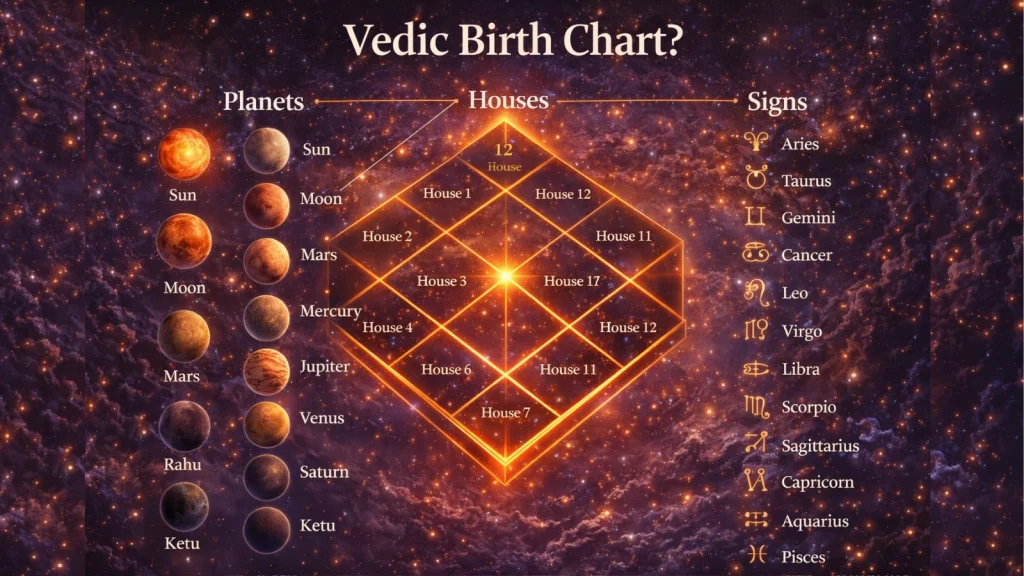
The chart is a diagram. Circular in some regional traditions, square in others. What it captures is the precise position of the Sun, Moon, and seven other celestial bodies at the exact moment you took your first breath. Each body occupies a zodiac sign and falls within one of twelve houses. That specific combination of placements is unique to you – no two charts are the same unless two people were born at the same time and location.
The key difference from Western astrology comes down to the zodiac system used. Vedic astrology uses the sidereal zodiac, anchored to the actual positions of stars. Western astrology uses the tropical zodiac, tied to the seasons. The gap between them runs about 23 degrees, which is why most people find their Vedic Sun sign lands one sign earlier than their Western one.
This guide is worth your time if:
- You’ve explored Western astrology but never quite felt described by it
- You’re new to astrology and want something that goes deeper than sun signs
- You notice recurring patterns in your life and want a real framework for understanding them
- You’re simply curious about what a 5,000-year-old system of self-knowledge actually has to say about you
The Core Elements of Your Vedic Birth Chart
A Vedic birth chart is made up of four distinct layers: twelve houses, nine planets, twelve zodiac signs, and twenty-seven Nakshatras. Each layer adds specificity. Put them together, and you get a portrait personal enough that generalizing it becomes nearly impossible.
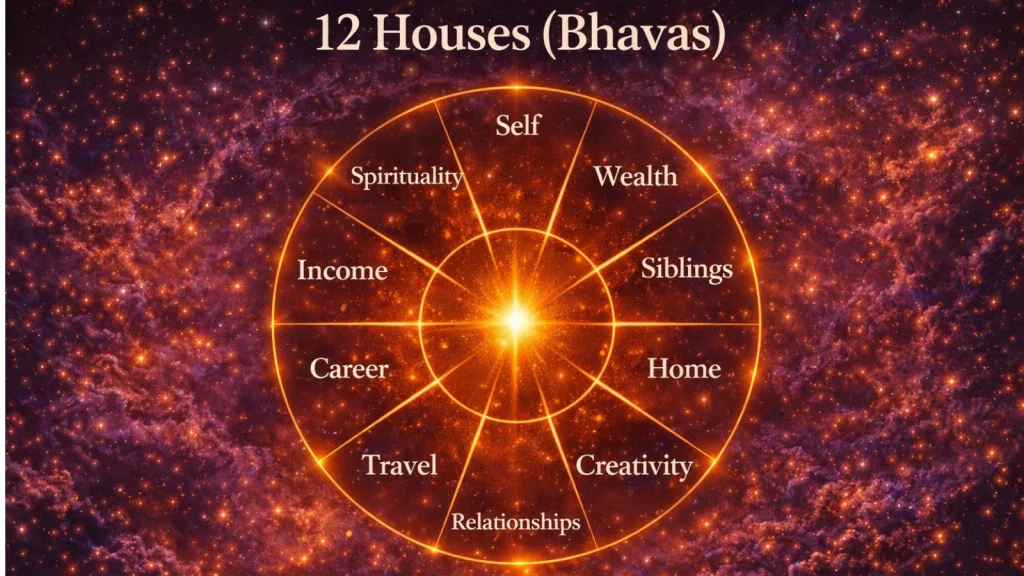
The 12 Houses (Bhavas) – Your Life’s Twelve Stages
Think of the chart as a house with twelve rooms. Each room governs a different area of your life. The planets that occupy each room – and the sign on its door – determine how that particular area plays out for you personally.
| House | Life Area | Key Themes |
| 1st House (Lagna) | Self & Body | Personality, appearance, and general life path |
| 2nd House | Wealth & Speech | Money, family, voice, and early childhood |
| 3rd House | Communication | Siblings, short travel, courage, writing |
| 4th House | Home & Heart | Mother, property, emotional security |
| 5th House | Creativity & Children | Intelligence, romance, past-life merit |
| 6th House | Health & Service | Enemies, debts, daily work, wellness |
| 7th House | Partnerships | Marriage, business partners, public dealings |
| 8th House | Transformation | Longevity, hidden wealth, research, change |
| 9th House | Luck & Wisdom | Father, spirituality, higher education, travel |
| 10th House | Career & Status | Profession, fame, authority, public life |
| 11th House | Gains & Goals | Income, friends, aspirations, and elder siblings |
| 12th House | Liberation | Expenses, isolation, foreign lands, spirituality |
The 9 Planets (Navagraha) – The Nine Cosmic Influencers
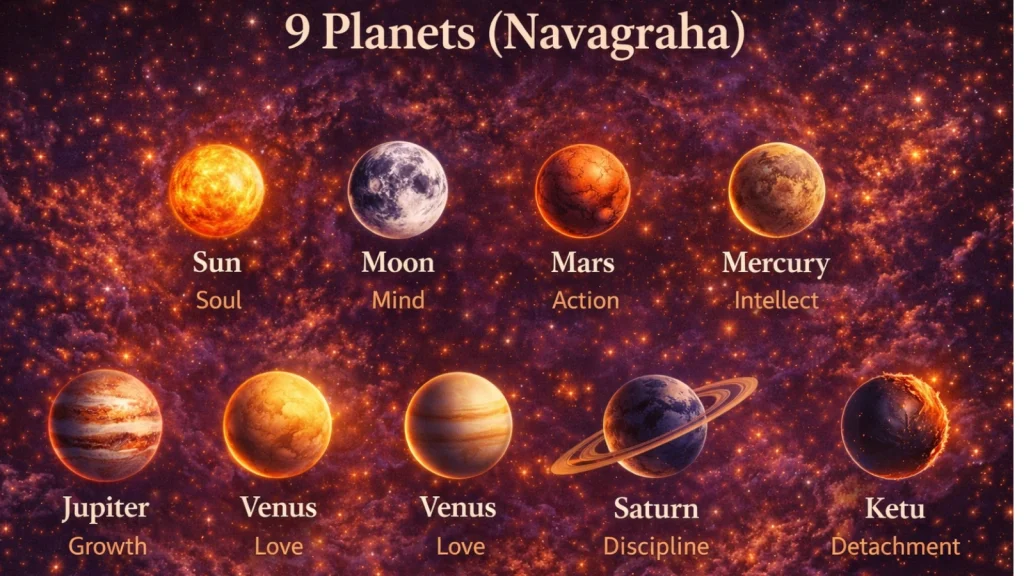
Vedic astrology tracks nine bodies called Grahas – from the Sanskrit word meaning “that which grips.” Seven of them are classical planets. The remaining two, Rahu and Ketu, are mathematically calculated lunar nodes rather than physical objects. They carry no mass, but their weight in a chart is real.
Each Graha governs a distinct set of life themes and psychological tendencies. Where a planet sits, which sign it occupies, and how it interacts with neighboring planets all shape how that energy actually shows up in a person’s life.
| Planet (Graha) | Rules Over | Key Influence |
| Sun (Surya) | Soul, authority, father | Leadership, confidence, life purpose |
| Moon (Chandra) | Mind, emotions, mother | Instincts, habits, and emotional well-being |
| Mars (Mangal) | Energy, drive, siblings | Ambition, courage, conflict, initiative |
| Mercury (Budha) | Intellect, communication | Thinking style, speech, learning, trade |
| Jupiter (Guru) | Wisdom, expansion, faith | Growth, blessings, teaching, marriage |
| Venus (Shukra) | Love, beauty, luxury | Relationships, creativity, material comfort |
| Saturn (Shani) | Discipline, karma, delay | Hard work, long-term results, life lessons |
| Rahu (North Node) | Desire, ambition, illusion | Unconventional paths, worldly obsession |
| Ketu (South Node) | Detachment, spirituality | Past karma, liberation, hidden talents |
The Ascendant (Lagna) – Your Chart’s Anchor
The Ascendant is the zodiac sign that was crossing the eastern horizon the moment you were born. It determines your first house and sets the structural layout for the entire chart. No single point in the chart is more personal than this one – and because it shifts approximately every two hours, your birth time needs to be accurate.
- The Lagna describes how you show up in the world: your natural energy, your instinctive reactions, and the impression you leave on people who meet you for the first time.
- Every other planetary influence in the chart is filtered through it
- Many people find their Lagna describes their personality far more precisely than their Sun sign ever did
Nakshatras – The 27 Lunar Mansions

Where Western astrology works with 12 zodiac signs, Vedic astrology adds a finer layer of detail: 27 Nakshatras, each spanning 13°20′ of the sky. Your Moon’s Nakshatra placement at birth produces a personality profile noticeably more textured than the Moon sign alone. Astrologers draw on Nakshatras for compatibility work, in-depth character readings, and precise timing calculations.
How to Read Your Vedic Birth Chart – Step by Step
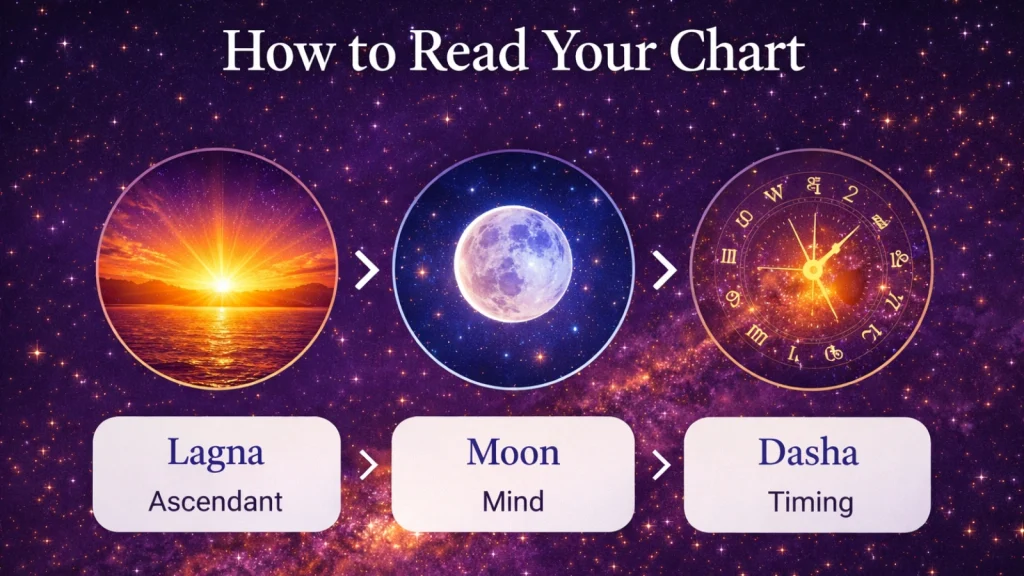
Most introductions to Vedic astrology tell you what’s in a chart, then leave you staring at a diagram with no idea where to start. So let’s do this differently. Rather than processing every placement at once, build from three foundational layers first.
The 3-Layer Reading Framework
| Layer | What to Look At | The Question It Answers |
| Layer 1 – Identity | Lagna (Ascendant Sign) | How do I approach life? How do others see me? |
| Layer 2 – Mind | Moon Sign (Rashi) | What are my emotional patterns and inner needs? |
| Layer 3 – Timing | Active Mahadasha (Dasha lord) | What life chapter am I in right now? |
These three elements alone give you a working portrait of who you are and what’s most active in your life right now. Once that foundation feels solid, every other placement in the chart adds texture rather than confusion.
Step-by-Step Reading Process
- Find your Lagna. This is your rising sign at birth. It sets every house in the chart and serves as your primary reference point for everything else.
- Identify your Moon sign (Rashi). This reveals how you process emotion, what you instinctively need, and where your mind naturally settles when things get quiet.
- Check your current Mahadasha. This tells you which planetary period is active right now and which life themes it’s bringing to the surface.
- Look at the 10th house. This is the career and life purpose house. The planet ruling it – and anything placed within it – describes your professional strengths and natural direction.
- Notice planetary conjunctions. When two or more planets share a house, they amplify each other. The life area that the house governs becomes more prominent and more charged.
- Check the 7th house for relationship themes and the 4th house for home and emotional foundations. These are the two most personally significant houses after the 1st.
How a Vedic Birth Chart Influences Your Life
Here’s something worth being clear about upfront: a birth chart doesn’t predict specific events. What it does is map patterns – the tendencies you naturally gravitate toward, the themes that resurface across different seasons of life, the cycles quietly shaping your experience from the inside. That distinction matters a great deal.
Personality and Self-Understanding
The Lagna and Moon signs are where most people feel the strongest recognition. The Lagna captures how you engage with the world outwardly – your energy, your manner, your first instincts in any situation. The Moon sign captures what’s happening internally – how you process emotion, what makes you feel genuinely safe, the conditions under which you feel most like yourself.
People who’ve spent years feeling only partially described by their Western sun sign often discover that the Vedic Lagna fits with an accuracy that surprises them. That single recognition tends to open up curiosity about everything else.
Relationships
The 7th house governs partnership in the broadest sense – romantic relationships, close friendships, business collaborations. The sign on its cusp and any planets within it describe the relational dynamics you naturally create: what draws you in, what you bring to a partnership, and which patterns tend to repeat themselves no matter the context.
Venus adds its own layer to this. It reveals how you express affection, what you find beautiful or comforting, and where love tends to flow most naturally in your life. None of this locks anything in. These are patterns – and recognizing them is genuinely useful.

Career and Life Purpose
The 10th house – the Karma Bhava – is consistently one of the most examined parts of any chart. It describes your professional instincts, your relationship with authority, and the kind of environment where your work tends to carry real weight. The planet that rules this house, wherever it happens to sit in the chart, points toward your most natural professional direction.
Timing Your Life – The Dasha System
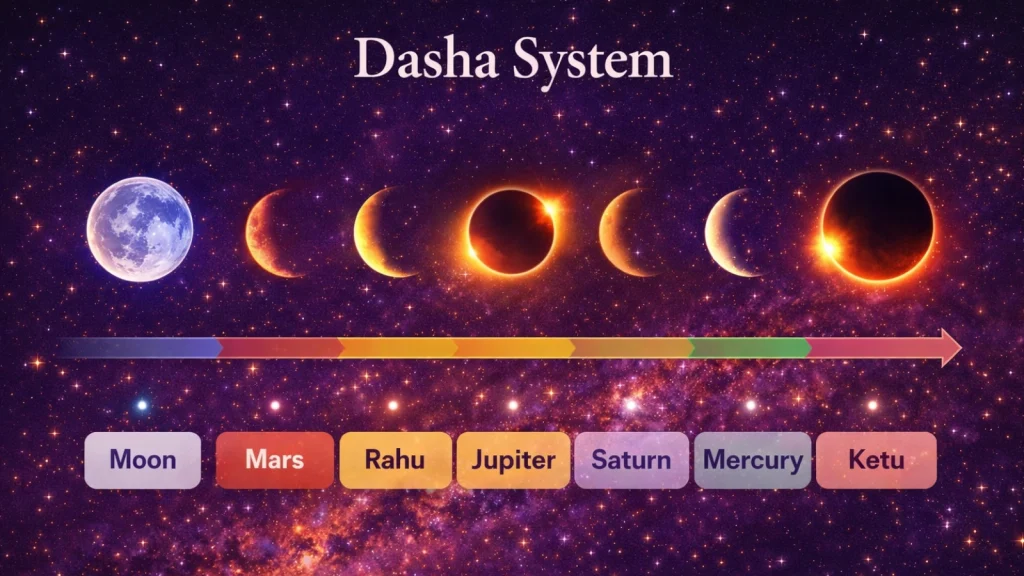
This is where Vedic astrology separates itself most clearly from other approaches. The Vimshottari Dasha is a 120-year cycle of sequential planetary periods, each ruled by a different planet, each activating its own distinct set of life themes. When people look back at major turning points in their lives and compare them with their Dasha timeline, the overlaps are often striking.
| Planetary Period | Duration | Life Focus |
| Sun Mahadasha | 6 years | Career spotlight, leadership, authority |
| Moon Mahadasha | 10 years | Emotions, home life, relationships |
| Mars Mahadasha | 7 years | Action, ambition, challenges, energy |
| Rahu Mahadasha | 18 years | Major worldly ambitions, sudden change |
| Jupiter Mahadasha | 16 years | Growth, wisdom, family, prosperity |
| Saturn Mahadasha | 19 years | Discipline, hard work, karmic lessons |
| Mercury Mahadasha | 17 years | Communication, business, intellect |
| Ketu Mahadasha | 7 years | Spiritual seeking, detachment, inner work |
| Venus Mahadasha | 20 years | Love, creativity, luxury, relationships |
Knowing your current Mahadasha won’t tell you what’s about to happen. What it will tell you is what kind of chapter you’re living through – and that context alone can help you respond to life with more clarity.
Get Your Free Vedic Birth Chart with AstroLive
Everything covered in this guide becomes genuinely useful once it’s applied to your chart – not a general example or a hypothetical.
AstroLive is a dedicated Vedic astrology platform that generates a complete free Vedic birth chart with interpretation, instantly, and without requiring any prior knowledge. You enter your birth date, time, and location, and the platform builds your chart using the same calculation standards that professional Jyotish practitioners rely on.
Everything covered in this guide becomes genuinely useful once it’s applied to your chart – not a general example or a hypothetical.
AstroLive is a dedicated Vedic astrology platform that generates a complete free Vedic birth chart instantly, with no login or account required. You enter your name, birth date, time, and location – and the platform produces your chart in seconds, backed by a panel of expert astrologers.
What AstroLive provides:
- Free Kundli (birth chart) generator – instant chart creation based on your exact birth date, time, and location; no account needed and no hidden charges
- Complete birth chart (Lagna Kundli) – all planetary positions and house placements laid out in full
- Yogas and Doshas analysis – includes Manglik Dosha, Kaal Sarp Dosha, and other significant planetary combinations that shape your life patterns
- Dasha and Antardasha timeline – your current and upcoming planetary periods identified, so you know exactly which life chapter you’re in right now.
- Career, marriage, and life overview – covers key life areas, including finances, relationships, family, and health, in one consolidated report.
- Personalized remedies – practical suggestions based on the planetary influences specific to your chart
- Kundli Matching tool – free compatibility analysis using the traditional 16 Guna Milan system for relationship assessment
- Multilingual support – available in English, Hindi, Tamil, Bengali, Malayalam, Kannada, Gujarati, and more
- Connect with a live astrologer – chat or call with an expert directly through the platform for personalized guidance.
Generate your free Vedic birth chart on AstroLive – understand your chart in minutes, not years.
Also Read!
A Guide to Using the Nakshatra List in Your Birth Chart
How to Calculate Vedic Astrology Transit
Common Misconceptions About Vedic Birth Charts
A few persistent misunderstandings follow people into this system, especially those arriving from a Western astrology background. Clearing them up early saves a lot of confusion later.
| Misconception | The Reality |
| My Vedic sign is the same as my Western sign | Vedic astrology uses the sidereal zodiac, anchored to actual star positions. For most people, this shifts the Sun sign back by one compared to the Western system. |
| A birth chart predicts fixed events. | A chart maps tendencies, timing cycles, and recurring patterns – not a predetermined script. It reveals what’s probable, not what’s inevitable. |
| Only the Sun sign matters | In Vedic astrology, the Ascendant and Moon sign carry equal or greater interpretive weight. The Sun sign is one factor among many, not the defining one. |
| Birth time doesn’t matter much | Birth time is actually critical. The Ascendant shifts approximately every two hours, and even a modest time error can move multiple house placements. |
| North and South Indian charts are different systems | They’re the same system represented in two different visual formats. The underlying planetary data is completely identical. |
The most useful mindset to carry into this: Vedic astrology is not fatalistic. Your chart describes tendencies – the directions things tend to move – not outcomes carved in stone. That distinction changes what the whole system is actually good for.
Conclusion
A Vedic birth chart is not a prediction. It’s a map – one refined over five thousand years of careful observation and preserved across some of the oldest astrological texts ever written.
Through your Lagna, it shows who you tend to be at the core. Your Moon sign, it reveals how your inner world actually operates. Through the Dasha system, it places you inside a specific chapter of a longer arc – and that context often makes sense of things that previously felt random or unexplained.
Reading about the system is a solid starting point. Seeing it reflected through your own chart is where the understanding becomes personal and genuinely useful.
Frequently Asked Questions
What information do I need to generate a Vedic birth chart?
You need three things: your exact date of birth, your time of birth (as precise as possible, ideally to the minute), and your place of birth. Birth time is the most critical variable of the three. The Ascendant sign changes approximately every two hours, and it determines the layout of the entire chart.
How is a Vedic birth chart different from a Western astrology chart?
The core difference comes down to the zodiac system. Vedic astrology uses the sidereal zodiac, aligned to actual star positions. Western astrology uses the tropical zodiac, aligned to the seasons. That gap runs roughly 23 degrees, which often shifts your Sun sign back by one position in the Vedic system.
Can I get a free Vedic birth chart with interpretation online?
Yes. AstroLive provides a free Vedic birth chart with interpretation – covering house meanings, planet placements, a Nakshatra report, and your active Dasha timeline – with no account required. It uses Lahiri Ayanamsa, the calculation standard recognized by the Government of India.
What does the Ascendant (Lagna) mean in a Vedic birth chart?
The Ascendant is the zodiac sign that was rising on the eastern horizon at your exact birth time. It sets the entire chart layout and is considered at least as significant as the Moon sign in Vedic astrology. It describes your physical constitution, your instinctive personality, and how you naturally move through the world.
What is the Dasha system and why does it matter?
The Vimshottari Dasha is a 120-year cycle of planetary periods used in Vedic astrology to map life timing. Each period activates a different set of themes based on its ruling planet. Knowing your current Dasha helps you understand what kind of chapter you’re in – and why certain patterns or pressures might be intensifying right now.