




**Download Free Astrology App →
A hard day with health or family strain does not need more guesswork. The fastest way to turn chaos into a plan is to read your chart’s 6th, 4th, and 7th house transits and pair them with the day’s tithi and nakshatra. Your daily horoscope and panchang give a practical clock for energy, care, and talks, and in 2026 that rhythm matters more than ever.
Here’s the answer up front: use house-focused transits to see what’s “active” (health, home, or partner), then use the day’s panchang to time actions. That means you rest or seek care when the chart shows strain, and you talk, repair, or decide when the day’s muhurat supports it.
You’re not wrong to want proof, either. Social proof matters; these astrology tools are trusted by millions for accurate guidance. But this guide stays education-first.
You’ll learn what your 6th house says about symptoms and habits, what the 4th and 7th say about family mood and talks, and how tithi, nakshatra, yog, and karan can support your next move. We’ll keep the tone kind and real because pain, grief, or worry at home isn’t trivia. It deserves care, timing, and steady steps through 2026.
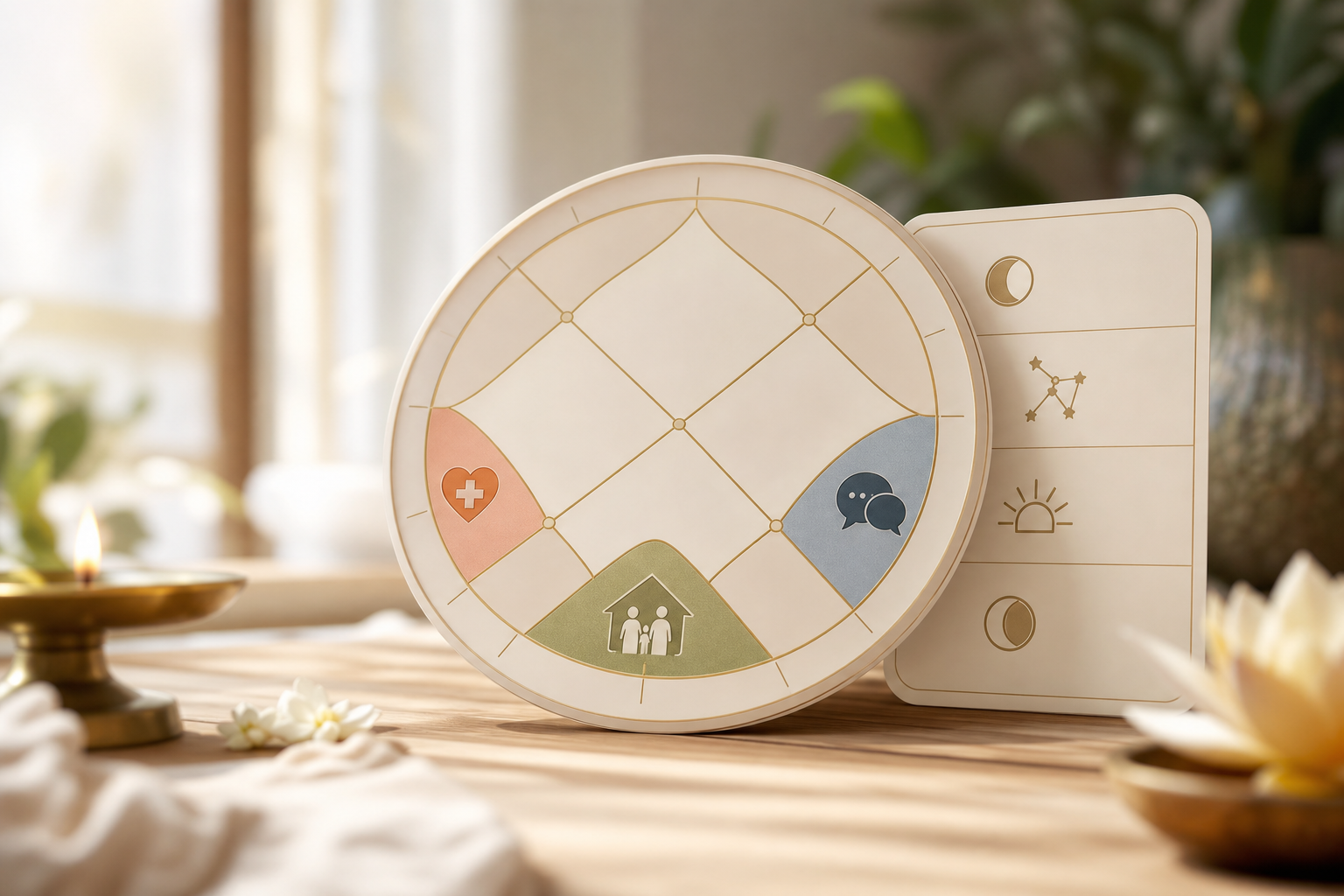
What Can Daily Horoscope and Panchang Actually Tell You About Health and Family?
Astrology does not replace a doctor or a therapist. However, it can show windows of ease or friction so you plan with less stress. Your daily horoscope is a short read on current planetary transits. For health, watch the 6th house and its lord.
Reading the Houses
For home and partner themes, watch the 4th and 7th houses. When malefics (Mars, Saturn, Rahu, Ketu) transit these, you may feel strain. When benefics (Jupiter, Venus, well-placed Mercury) touch them, you get support.
In Vedic terms, the 6th house covers illness, routines, and immunity. If the day’s transit makes a hard contact to your 6th lord, treat it as a “care day.” Eat on time, hydrate, and avoid new stress. The 4th house reflects home, mother-like care, and emotional roots.
If it’s tense, keep talks short and kind. The 7th house reflects spouse, partner, or key one-to-one ties. If it’s lit, choose the hour to talk, not the day to fight.
Panchang Basics
Your panchang is the day’s cosmic weather. It includes five limbs (pañc-aṅga). Paired with your daily horoscope and panchang view, you get both “what” and “when.
- Tithi (lunar day): Shows emotional tide. Waxing tithis suit growth; waning tithis suit release and rest.
- Nakshatra (lunar mansion): Sets the tone for tasks. Healing-friendly stars favor checkups and self-care.
- Yog: Blends Sun and Moon positions to rate flow or strain. Smooth yogs support complex talks.
- Karan: Half-tithi units linked with doing. Certain karans are good for starts; others for closure.
Moreover, check inauspicious windows like Rahu Kaal, a daily period linked with delays. You can read about the idea of Rahu in Wikipedia’s Rahu overview. If your schedule is tight, at least avoid big first steps in that slot.
“Daily panchang with details on tithi, nakshatra, yog, and karan” plus “personalized insights based on planetary alignments” help you decide what to do now and what to park till tomorrow.
Quick Map: Houses to Life Areas
- 6th house → health, habits, immunity, medical routines
- 4th house → home, comfort, inner peace, caregiving
- 7th house → spouse/partner, key talks, mediation, agreements
As a result, use the panchang to time calls, checkups, and rest, while the daily transit view shows why that plan fits today.
Also Read!
Best Daily Horoscope and Panchang for Health and Family Problems in 2026
How to Book the Best Pooja Online for Marriage Compatibility
Step-by-Step: Reading Your Horoscope and Panchang for Health and Family Guidance
You only need a 10-minute habit. Do this every morning, and your week will feel less random. Keep your notes short and honest. Also, spread your use of the daily horoscope and panchang evenly across the week so you can see patterns, not just one-off blips.
- Identify your Moon sign: First, get your Janam Kundli (birth chart). You can use free and instant Janam Kundli generation using your date, time, and place of birth. Your Moon sign drives daily mood and how transits hit you. Write it down and keep it handy. 2) Check the daily horoscope health section: Second, read the part tied to health and the 6th house.
Note if malefics touch the 6th lord or if the Moon is weak. If yes, lower your load, prep easy meals, and plan a short walk instead of a hard workout. If benefics help the 6th, book a checkup, start physiotherapy, or fix a habit. 3) Read panchang tithi and nakshatra: Third, open the panchang. On growth-leaning tithis, add new habits; on release-leaning tithis, declutter diet or screen time.
If the nakshatra supports healing or gentle talks, pick that slot for family check-ins. You can learn the basics of the calendar at Wikipedia’s Panchangam page. 4) Note inauspicious timings (Rahu Kaal): Fourth, mark Rahu Kaal and skip big first starts there. If you must act, use that slot for prep, not decisions. As a result, you reduce friction without losing time.
Steps 5–7
- Match remedies to doshas: Fifth, if your chart has a known dosha (for example, Mangal Dosha touching family houses), use light remedies you trust. That could be a Tuesday fast if your health allows, a brief mantra, or service (seva). Keep it simple. Daily strain eases with steady, kind acts. 6) Time health decisions to shubh muhurat: Sixth, for scans, consults, or hard family talks, match them to a shubh muhurat.
Look for smooth yogs and a supportive nakshatra. Pair this with your transit read: if the 7th house is calm, plan the hard talk; if the 6th house is strong, book the test. 7) Track patterns weekly: Seventh, keep a one-page log. Note sleep, mood, pain, steps, and one line on family tone. After 3-4 weeks, you’ll spot links between the day’s tithi, your Moon’s transit, and how talks or symptoms went.
That’s your custom map.
Mini Example: A Calm Talk Day
- Tithi: waxing (growth)
- Nakshatra: harmony-friendly
- Yog: smooth
- 7th house: no malefic hit today
Therefore, plan the talk for mid-morning, skip Rahu Kaal, and keep it to 30 minutes with clear asks.
Tools that show “auspicious and inauspicious timings for various activities,” “dosha identification (such as Mangal Dosha) with remedies,” and “free and instant Janam Kundli generation” save you time and guesswork.
For a deeper walk-through focused on work-life balance, see this career guide for 2026. If you’re weighing a long-term relationship talk, this marriage compatibility walkthrough connects daily timing to long-range match.
Common Mistakes People Make When Using Astrology for Health and Family Issues
Pain makes us rush. That’s human. Yet a few avoidable errors make stress worse. Here are five mistakes and how to fix them so your daily horoscope and panchang work for you, not against you.
-
Using your Sun sign instead of your Moon sign
Your daily rhythm tracks the Moon. If you read only Sun-sign content, you’ll miss the real mood and body clock tones. Fix: Identify your Moon sign first and read that section. -
Ignoring panchang and only reading the horoscope
Transits show themes. Panchang sets the clock. Fix: Pair both. If the 6th house is tense but the day has a smooth yog, time a short, well-bound task in a calm hour. -
Treating astrology as a replacement for medical advice
Charts can point to windows for care. They cannot diagnose. Fix: If you have symptoms, see a clinician. You can read the day to support the plan. For mental strain basics, see the WHO mental health overview. -
Skipping Kundli analysis for deeper patterns
Daily reads are a snapshot. The birth chart shows doshas, yogas, and the strength of health and family houses. Fix: Review your Kundli monthly. Advanced Kundli software calculates planetary positions, houses, doshas, and yogas so you see root causes, not just weather. -
Panic-reacting to one bad transit without context
One tough Mars transit isn’t the whole story. Fix: Track a week. Watch whether the same issue peaks during certain nakshatras or repeats on waning tithis. Then plan buffers before those windows.
A Quick Self-Check Before You Act
- Did I read Moon-sign guidance?
- Did I note tithi, nakshatra, yog, and karan?
- Did I avoid Rahu Kaal for first starts?
- Did I check my 6th/4th/7th house transits?
- Did I make a plan that also respects medical or counseling advice?
For Hindi readers, this concise Hindi guide for 2026 gives the same steps in simple language.
Also Read!
Best Talk to Astrologer Online for Marriage Compatibility in 2026
How to Talk to an Astrologer Online for Marriage Compatibility
Tools and Resources for Daily Horoscope and Panchang Tracking
You have three main sources to build your practice.
-
Panchang calendars and almanacs
Printed panchang and well-known calendars like Drik Panchang (named here as an example) are reliable for tithi, nakshatra, yog, and karan. Use them as your daily weather map. -
Mobile apps with daily, monthly, and yearly horoscopes
Good apps pair a daily panchang with house-focused reads and let you chat or call experts. One option is tools like Astrolive, which combine daily horoscopes for all zodiac signs, a daily panchang with details on tithi, nakshatra, yog, and karan, and access to experienced astrologers in a multilingual platform (English, Hindi, Bengali, Tamil, Malayalam, Kannada, Gujarati, and more). They also offer “Chat with an astrologer at ₹10/min,” “Talk to an astrologer at ₹15/min,” and reports you can download, plus Kundli tools like 16 Guna Milan and dosha identification with remedies. Mentioned here as a helpful example, not as the only path. -
Books and study references
If you like to learn the logic, classic texts by B. V. Raman are clear and kind to beginners. Keep a small notebook next to your book and note which nakshatras helped your talks or rest. Over 30 days, you’ll build a map that no generic write-up can match.
Social proof: Trusted by millions for accurate astrology tools. Risk reversal: You can start with free and instant Janam Kundli generation using your birth details.
For a cross-app comparison aimed at career timing, this short read on which platform helps more for work decisions can help you decide where to start.
**Chat With an Astrologer Today →
What to Do Next: Building a Daily Astrology Practice for Wellbeing
Start simple. Your goal isn’t to predict every twist. It’s to make kinder choices with the time and energy you have. A steady routine beats a perfect one.
Morning (5 minutes):
-
Check the panchang first. Note tithi, nakshatra, yog, and karan. Mark one shubh hour and Rahu Kaal.
-
Glance at your Moon-sign daily read. See if the 6th, 4th, or 7th house is active. Tag the day “Care,” “Home,” or “Talk.
Week (15 minutes on Sunday):
- Journal three lines: body (sleep, pain, steps), mind (mood, calm), ties (home/partner tone).
- Circle the day that felt easiest. Check which nakshatra and yog matched it. Plan next week with one similar slot for key tasks.
Month (30–40 minutes):
- Review your Kundli with an expert or study guide. Look for patterns: Is the 6th lord weak during a certain dasha? Does Mars inflame the 4th during transits?
- Request or download various astrology-related reports if you want a clean PDF baseline you can revisit.
Furthermore, keep support broad. Astrology can guide timing and tone, but you should still seek doctors for health and trained counselors or mediators for family strain. As a result, you get the best of both worlds: skilled care and kinder timing.
Key Takeaways
- Read houses first, then time with the panchang: 6th for health, 4th for home, 7th for partner.
- Pair the daily horoscope and panchang to choose what to do and when to do it.
- Use a 7-step morning flow: Moon sign, health read, tithi/nakshatra, Rahu Kaal, remedies, shubh muhurat, weekly tracking.
- Avoid five traps: wrong sign, skipping panchang, replacing doctors, ignoring Kundli, and panic on one transit.
- Build a routine through 2026: 5 minutes daily, 15 weekly, 30 monthly, always alongside medical and family support.
What to Do This Week
Pick one goal, better sleep, a calmer talk, or a checkup. Each morning, read your Moon-sign daily note and the panchang. Block one shubh hour, avoid Rahu Kaal for new first steps, and log two lines at night. By next Sunday, you’ll see your first pattern. That’s your map for the rest of 2026.