




**Download Astrolive Free Today →
Retrograde is an optical illusion where a planet appears to move backward against the stars because of how Earth and that planet orbit the Sun. This retrograde beginner guide planetary retrograde gives you the quick science, the calm astrology take, and what to do in 2026.
In simple terms, you see a planet trace a loop in the sky and seem to reverse. However, the planet never slams on the brakes. It keeps moving forward in space at all times. The “backward” look is a line-of-sight effect that shows up when Earth “overtakes” or is “overtaken” on our different orbital tracks.
For context, Mercury appears retrograde about three or four times each year for roughly three weeks (source: Apparent retrograde motion. Wikipedia). Meanwhile, the outer planets spend months each year in this state, which is why you see long retrograde spans on many 2026 calendars.
As a result, you don’t need to fear these periods. Instead, you can plan for them. You’ll learn both the astronomy and the astrology, without hype. You’ll also see how Vedic and Western lenses differ, and how to turn any retrograde into a time to review, revise, and reset.

What Does Retrograde Actually Mean?
Retrograde, in astronomy, is the apparent backward motion of a planet when plotted night by night against the background stars. The key word is “apparent.” Planets always orbit the Sun in the same direction. The “reverse” look shows up because we view them from a moving Earth.
Moreover, the highway-passing analogy nails it. Picture yourself in the fast lane passing a slower car. For a few seconds, the slower car seems to drift backward, even though both of you still move forward. Similarly, when Earth passes an outer planet, or an inner planet passes Earth, the line of sight shifts, and the planet seems to backtrack.
Astrologically, retrograde is read as a shift in focus. Western astrology tends to frame it as review, reflection, or rework in the planet’s themed areas (communication for Mercury, love/values for Venus, and so on). In Vedic astrology (Jyotish), retrograde planets (vakri grahas) can be seen as strong but inward-turning influences, often calling for patience and conscious use of “Personalized insights based on planetary alignments.
Astronomy vs. Astrology, At a Glance
- Astronomy: measurable optical illusion due to orbital geometry.
- Astrology: time to revisit, rethink, and realign in life themes tied to that planet.
- Sun and Moon: never retrograde from Earth’s view. Planets that do: Mercury, Venus, Mars, Jupiter, Saturn, Uranus, Neptune, and Pluto (used by many astrologers).
In short, the sky effect is clear physics; its meaning is up to your chosen system. If you prefer Vedic astrology and personalized astrological services, you’ll often find retrograde linked with karmic lessons, timing, and practical remedies. If you’re a skeptic, you can still use it as a rhythm cue for planning and reflection. Either way, this retrograde beginner guide planetary retrograde aims to keep you grounded, not spooked.
Also Read!
How to Read Your Zodiac Birth Chart: A Beginner’s Complete Guide
When Does Jupiter Enter Leo in 2026? Exact Date, Meaning, and What to Expect
How Each Planet's Retrograde Affects You — A Practical Breakdown
Retrogrades differ by planet in both frequency and feel. You’ll see shorter, sharper swings with the fast inner planets and long, slow arcs with the outer ones. Here’s a step-by-step, planet-by-planet view with practical moves you can use.
Mercury Retrograde: Communication, Tech, Travel
Mercury appears retrograde three or four times each year, for about 20–24 days each time. During those windows, messages, schedules, and small devices feel more sensitive to gaps or glitches.
- Action you can take: Build buffer time into travel. Confirm key details in writing. Back up your phone and laptop. Re-read emails before you hit send.
- Planning tip: Check your Daily, Monthly, and Yearly Horoscopes for timing cues. Then use a Daily panchang with details on tithi, nakshatra, yog, and karan to pick calmer hours for signings or launches.
Venus Retrograde: Love, Money, and Values
Venus retrogrades about every 18 months for roughly 40–43 days. It’s a great time to reassess your relationships, creative taste, and spending priorities.
- Action you can take: Pause on drastic style changes. Review budgets and shared costs. Revisit what romance means to you and how you express care.
Mars Retrograde: Drive, Goals, and Conflict
Mars goes retrograde about every 26 months for around 55–80 days. Energy can feel hot-and-cold. Old setbacks surface, not to stall you, but to show where to refine your push.
- Action you can take: Pace your workouts. Channel heat into focused sprints, not fights. Rework tactics on a stalled project rather than forcing a win.
Jupiter Retrograde: Growth, Learning, and Faith
Jupiter spends about four months a year retrograde. Big plans benefit from edits. Beliefs and long-term goals get a reality check that can save time later.
- Action you can take: Audit your courses, mentors, and growth plans. Prune what no longer adds value. Refine the “why” behind your next big step.
Saturn Retrograde: Structure, Boundaries, and Duty
Saturn retrogrades for about four to four-and-a-half months each year. Systems want stress tests. Commitments mature as you adjust rules that now feel too loose or too tight.
- Action you can take: Fix weak links in your workflow. Clarify roles and timelines. Strengthen boundaries so you don’t burn out on slow, heavy tasks.
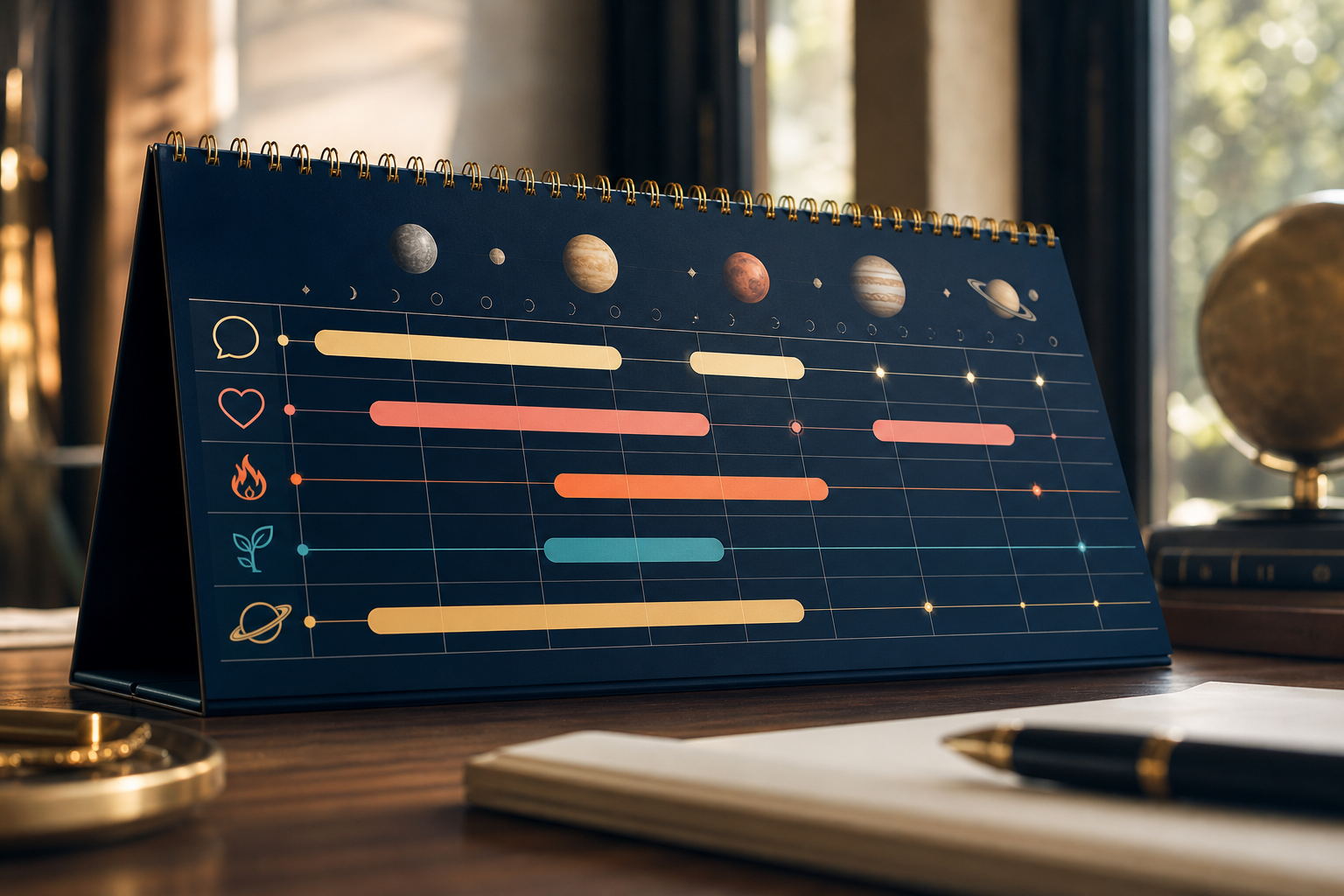
As you apply these, remember the spirit of this retrograde beginner guide planetary retrograde: use dates as prompts to review, not reasons to fear. The sky can mark cycles, but your choices shape the results.
5 Common Misconceptions About Retrograde
Retrograde sparks big myths. Here are five that deserve a calm, clear correction from both Western and Vedic perspectives.
1) “Retrograde is always bad.”
It isn’t. In Western reading, it’s a review phase. In Vedic terms, a vakri graha can act with strength, but in a non-linear way. Projects can improve because you see the hidden edits you missed the first pass.
2) “Only Mercury matters.”
Mercury gets press because it happens more often. However, Venus and Mars retrogrades feel personal, and Jupiter and Saturn shape long arcs. Your chart context matters, too, which is why personalized readings can help.
3) “Planets literally move backward.”
Astronomically, they don’t. The effect is an Earth-based viewing angle, not a real reverse in space. That’s why astronomers label it “apparent retrograde motion.
4) “Babies born during retrograde are cursed.”
They aren’t. In Vedic practice, charts are judged by the whole picture. Advanced Kundli software calculates planetary positions, houses, doshas, and yogas to show nuance. A single factor never seals fate.
5) “You must stop living during retrograde.”
You don’t. You can sign, ship, and speak. Therefore, think “review, refine, and re-confirm,” not “freeze.” This is the heart of any sane retrograde beginner guide planetary retrograde.
"AstroLive has quickly become my favorite astrology platform. The variety of astrologers and their expertise is truly impressive. I consulted for a career-related query, and the guidance I received was spot on." — Rajesh Kumar, Delhi
Tools and Resources to Track Retrograde Periods
You have great tools for both the science and the astrology. For raw astronomy data, the NASA JPL Horizons ephemeris lets you compute exact planet positions by date and location. It’s precise enough for professional observatories.
For calendar-style views, printed ephemerides and astrology datebooks show start and end dates with simple glyphs. In addition, Vedic panchang tools list auspicious and inauspicious timings for various activities, alongside tithi, nakshatra, yog, and karan. That mix helps you cross-check “clock time” with “ritual time.
If you want a human read, platforms like Astrolive are one option among several to consult astrologers about birth chart retrogrades and transits. You can Chat with an astrologer at ₹10/min, get Free Kundli generation, and ask about timing windows. Trusted by millions for accurate astrology tools, services like these bring dates to life with context rather than hype.
As always, try more than one source. Therefore, pair an ephemeris for numbers with a calendar for quick scanning, and a panchang for day quality. You’ll feel more prepared for 2026 and beyond.
Also Read!
Diwali 2026 Date: When Is Diwali in 2026 and How to Plan Ahead
Blue Jay Spiritual Meaning: What This Bird Is Trying to Tell You
What to Do During Retrograde — Your Action Plan
You don’t need to halt your life. Instead, you can use retrograde to sharpen your plans. Here’s a clear, calm checklist you can use for any planet’s cycle.
Step 1: Review, Don’t Rush
First, scan ongoing projects. Identify what needs edits, tests, or a better brief. Then schedule small fixes that pay off fast.
Step 2: Back Up and Double-Check
Second, back up data before Mercury turns retrograde. Verify addresses, times, and terms. As a result, you’ll catch typos and avoid last-minute scrambles.
Step 3: Journal and Debrief
Third, keep short notes on what works and what breaks. Moreover, ask: what did I learn, and what will I change by the end of this phase?
Step 4: Revisit Paused Work
Fourth, pull one stalled idea off the shelf. Update your scope and next step. Specifically, aim to ship a small but real win by the direct station.
Step 5: Protect Margins and Energy
Fifth, leave buffer time in calendars during Mars or Saturn retrogrades. Therefore, say “no” to extras that don’t move your main goals.
Step 6: Align With Your System
Sixth, if you follow Vedic guidance, consider Dosha identification (such as Mangal Dosha) with remedies. If you prefer Western, use sign/house themes to set weekly micro-goals. Either way, seek personalized insights based on planetary alignments if you feel stuck.
Step 7: Check Dates, But Choose Calmly
Seventh, use a panchang and a retrograde calendar to pick sane windows for signings or launches. However, if life demands action now, act, and add a clear review date to your plan.

Before you move on, mark two milestones in 2026 when your top planet of interest shifts gears (stations). Then block 60 minutes on each date to re-check progress.

Key Takeaways
- Retrograde is an optical illusion, not a backward spin; Earth’s changing line of sight makes a planet appear to loop or drift in reverse.
- Each planet’s cycle has a theme: Mercury for messages, Venus for values, Mars for drive, Jupiter for growth, and Saturn for structure and rules.
- Dates are prompts, not prison. Therefore, plan to review and refine; don’t pause your life or delay what must happen now.
- Vedic and Western perspectives differ in method, but both can guide wise timing. Moreover, a Kundli or chart reading adds personal context.
- Tools matter: use NASA’s ephemeris for exact positions, a calendar or panchang for daily cues, and a trusted advisor for nuance.
- This retrograde beginner guide planetary retrograde frames cycles as chances to edit your path, reduce risk, and act with care.
What to Do This Week
Start small and calm. First, note the next retrograde station for a planet you care about in 2026. Second, create a 3-line brief: what you’ll review, what you’ll pause, and what you’ll complete by that station. Third, back up your devices and tidy your inbox rules, so key messages land where you’ll see them.
Then, choose one relationship, one money habit, and one workflow to reassess. For example, you might plan a frank, kind talk with a partner, switch a recurring bill to a lower-cost plan, and fix the step in your process where handoffs stall. As a result, you’ll bank quick wins that pay off long after retrograde ends.
Finally, set a 15-minute weekly check-in to log learnings. Moreover, add a “review day” after the planet goes direct to lock in changes. If you want a second set of eyes or Vedic remedies for a dosha, consider a short consult.
You’ve got this. Retrograde isn’t a stop sign, it’s a highlighter for edits that make your plans sturdier and your choices clearer.