




Few astrological terms create as much concern as Sade Sati. People often hear about it during difficult periods, which is why the cycle gets linked with loss, delays, or emotional strain. This association creates fear before understanding.
Sade Sati is not a punishment. It is a Saturn transit cycle connected with responsibility, timing, and long term life adjustments. Instead of sudden disruption, the period usually brings gradual change that pushes people toward realism and stability.
Understanding how it works removes unnecessary anxiety. When the mechanics become clear, the focus shifts from prediction to preparation. This guide explains the meaning of Sade Sati, how the phases unfold, which stage can feel most intense, how to check your cycle, and what practical changes people often experience.
The goal is clarity and context so the cycle feels understandable rather than intimidating.
What Is Sade Sati?
Sade Sati refers to the approximately 7.5 year period when Saturn moves across three zodiac signs around a person’s Moon sign.
In astrology, the Moon reflects emotional responses, comfort patterns, and everyday psychological habits. When Saturn moves through this sensitive area, life tends to slow down and situations require maturity, patience, and consistency.
The duration comes from Saturn’s speed. The planet spends about 2.5 years in one sign. Since the cycle includes the sign before the Moon, the Moon sign itself, and the sign after, the total duration becomes seven and a half years.
Saturn, also known as Shani Dev, is associated with discipline, time, accountability, and structure. Its influence rarely creates sudden chaos. Instead, it highlights weak areas and encourages stronger foundations.
At its simplest, it is a timing cycle where emotional patterns meet practical reality.
How Sade Sati Works?
The cycle begins when Saturn enters the zodiac sign just before your Moon sign. It continues while Saturn crosses the Moon sign and ends once Saturn leaves the next sign.
This creates three stages of influence around emotional life.
Because Saturn moves slowly, the experience unfolds gradually. Events build over time. Situations demand consistency rather than quick fixes. The lessons usually appear through real responsibilities such as career decisions, financial planning, family duties, or lifestyle adjustments.
Saturn completes one full zodiac journey in about 29.5 years. This means most people experience Sade Sati two or three times during their lifetime.
The first cycle often introduces responsibility.
The second cycle tends to test stability.
The third cycle frequently reflects consolidation and wisdom.
These patterns are tendencies rather than fixed rules because each birth chart modifies the experience.
The Three Phases of Sade Sati
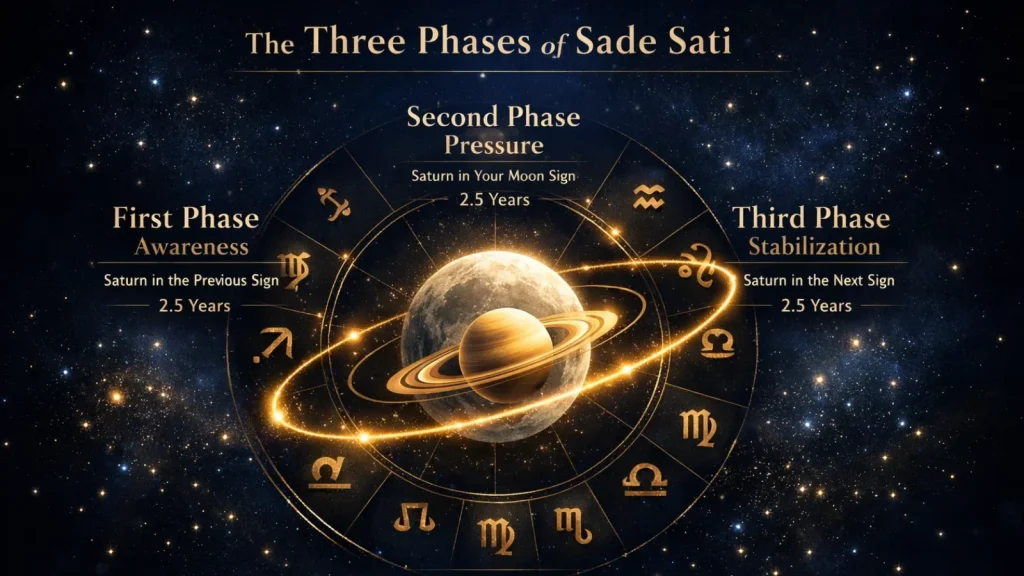
Sade-Sati does not unfold as a single continuous experience. It progresses through three distinct phases that reflect Saturn’s movement around the Moon sign. Each phase carries a slightly different focus, shaping how responsibilities, emotions, and external circumstances evolve over time.
First Phase
The first phase begins when Saturn enters the sign before the Moon. This stage usually brings awareness.
People may start noticing dissatisfaction in routines, relationships, or financial habits. The pressure is subtle. Situations encourage reflection and preparation rather than immediate crisis.
This phase often feels like a slow realization that change is necessary.
Second Phase
The second phase occurs when Saturn moves over the Moon sign itself. This stage is commonly described as the most demanding because emotional responses meet real world expectations.
Responsibilities may increase. Decisions carry longer consequences. Many individuals encounter career restructuring, relocation, caregiving roles, or shifts in priorities.
The intensity typically comes from accountability rather than bad luck.
Third Phase
The final phase begins when Saturn enters the sign after the Moon. The focus moves toward stabilization.
Lessons learned earlier start producing visible results. People often develop clearer boundaries, stronger routines, and more realistic expectations.
Progress may remain gradual, but direction becomes steadier. This phase frequently reflects integration.
Also Read
5 Effects of Rahu in 7th House on Your Life
Decoding Your Saturn Transit: Ancient Wisdom For Modern Soul Growth
Which Phase of Sade Sati is Worse?
The second phase is widely considered the most challenging because Saturn directly interacts with emotional patterns. However, experiences vary significantly.
Some people struggle more in the first phase when awareness disrupts comfort. Others find the last phase difficult if they resist necessary endings or adjustments.
The intensity depends on multiple factors such as Saturn’s placement in the birth chart, life stage, support systems, and personal decision making.
Sade-Sati becomes difficult when change is resisted and more constructive when adaptation happens early.
Effects of Sade Sati on Life

Sade Sati tends to influence areas that require structure and realism.
Career
Work environments may demand consistency, skill development, or role changes. Growth often happens through effort rather than shortcuts.
Money
Spending patterns become visible. Long term planning becomes more important. People may focus on savings, debt reduction, or stability.
Relationships
Superficial love or connections may fade while dependable relationships become stronger. Boundaries become clearer.
Health
Stress management, sleep patterns, and daily routines gain importance. Neglected habits often surface.
Personal growth
Confidence shifts from external validation to internal stability. Decision making becomes more measured.
Many individuals complete the cycle with improved discipline, clearer direction, and stronger emotional resilience. Outcomes usually reflect how consistently changes were implemented.
Zodiac Based Variation
The impact of Sade-Sati differs by Moon sign because Saturn interacts with each emotional style differently.
For example, earth sign Moons may experience a stronger focus on career structure and financial planning. Air sign Moons may notice changes in communication patterns and social dynamics. Fire sign Moons often face adjustments related to direction and identity. Water sign Moons may experience deeper emotional restructuring.
General predictions provide context but cannot replace personal chart analysis. Planetary aspects, Saturn strength, and life circumstances shape the final experience.
Itis universal as a transit but personal in expression.
How Long Each Phase Lasts With Example
Each phase lasts about 2.5 years.
For instance, if someone has their Moon in Taurus, Sade Sati begins when Saturn enters Aries. The second phase starts when Saturn enters Taurus. The final phase begins when Saturn moves into Gemini. The cycle ends once Saturn leaves Gemini.
This timeline shows why the experience feels gradual. The shift between phases happens slowly, often blending rather than changing suddenly.
Understanding the timeline helps people track progress instead of assuming constant difficulty.
How to Check Your Sade Sati

Checking Sade-Sati requires knowing your Moon sign.
Step by step
Find your birth date, time, and place.
Generate your birth chart using an astrology tool.
Identify your Moon sign.
Check Saturn’s current zodiac position.
If Saturn is in the sign before, the same sign, or the sign after your Moon sign, It is active.
The Moon sign is essential because the cycle is calculated from emotional patterns rather than Sun sign identity.
Online astrology calculators like AstroLive can quickly show whether the cycle is active and which phase is running. These tools provide timing. Interpretation still depends on the full chart and life context.
Remedies for Sade Sati That Focus on Practical Change
Traditional approaches often include charity, service, prayer, or rituals connected with Shani Dev. These practices emphasize humility and discipline rather than fear.
Behavior based remedies usually create visible impact.
Maintaining consistent routines
Strengthening financial planning
Keeping commitments in professional settings
Improving time management
Practicing patience in decision making
Lifestyle adjustments such as regular sleep, physical activity, and stress reduction help reduce pressure during the cycle.
The most effective approach aligns actions with Saturn’s themes of responsibility and consistency.
Long Term Impact of Sade Sati
Sade Sati often marks a shift from reactive living to intentional living.
People learn to manage energy, time, and expectations more carefully. Career direction becomes more realistic. Financial decisions become more deliberate. Relationships become more selective.
Later stages frequently feel lighter because clarity replaces confusion. Effort based progress becomes visible.
The cycle tends to feel constructive when individuals accept delayed gratification and focus on sustainable progress.
It rarely transforms life overnight. Its influence is gradual, but the changes tend to last.
Awareness Tools That Help You Track Important Life Cycles

Understanding timing in astrology becomes easier when you can see planetary movements clearly instead of guessing. Many people miss important transitions simply because they do not track their Moon sign cycles or Saturn’s movement regularly.
Digital astrology apps now simplify this process by offering personalized timelines, phase alerts, and birth chart insights in one place. Instead of manually checking planetary positions, users can enter their birth details and view whether Sade Sati is active, which phase is running, and what upcoming shifts may bring attention.
Platforms such as AstroLive provide features that help users monitor cycles, revisit interpretations, and stay aware of gradual changes that unfold over months and years. These tools are not meant to create fear or predict fixed outcomes. Their value lies in awareness. When people understand timing, they tend to make calmer decisions, plan better, and respond to challenges with more clarity.
Using an astrology app as a reference point can turn complex planetary movements into practical information that supports everyday choices.
Conclusion
Sade Sati is best understood as a timing cycle that encourages structure, accountability, and emotional maturity. While certain phases may feel demanding, the experience is not universally negative.
Knowing how the cycle works allows people to respond with preparation rather than fear. Tracking phases, understanding timelines, and focusing on practical habits makes the period more manageable.
The value lies in what it builds. Stability, clearer priorities, and stronger foundations often emerge when the lessons are applied consistently.
When viewed through this lens, It becomes less about difficulty and more about alignment with long term growth.
FAQs
1. How long does Sade Sati last?
Sade Sati lasts about 7.5 years because Saturn spends roughly 2.5 years in each of the three zodiac signs surrounding the Moon sign.
2. Which phase of Sade Sati is considered the hardest?
The second phase is often described as the most intense since Saturn moves over the Moon sign, but the experience varies based on an individual birth chart and life circumstances.
3. How can I check if my Sade Sati is running?
You need your Moon sign and Saturn’s current zodiac position. If Saturn is in the sign before, the same sign, or the sign after your Moon sign, Sade Sati is active.
4. Does Shani Sade Sati always bring negative results?
No. While it can bring responsibilities and delays, many people experience long term growth, career clarity, and improved financial discipline during this period.
5. Are remedies necessary during Sade Sati?
Remedies are optional. Practical steps such as consistent routines, financial planning, patience, and accountability often help manage the cycle more effectively.