




**Download free Kundli today →
This beginner guide reading your Vedic chart starts with one clear answer: read your chart by finding your Ascendant, placing planets into the 12 whole‑sign houses, checking aspects, noting your current dasha, and then tying patterns together. In 2026, you can do all of that in minutes with free tools, then study at your pace with this guide.
For quick context, a Vedic chart (Janam Kundli) maps the sky at your birth using the sidereal zodiac and whole‑sign houses. That structure shows the stage, actors, and timing of your life. However, it is not a verdict. Instead, it is a map of tendencies and windows of time you can use with awareness.
Moreover, you do not need to memorize a library to start. With your birth date, exact time, and place, you can generate a chart for free and follow the steps below. As you read, you will see simple definitions for key terms, practical examples, and pointers to go deeper without jargon.

What Is a Vedic Astrology Chart and What Can It Tell You?
A Vedic astrology chart, also known as a Kundli or Janam Kundli, is a diagram of the sky at your birth. It uses the sidereal zodiac, which aligns signs with the fixed stars rather than the equinox point. In contrast, Western astrology usually uses the tropical zodiac. For a neutral overview of Vedic methods, see Hindu astrology (Wikipedia).
Sidereal and House Systems at a Glance
In addition, most beginners notice the shape of the chart looks different. Vedic readers commonly use whole‑sign houses. That means the entire sign rising on the eastern horizon becomes the 1st house, the next full sign is the 2nd house, and so on. Therefore, house changes happen at sign boundaries, not mid‑sign.
Your chart reveals several layers:
At the core are life themes by house: identity (1st), money (2nd), siblings and skills (3rd), home (4th), creativity and children (5th), health and work (6th), partners (7th), shared assets (8th), beliefs and travel (9th), career (10th), networks (11th), and rest or losses (12th). The nine “grahas”. Sun, Moon, Mars, Mercury, Jupiter, Venus, Saturn, Rahu, and Ketu, act like characters with agendas. Timing arrives through dasha systems, which show whose storyline is loudest in a given period.
Furthermore, you do not need to pay to start. Free and instant Janam Kundli generation using date, time, and place of birth is common on modern platforms. These services sit within a larger niche of Vedic astrology and personalized astrological services, which you can tap as your questions become more specific.
Beginner Guide: What Your Chart Needs
- Date of birth (DD/MM/YYYY).
- Exact time of birth to the minute, if possible.
- Place of birth (city/town and country).
- Time zone and any daylight saving in effect at birth.
Tip: If your birth time is uncertain, note a range (e.g., 10:00–10:30). Then, test both charts for life events to see which fits better. This process is called “rectification.”
How to Read a Vedic Astrology Chart Step by Step
Start methodically. The steps below form a loop you can reuse. As a result, you build skill with each pass.
- Identify the Lagna (Ascendant).
- Find the sign marked as the 1st house. That rising sign colors your body, style, and instinct.
- Locate the 12 houses and their meanings.
- Read each whole sign from the Ascendant as House 1 through House 12. Note life areas linked to each.
- Map the 9 planets (Navagraha).
- Place Sun, Moon, Mars, Mercury, Jupiter, Venus, Saturn, Rahu, and Ketu into their houses and signs.
- Read signs in each house.
- Temperament shifts by sign. Aries is initiating, Taurus is steady, Gemini is curious, and so on.
- Check planetary aspects (drishti).
- In Vedic reading, Mars aspects 4th and 8th from itself, Jupiter 5th and 9th, Saturn 3rd and 10th, plus the standard 7th for all.
- Understand Dasha periods.
- Note your current Mahadasha and Antardasha. The active planet sets the tone and timing.
- Identify key yogas.
- Look for classical combinations that support talent, wealth, service, or tests.
Specifically, advanced Kundli software calculates planetary positions, houses, doshas, and yogas in seconds. That frees you to focus on meaning. However, the sequence above keeps you in charge of the story, not the software.
Reading Your Ascendant and Houses (Beginner Focus)
Ascendant example: Leo rising tends to act bold and expressive. Therefore, the Sun’s sign and house become central in your life plot. House example: If Venus sits in the 10th house, relationships and art may shape your public role and career.
Planetary Aspects and Sign Qualities (Guide Lens)
Aspect example: Saturn in the 4th aspects the 6th, 10th, and 1st. As a result, it can add discipline at home, at work, and to health routines. Sign tone: A planet in Capricorn behaves dutifully; in Pisces, it imagines and empathizes.

Dashas, Transits, and Synthesis (Reading Your Timing)
Dashas set the long‑range rhythm; the Vimshottari system assigns a precise sequence totaling 120 years (see Vimshottari dasha (Wikipedia) for the classical order). Transits are current sky placements that trigger parts of your chart, so note both dasha and transit for timing. Synthesis means tying repeating themes, if money houses, Venus, and your dasha all point to income growth, that’s a strong signal.
Finally, keep a notebook. In 2026, phones make it easy, but written notes train your eye faster than screenshots. Write one sentence per step, then revise across weeks.
Also Read!
How to Read Your Zodiac Birth Chart: A Beginner’s Complete Guide
Common Mistakes Beginners Make When Interpreting Vedic Charts
First, do not mix systems by accident. If your Western Sun is in Cancer but your Vedic Sun shows in Gemini, that’s normal. The sidereal zodiac shifts signs backward by about 23–24 degrees compared with tropical. Therefore, double‑check that your software is set to “sidereal” and “whole‑sign houses” before you start.
Second, avoid fixating on the Sun. In Vedic reading, the Ascendant (Lagna) and Moon sign set the stage for daily life. As a result, your rising sign and its ruler deserve prime attention. Read the 1st house and its lord before you chase Sun sign traits.
Setup and Focus
Third, do not ignore timing. If you skip your dasha, you miss the “who” of the present year. For example, a strong Jupiter promise won’t act loudly during a tight Saturn Mahadasha unless both work together.
Fourth, take doshas in context. Mangal Dosha (Mars affecting key houses for marriage) shows potential friction, not a life sentence. In addition, dosha identification (such as Mangal Dosha) with remedies exists to balance charts, not to scare you. Remedies work best when chosen with the whole chart in view.
Therefore, always ask: “What repeats?”
Fifth, never read a house in isolation. Planets cast aspects. Signs flavor results. Dashas set the clock. That question protects you from one‑symbol conclusions and guides you toward personalized insights based on planetary alignments.
**Chat with an astrologer, ₹10/min →
Tools and Resources for Generating Your Vedic Chart
You can start free. Most services offer free Kundli generation with instant charts. Moreover, you can usually download your Kundli as a PDF with detailed reports, which helps you annotate and revisit interpretations over time.
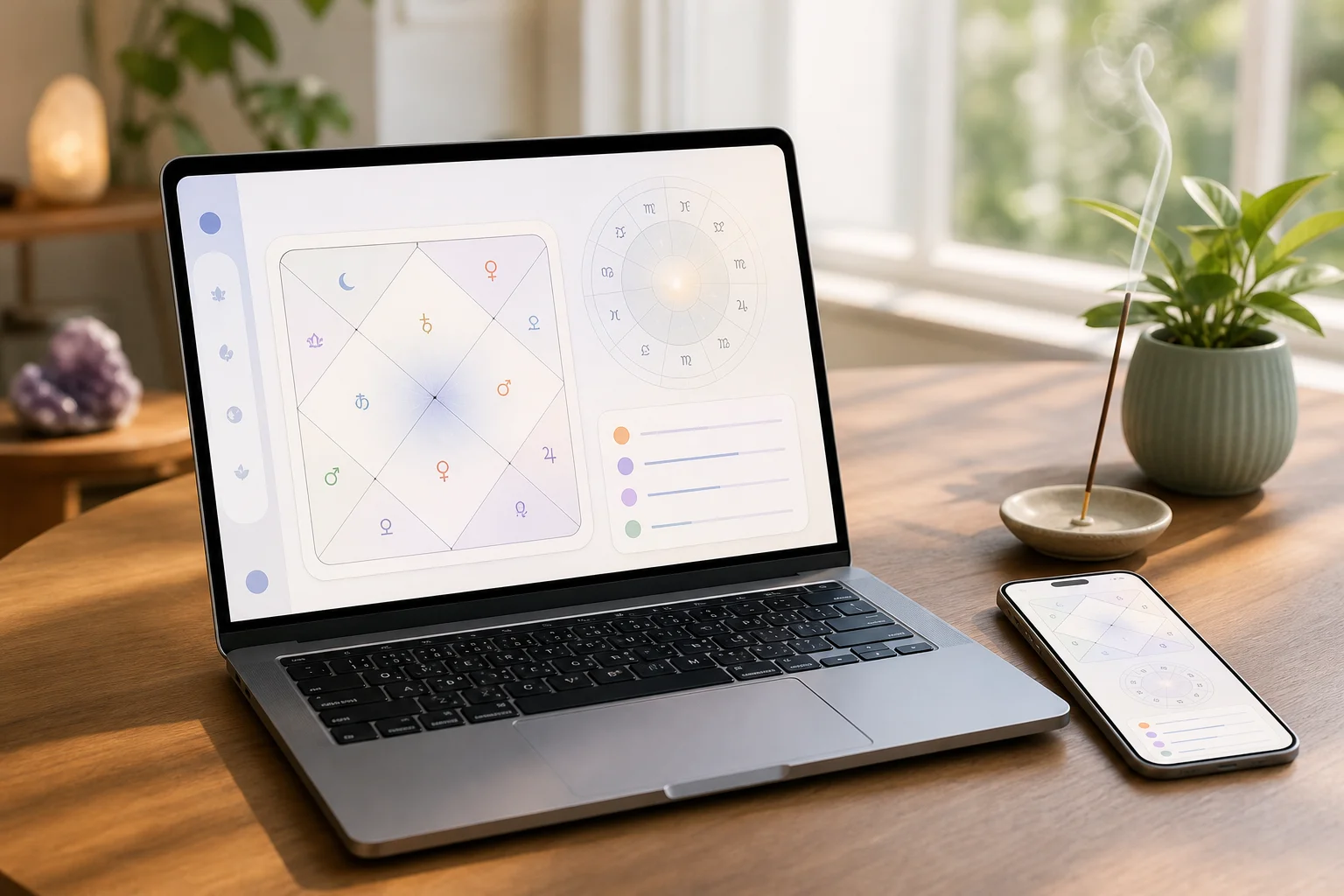
In addition, traditional Panchang references list daily tithi, nakshatra, yoga, and karana. If you like to check daily qualities alongside transits, a Panchang is a handy add‑on. For background, see Panchangam (Wikipedia). Pair that with your dasha to plan key dates with more care.
For mobile ease, apps like Astrolive are one option among several. They offer free and instant Janam Kundli generation and multilingual support in English, Hindi, Bengali, Tamil, Malayalam, Kannada, Gujarati, and more. You can also use live chat at about ₹10/min or place calls with listed ratings, and download PDF reports to share or print.
Furthermore, social proof matters. Trusted by millions for accurate astrology tools is more than a slogan; it signals that you can find verified readers and steady features without guesswork. However, always test a tool against your lived events to confirm it matches what you need.
Beginner Guide: Picking and Saving Your Chart
- Generate both North and South Indian styles. Read the same placements in either view.
- Save the PDF and a PNG image. Therefore, you can mark one and keep one clean.
- Note your Ayanamsha setting. Stick to the same one to avoid confusion.
What to Do After You Generate Your Vedic Chart
Now move from map to movement. Start with your Ascendant lord, because the rising sign’s ruler acts like the main character. For example, if you have Libra rising, Venus is your chart ruler. Therefore, track Venus by sign, house, dignity, and current transit.
Identify Your Current Dasha
Next, identify your current dasha period. Write the Mahadasha and Antardasha on a sticky note. Then, jot two lines: “This period wants me to learn X” and “This period helps me grow Y.” That clarity helps you choose projects and pace.
Work With Timing
Moreover, watch transits that hit your angles (1st, 4th, 7th, 10th) and the houses ruled by your current dasha lord. As a result, you pinpoint weeks that ask for action or patience. If marriage is relevant, consider Kundli matching tools available with 16 Guna Milan and compatibility analysis. That gives a fast, structured look at long‑term fit before you invest more time.
Finally, ask for a second set of eyes when stakes run high. Experienced astrologers are available for live chat and calls with ratings provided. Bring three questions, one date window, and your notes. Then, leave with a plan you can test over the next 90 days.
Your First 5 Actions (Guide for Reading Your Next Steps)
- Circle your Ascendant and its lord in your chart.
- Write your current Mahadasha/Antardasha and the end dates.
- List three houses most activated by planets and aspects.
- Mark transits to your 1st, 4th, 7th, and 10th houses for the next month.
- If dating or engaged, run a Guna Milan check as a first pass.
**Get an instant call, answers today →
Key Takeaways
- Your Kundli uses the sidereal zodiac and whole‑sign houses; set your software before reading.
- Start with the Ascendant, then houses, planets, signs, aspects, dashas, and finally yogas.
- Track your current dasha; it frames which themes speak loudest in 2026.
- Fix confusions: do not mix Western and Vedic signs or read houses alone.
- Free tools give you charts and PDFs; save settings, note dates, and test insights.

What to Do This Week
Print your PDF chart, highlight your Ascendant, and write three lines about your current dasha. Then, pick one life area, career, love, or health, and read only the houses and planets tied to it. After seven days of notes, compare what you felt with your chart signals. If you want a second opinion, bring your notes to a short consult and refine your plan for the rest of 2026.