




Your parents have the charts ready. You’re wondering how much weight to give to kundli matching before making one of the biggest decisions of your life.
That tension is more common than people admit. Some couples see astrology as deeply meaningful. Others treat it as a family ritual they need to respect, even if they are unsure about the logic behind it. Most people fall somewhere in the middle.
The problem is that advice around marriage compatibility often feels extreme. One side treats astrology as an unquestionable truth. The other dismisses it entirely. Neither approach really helps someone trying to make a thoughtful decision.
This post breaks down what the process actually measures, why families still care about it, how modern couples use it today, and where its limits begin.
What Is Kundli Matching, Really?
At its core, kundli matching compares two birth charts to evaluate long-term compatibility between partners. A kundli is a Vedic astrology chart created using a person’s birth date, exact birth time, and birthplace.
The idea is simple. Planetary positions at birth are believed to influence personality, emotional tendencies, health patterns, and relationship dynamics. When two charts are compared, astrologers look for areas of harmony and conflict.
Most systems rely on the Ashtakoota method, which measures compatibility across eight categories called gunas. Together, these categories add up to 36 points.
In practical terms, kundli matching for marriage is a compatibility framework. It is not meant to predict every event in a relationship or guarantee happiness. Instead, it highlights areas where couples may naturally align or struggle.
That distinction matters because many people misunderstand the process as fortune-telling. Traditionally, it was designed more as a risk assessment tool than a prediction machine.
The 8 Gunas Decoded
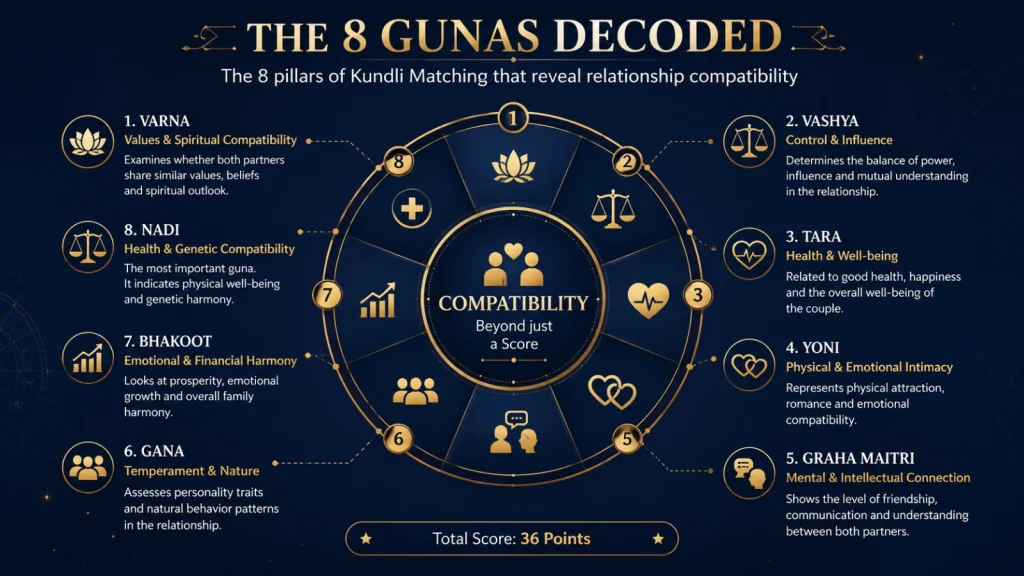
Each guna in the kundli matching tries to answer a real-life relationship question. Once you understand that, the scoring system becomes far less confusing.
Varna looks at spiritual outlook and values. It asks whether two people approach life with similar priorities.
Vashya focuses on influence and control within the relationship. It examines balance, dominance, and cooperation.
Tara relates to health, well-being, and emotional stability over time.
Yoni explores physical chemistry and emotional intimacy. Many astrologers consider this one especially important for long-term comfort.
Graha Maitri measures intellectual connection and friendship. Can the couple communicate naturally? Do they understand each other mentally?
Gana evaluates temperament. Traditional astrology groups personalities into Deva, Manushya, and Rakshasa categories.
Bhakoot looks at financial stability and emotional growth as a unit. It often relates to family harmony as well.
Nadi is tied to health and genetic compatibility. It carries the highest score weight and is usually treated seriously by astrologers during kundli matching.
The reason these categories still interest people is that they mirror concerns every couple already has. Communication, attraction, emotional balance, health, and shared values matter whether someone believes in astrology or not.
So What Does the Score Actually Mean?
Most families only mention one thing: “You need at least 18 points.” Rarely does anyone explain what that means in practice.
A score between 0 and 17 is generally considered weak compatibility. Astrologers may recommend caution or deeper analysis.
Scores between 18 and 24 are viewed as acceptable. This range is surprisingly common and does not automatically signal problems.
A score between 25 and 32 is considered strong. Couples in this category are believed to have smoother compatibility across multiple areas.
Anything above 33 is treated as excellent, though even astrologers admit that a perfect score does not guarantee a perfect relationship.
This is where people often panic unnecessarily. A lower score does not automatically mean failure. Many astrologers look beyond numbers and focus on specific combinations, planetary placements, and doshas.
Mangal Dosha is one example. A couple may have a decent score overall but still need a closer review because Mars placement can influence conflict patterns or emotional intensity.
Good astrologers rarely treat kundli matching as a final verdict. They use it as one layer of evaluation, not the entire decision.
The Modern Question: Does It Still Matter?

Ask ten couples whether astrology matters in marriage, and you will probably hear ten different answers.
For many families, the process provides emotional reassurance. It creates a sense of preparedness before marriage. Parents often feel calmer when charts align well, and that peace of mind can reduce tension between families later.
Some couples approach it differently. They complete the process mainly to avoid conflict at home, even if they are personally skeptical.
That does not automatically make the ritual meaningless. Belief itself carries psychological weight. When both families trust the system, it can shape expectations and reduce anxiety.
At the same time, younger couples increasingly treat astrology as advisory rather than binding. They may value emotional compatibility, communication skills, and shared goals more heavily than numerical scores.
The better question is not “Is kundli matching important.” The more useful question is how much importance you personally want to give it within your relationship and family context.
Common Mistakes People Make
One of the biggest mistakes people make during kundli matching is obsessing over the final score without understanding the individual categories behind it.
A couple may score well overall but still have serious concerns around Nadi or Mangal Dosha. On the other hand, a modest score with strong emotional indicators may not be alarming at all.
Another common issue is inaccurate birth information. Even small timing errors can shift planetary placements significantly. Many people rely on rough estimates from relatives instead of verified records.
People also make decisions too quickly after hearing one opinion. Astrology is interpretive by nature. Two experienced astrologers may focus on different aspects of the same charts during kundli matching.
Some families treat low compatibility as a disaster before understanding the full picture. That emotional reaction creates unnecessary stress.
A calmer approach works better. Use the analysis as information, not fear.
Read More!
जन्म कुंडली कैसे पढ़ें- जानिए 3 आसान चरणों में!
Kundli Matching: A Guide To Finding True Compatibility
How to Do It Online Without Confusion
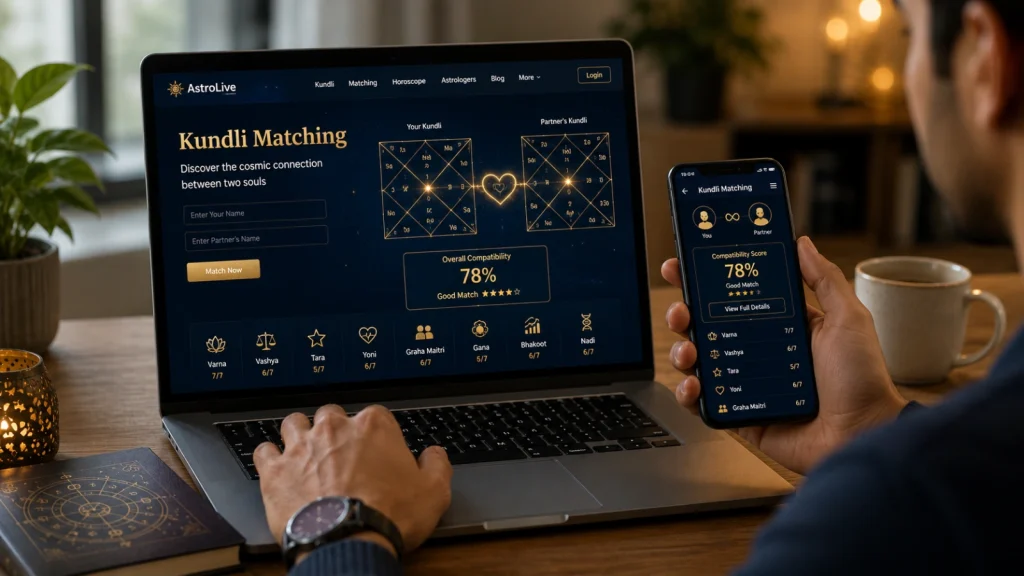
Digital astrology tools have made the process far more accessible. Years ago, families depended entirely on local astrologers. Today, detailed reports are available within minutes.
Still, quality varies widely. A good online kundli matching platform should do more than display a single number.
Look for tools that include:
- complete guna breakdowns
- dosha analysis
- compatibility explanations
- readable interpretations instead of technical jargon
Birth accuracy matters here, too. Entering an approximate birth time can distort the final reading.
After receiving results, treat them as the beginning of a conversation rather than the end of one. The report should help couples discuss expectations, values, and concerns more openly.
That practical mindset makes the process more useful and far less intimidating.
Why AstroLive Feels Easier to Navigate
Many people feel overwhelmed once they start reading astrology reports online. The terminology alone can become confusing within minutes.
AstroLive simplifies the process by focusing on clarity instead of complexity. Rather than presenting disconnected scores, the platform explains what each compatibility factor actually means in everyday terms.
Features include:
- Detailed Ashtakoota analysis
- Mangal and Nadi Dosha evaluation
- readable compatibility reports
- consultations with verified Vedic astrologers
- multilingual accessibility for families
That balance matters because most users are not astrology experts. They simply want reliable explanations they can understand without anxiety.
Whether someone strongly believes in astrology or is doing it mainly for family harmony, accurate interpretation makes discussions much easier.
What It Cannot Tell You
This is the part many blogs avoid discussing honestly.
A chart comparison cannot measure emotional maturity, communication habits, empathy, or willingness to grow together. It cannot predict whether two people will handle stress well or support each other during difficult periods.
Two couples may receive the same score and experience completely different marriages.
Human behavior changes over time. Relationships evolve through effort, trust, compromise, and shared experiences. Astrology does not replace those realities.
Even classical Vedic texts describe compatibility analysis as one consideration among many. The purpose was guidance, not absolute control over personal decisions.
That perspective is important because fear-based interpretations often do more harm than the charts themselves.
Frequently Asked Questions About Kundli Matching
What is the minimum score required?
Most astrologers consider 18 out of 36 acceptable, though context matters more than the number alone.
What happens if Nadi Dosha appears?
Nadi Dosha is treated seriously because it relates to health compatibility. Astrologers usually recommend deeper analysis before drawing conclusions.
Is online kundli matching accurate?
Accuracy depends heavily on birth details and the quality of the platform being used.
What is Mangal Dosha?
It is a planetary condition linked to Mars placement. Traditional astrology associates it with emotional intensity and conflict patterns in marriage.
What details are required?
You need the full birth date, exact birth time, and birthplace for both individuals.
Whether you deeply trust astrology or simply want to respect family traditions, the goal was never to surrender your future to a score.
Used thoughtfully, kundli matching can open conversations about compatibility, emotional expectations, health concerns, and long-term values. That can be genuinely useful.
The healthiest approach is balanced. Understand the results clearly, ask questions when something feels confusing, and avoid making decisions from fear alone.
A chart can offer perspective. The relationship itself is still built by two people.