



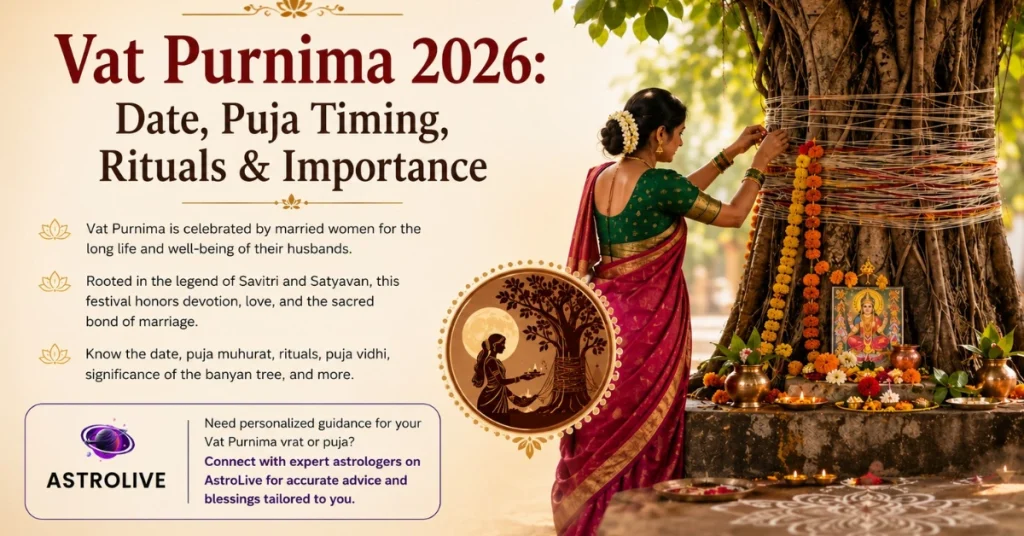
Vat Purnima is one of the most cherished festivals in the Hindu tradition, observed with great devotion by married women who pray for the long life, good health, and prosperity of their husbands. Falling on the full moon day of the Jyeshtha month, the festival draws its name and spirit from the majestic banyan tree, which is worshipped as a living symbol of strength, longevity, and eternal devotion.
The festival is deeply rooted in the timeless legend of Savitri and Satyavan, a story that celebrates a wife’s unwavering love, wisdom, and determination. For generations, women in Maharashtra, Gujarat, and Goa have kept this vrat with sincerity, tying a sacred thread around the banyan tree and offering their prayers under its shade.
In this comprehensive guide, you will learn the correct date and tithi timings of Vat Purnima 2026, the auspicious muhurat for performing the puja, the complete step-by-step puja vidhi, the items required for worship, the significance of the banyan tree, and the beautiful story behind the festival. We shall also clear the common confusion between Vat Purnima and Vat Savitri Vrat, and answer the questions that devotees most often ask.
Meaning of Vat Purnima
The word “Vat” refers to the banyan tree (Ficus benghalensis), while “Purnima” means the full moon day. Together, Vat Purnima signifies the full moon day on which the sacred banyan tree is worshipped. The banyan holds a place of great reverence in Hinduism, for it is believed to be the abode of the holy trinity. Brahma resides in its roots, Vishnu in its trunk, and Shiva in its upper branches. With its sprawling roots and far-reaching branches that live for hundreds of years, the banyan tree has long been regarded as a symbol of immortality, continuity, and the enduring bond of marriage.
Why Is Vat Purnima Celebrated?
Vat Purnima is celebrated primarily as an expression of marital devotion. Married women observe a fast and perform the puja seeking the well-being and long life of their husbands, as well as harmony and happiness within the family. Spiritually, the festival reminds devotees of the power of faith, patience, and selfless love, drawing inspiration from Savitri, who, through her devotion and wit, won back the very life of her husband from Yama, the god of death. The festival, therefore, stands as a celebration of feminine strength, family unity, and the sanctity of the marital relationship.
Read More!
What Is Tarot Card Reading and How Does It Work?
What Is Tarot Reading? A Clear Explanation For New Readers
When Is Vat Purnima in 2026?
In 2026, Vat Purnima will be observed on Monday, 29 June 2026. The festival coincides with Jyeshtha Purnima, the full moon day of the Jyeshtha month as per the Hindu lunar calendar. Falling on a Monday, a day traditionally associated with Lord Shiva, the occasion is considered especially auspicious for prayers concerning marriage and family welfare.
Vat Purnima 2026 Purnima Tithi Timings
The Purnima tithi does not always align neatly with sunrise to sunset, which is why knowing the exact timings is important for observing the vrat correctly. For 2026, the timings (in IST) are as follows:
| Event | Date & Time (IST) |
| Festival Date | Monday, 29 June 2026 |
| Purnima Tithi Begins | 03:06 AM on 29 June 2026 |
| Purnima Tithi Ends | 05:26 AM on 30 June 2026 |
| Lunar Month | Jyeshtha (Purnima) |
Note: Timings may vary slightly by city. Devotees are advised to confirm local panchang timings for their region.
Because the tithi spans two days, the vrat is observed on the day when the Purnima prevails during the morning hours of worship, which in 2026 is the 29th of June. Observing the puja while the full moon tithi is active is believed to bring the fullest blessings.
Vat Purnima 2026 Puja Muhurat
The most auspicious time to perform the Vat Purnima puja is in the morning after sunrise, generally between 05:01 AM and 10:10 AM. Many women complete their rituals in this window, while others gather near the banyan tree in the late afternoon or early evening, as is the custom in their region. The morning muhurat is widely preferred, as the mind is calm and the atmosphere is fresh for worship. Whatever the time chosen, devotion and a pure heart matter far more than the precise minute.
What Is the Vat Purnima Vrat?
The Vat Purnima vrat is a day-long fast observed mainly by married women for the longevity and prosperity of their husbands. The fast is a sankalp, a solemn vow, taken in the morning, after which the woman abstains from food for the day, breaking the fast only after completing the puja and rituals. The vrat is traditionally kept by sumangalis (married women), though the manner of fasting varies; some keep a complete fast, while others observe a partial fast with fruits and milk.
Spiritual Benefits of Observing Vat Purnima Vrat
It is believed that observing the Vat Purnima vrat with sincerity bestows a long and healthy life upon one’s husband, blesses the couple with marital harmony, and brings prosperity and peace to the household. Religious tradition holds that just as Savitri brought her husband Satyavan back from the clutches of death, women who keep this fast with faith are blessed with a happy and blessed married life. Beyond the spiritual rewards, the vrat also nurtures discipline, patience, and a sense of gratitude within the family.
Can Unmarried Women Observe Vat Purnima Vrat?
Traditionally, Vat Purnima has been a vrat for married women. However, in modern practice, unmarried girls also observe the fast, often praying for a good husband and a happy married life, much in the spirit of other vrats kept for similar wishes. There is no rigid prohibition, and many families today welcome the participation of young women who wish to learn and partake in the rituals. As with all such observances, the intention and devotion behind the fast are what truly count.
Preparation for the Puja
On the morning of Vat Purnima, women wake up before sunrise and take a bath, after which they dress in traditional attire, often a new or freshly washed saree, and adorn themselves with the sixteen adornments known as solah shringar. Cleanliness, both of the body and the surroundings, is considered essential, as is a calm and devoted state of mind. The puja items are gathered in a basket or thali and carried to the banyan tree, where the rituals are performed.
Vat Purnima Puja Samagri List
Keeping the puja samagri ready in advance helps the rituals proceed smoothly. The essential items include:
| Item | Purpose |
| Sacred thread (Kalava / cotton) | Tied around the banyan tree during the ritual |
| Flowers and fruits | Offered to the tree and the deities |
| Kumkum and turmeric (haldi) | Applied to the tree and used in worship |
| Diya and incense sticks | Lit to offer light and fragrance |
| Water vessel (Kalash / lota) | Water is offered at the roots of the tree |
| Other offerings | Rice (akshata), betel leaves and nuts, coconut, sweets, and a hand fan |
How to Perform Vat Purnima Pooja
1. Worship Lord Vishnu and Goddess Savitri: Begin the puja by invoking Lord Vishnu and Goddess Savitri, offering flowers, kumkum, and turmeric while seeking their blessings for a blessed married life.
2. Offer prayers to the banyan tree: Pour water at the roots of the banyan tree, then offer flowers, fruits, rice, and kumkum, expressing reverence for this sacred symbol of longevity.
3. Tie the sacred thread around the tree: Wrap the cotton or kalava thread around the trunk of the banyan tree, praying for the long life and well-being of your husband as you do so.
4. Perform circumambulation (parikrama): Walk around the tree, traditionally seven times, while reciting prayers, each round strengthening the vow and devotion.
5. Recite or listen to the Savitri–Satyavan katha: Read or listen to the story of Savitri and Satyavan, which forms the heart of the festival and reminds devotees of the power of faith and devotion.
6. Seek blessings for family well-being: Conclude the puja by praying for the health, happiness, and prosperity of your family, and offer prasad before breaking the fast.
Read More!
Nirjala Ekadashi 2026: Meaning, Date, Fasting Rules & Spiritual Significance
5 Powerful Astrological Mantras for Stress Relief | Astrological Remedies
Religious Importance of the Banyan Tree
The banyan tree is revered as a symbol of immortality, strength, and endurance. Its remarkable ability to live for centuries, sending down aerial roots that grow into fresh trunks, makes it a natural emblem of continuity and eternal life. Hindu scriptures hold the tree in great esteem, associating it with the holy trinity and describing it as a tree under whose shade sages meditated and divine wisdom was imparted. Worshipping the banyan on Vat Purnima is thus a prayer for a long, rooted, and ever-flourishing married life.
Symbolism Behind Tying the Sacred Thread
Tying the sacred thread around the banyan tree is the central ritual of Vat Purnima. The act symbolises the binding of love and devotion between husband and wife, and the wish for that bond to remain unbroken and everlasting. As the thread encircles the strong, enduring trunk, the devotee prays that her marriage may be blessed with the same strength and permanence. It is a simple yet deeply meaningful gesture that captures the very essence of the festival, the longevity of the marital union.
The Legend Behind Vat Purnima
The story of Savitri and Satyavan is the soul of Vat Purnima. Savitri was a wise and devoted princess who chose to marry Satyavan, the son of a blind king who had lost his kingdom and lived in the forest. Though Satyavan was noble and virtuous, the sage Narada warned Savitri of a grave prophecy that Satyavan was destined to die exactly one year from the day of their marriage. Undeterred, Savitri resolved to marry him all the same, accepting her fate with courage and quiet determination.
How Savitri Won Back Her Husband’s Life
As the fated day drew near, Savitri observed a strict fast and prayed devoutly. On the appointed day, while Satyavan was cutting wood in the forest, he suddenly grew weak and lay down in her lap, and Yama, the god of death, arrived to take his soul. Savitri followed Yama with steadfast resolve. Moved by her devotion and impressed by her wisdom, Yama granted her several boons, but Savitri, through her clever and virtuous words, ultimately secured the restoration of Satyavan’s life itself. Her faith, intelligence, and unshakeable love triumphed over death.

Lessons from the Savitri–Satyavan Story
The legend teaches enduring lessons that remain relevant to this day. It speaks of dedication, Savitri’s complete commitment to her husband; of faith, her unwavering belief that righteousness would prevail; and of courage and resilience, her willingness to confront even the god of death without fear. The story celebrates not blind submission but the strength of a woman who used her wisdom and determination to change her destiny, making it a timeless source of inspiration.
Common Rituals Followed During Vat Purnima
Fasting: Married women observe a day-long fast as a vow for their husband’s long life.
Banyan tree worship: Offering water, flowers, kumkum, and the sacred thread to the banyan tree.
Story recitation: Reading or listening to the Savitri–Satyavan katha during the puja.
Charity and donations: Giving food, clothing, or alms to the needy is considered highly meritorious on this day.
Looking for personalized spiritual guidance this Vat Purnima? Talk to verified astrologers on AstroLive to understand the significance of the festival, auspicious timings, and rituals best suited for you.
Regional Celebrations Across India
Vat Purnima in Maharashtra
Maharashtra celebrates Vat Purnima with the greatest devotion and cultural importance. Married women dress in traditional nine-yard sarees, gather near banyan trees, tie the sacred thread, and perform the parikrama while singing devotional songs. The day is marked by community gatherings and a strong sense of togetherness among women.
Vat Purnima in Gujarat
In Gujarat, the festival is observed with similar reverence, with women keeping the fast and worshipping the banyan tree for the welfare of their husbands. The rituals follow the same essence, blending local customs with the shared devotion to Savitri and Satyavan.
Celebrations in Goa and Other Regions
Goa also observes Vat Purnima as an important festival for married women. In parts of South India, a related observance is kept under different names, while across the country, the underlying spirit, a prayer for marital well-being inspired by Savitri’s devotion, remains the same.
Key Differences Between the Two Festivals
Although Vat Purnima and Vat Savitri Vrat share the same legend and purpose, they differ chiefly in the day on which they are observed and the regions where they are popular:
| Aspect | Vat Savitri Vrat | Vat Purnima |
| Day of observance | Jyeshtha Amavasya (new moon) | Jyeshtha Purnima (full moon) |
| 2026 date | 16 May 2026 (Saturday) | 29 June 2026 (Monday) |
| Popular regions | Uttar Pradesh, Bihar, Madhya Pradesh, and other North Indian states | Maharashtra, Gujarat, and Goa |
| Rituals | Fast, banyan worship, sacred thread, Savitri katha | Fast, banyan worship, sacred thread, Savitri katha |
Why the Festivals Are Often Confused
The two festivals are easily confused because they share the same beautiful story of Savitri and Satyavan, the same purpose of seeking a husband’s long life, and very similar rituals. The difference lies in the lunar calendar followed in different regions. In North India, the Purnimanta calendar leads women to observe the vrat on the Amavasya (new moon), known as Vat Savitri Vrat, while in Maharashtra, Gujarat, and Goa, the Amanta calendar leads to observance on the Purnima (full moon), known as Vat Purnima. Both, in essence, honour the same ideal of devotion.
Conclusion
Vat Purnima 2026, falling on Monday, 29 June, is a festival that beautifully blends faith, tradition, and the celebration of marital love. From understanding the correct tithi timings and the auspicious puja muhurat, to performing the rituals under the sacred banyan tree and reciting the inspiring story of Savitri and Satyavan, every aspect of the festival reflects deep devotion and meaning.
At its heart, Vat Purnima reminds us of the power of faith, patience, and selfless love, values embodied so completely by Savitri. The vrat is far more than a ritual; it is a heartfelt prayer for the happiness and longevity of one’s family, kept alive through generations of women who carry the tradition forward with sincerity.
As we observe Vat Purnima, let us cherish and preserve these cultural and spiritual traditions, passing them on to the next generation with the same devotion and joy. May the blessings of Savitri grace every home, and may the bond of love grow as strong and enduring as the great banyan tree itself.
Still have questions about your Vat Purnima vrat, puja rituals, or the best muhurat for your location? Connect with experienced astrologers on AstroLive for personalized guidance and accurate answers based on your birth chart and traditions.

Frequently Asked Questions About Vat Purnima
What is the significance of Vat Purnima?
Vat Purnima is significant as a festival of marital devotion, on which married women fast and worship the banyan tree for the long life, health, and prosperity of their husbands, inspired by the story of Savitri and Satyavan.
What is the correct date of Vat Purnima 2026?
Vat Purnima 2026 falls on Monday, 29 June 2026, coinciding with Jyeshtha Purnima.
How do you perform Vat Purnima pooja at home?
If a banyan tree is not nearby, you may worship a banyan twig or branch placed at home. Take a bath, dress in traditional attire, offer water, flowers, and kumkum, tie the sacred thread, perform parikrama, recite the Savitri–Satyavan katha, and pray for your family’s well-being before breaking the fast.
Can unmarried women observe the vrat?
Yes. While the vrat is traditionally for married women, unmarried girls may also observe it, often praying for a good husband and a happy married life.
How many times should the banyan tree be circled?
The banyan tree is traditionally circumambulated seven times while tying the sacred thread and offering prayers.
What items are required for Vat Purnima pooja?
The essential items include a sacred cotton thread (kalava), flowers, fruits, kumkum, turmeric, a diya, incense sticks, a water vessel, rice, betel leaves, coconut, sweets, and a hand fan.