



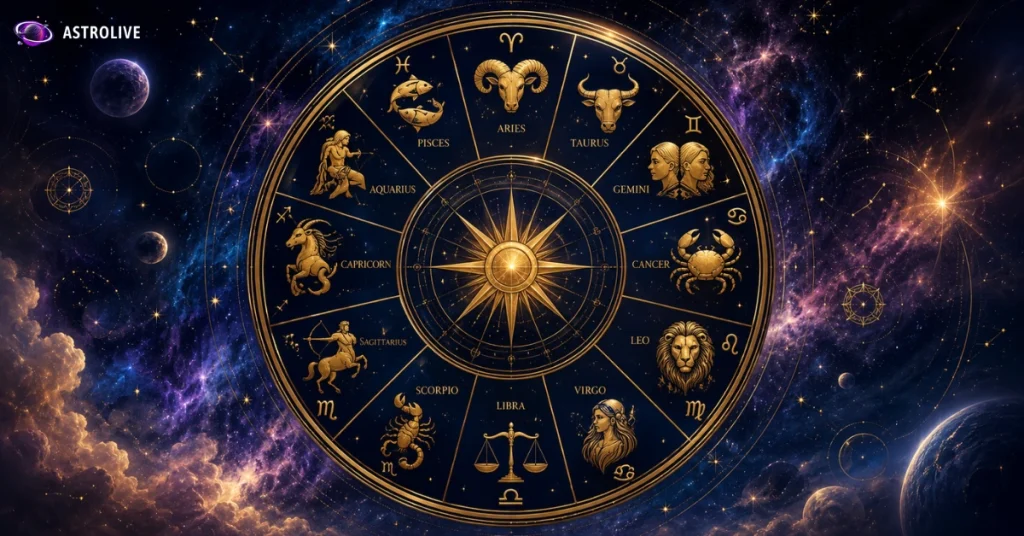
Most people know their zodiac sign. Few actually understand it. Yet astrology signs are far more layered than a personality blurb in a magazine – they reflect ancient frameworks for understanding human behavior, seasonal cycles, and the patterns people carry through life. Whether you’re curious about your own sign or trying to make sense of the zodiac as a system, this guide covers the full picture.
Astrology Signs at a Glance
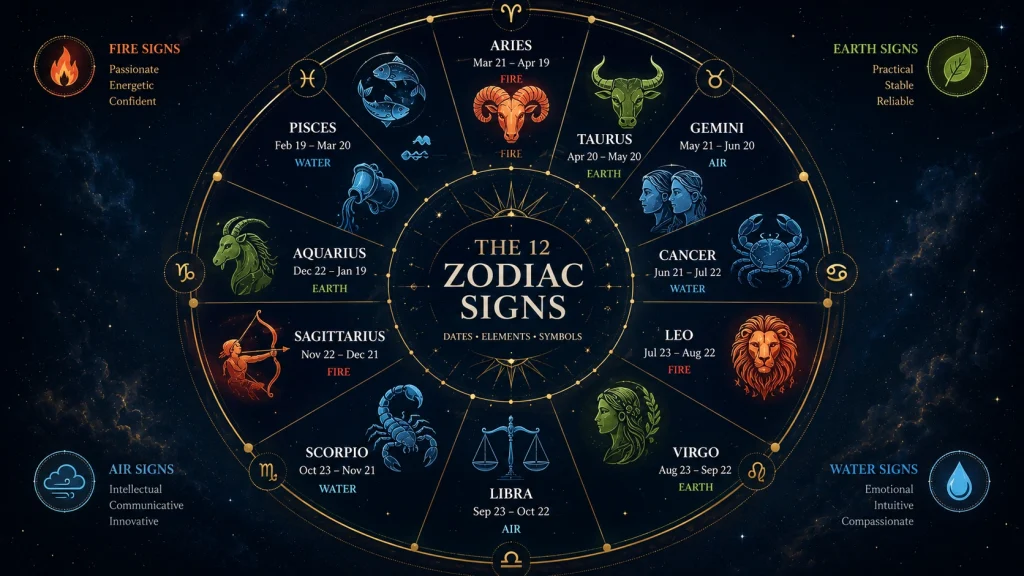
Astrology signs are twelve divisions of the celestial belt, each linked to a specific birth date range. Western astrology assigns everyone a sun sign based on where the sun was positioned in the sky at the moment of birth.
Each sign carries its own element, symbol, and set of associated traits. These aren’t arbitrary labels – they’re rooted in thousands of years of observation, mythology, and seasonal significance. The twelve signs cycle through the year, beginning with Aries in late March and closing with Pisces in late February.
The 12 Astrology Signs and Their Dates
Zodiac Sign Dates at a Glance
| Sign | Date Range | Element | Symbol |
| Aries | March 21 – April 19 | Fire | ♈ Ram |
| Taurus | April 20 – May 20 | Earth | ♉ Bull |
| Gemini | May 21 – June 20 | Air | ♊ Twins |
| Cancer | June 21 – July 22 | Water | ♋ Crab |
| Leo | July 23 – August 22 | Fire | ♌ Lion |
| Virgo | August 23 – September 22 | Earth | ♍ Maiden |
| Libra | September 23 – October 22 | Air | ♎ Scales |
| Scorpio | October 23 – November 21 | Water | ♏ Scorpion |
| Sagittarius | November 22 – December 21 | Fire | ♐ Archer |
| Capricorn | December 22 – January 19 | Earth | ♑ Sea-Goat |
| Aquarius | January 20 – February 18 | Air | ♒ Water-Bearer |
| Pisces | February 19 – March 20 | Water | ♓ Fish |
Why Sign Dates Matter
The astrology signs dates align with the sun’s apparent path across the sky throughout the year. Your sun sign reflects which constellation the sun was passing through on your birthday. That seasonal timing – spring, summer, autumn, winter – is thought to shape certain tendencies, though interpretation varies widely between traditions.
What Each Sign Reveals About Personality
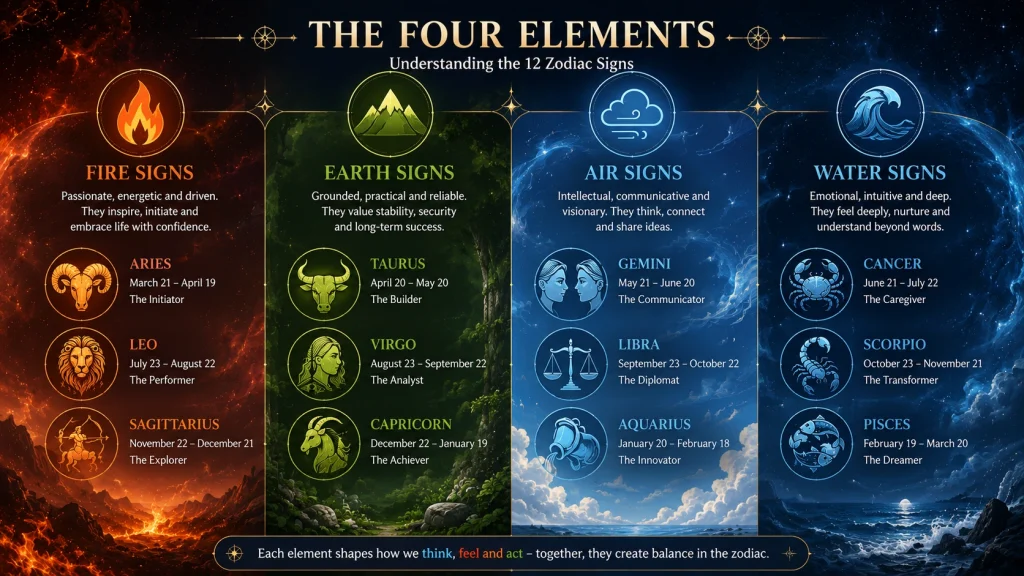
Rather than memorizing twelve isolated trait lists, understanding the four elemental groups is a better starting point. Each element gives a cluster of signs a shared underlying quality.
Fire Signs – Aries, Leo, Sagittarius
Fire signs operate with heat: enthusiasm, ambition, and a pull toward action. Aries launches things. Leo sustains momentum through sheer force of personality. Sagittarius chases the horizon, always reaching for the next idea or experience. The shadow side? Fire can burn too fast. Impulsiveness and impatience are common patterns here.
Earth Signs – Taurus, Virgo, Capricorn
Practicality defines this group. Earth signs think in systems, long timelines, and tangible outcomes. Taurus values security. Virgo brings precision. Capricorn focuses on structure and sustained achievement. Their steadiness makes them reliable in complex, long-running efforts.
Air Signs – Gemini, Libra, Aquarius
Air signs are the communicators and conceptual thinkers. Gemini jumps between ideas quickly. Libra weighs options with care. Aquarius sees systems and social patterns that others miss. The weakness is inconsistency – air signs can struggle to commit when too many ideas are in circulation.
Water Signs – Cancer, Scorpio, Pisces
Emotion, depth, and intuition characterize water signs. Cancer reads the emotional temperature of any room. Scorpio investigates beneath surfaces. Pisces absorbs the emotional landscape around it, often with creative effect. Without grounding, water signs can drift toward over-sensitivity.
How Zodiac Signs Shape Daily Behavior
Personality descriptions are the obvious entry point, but astrology signs have a practical layer most guides skip.
A Virgo and a Sagittarius approach the same disagreement very differently – one wants to methodically review details, the other wants to focus on the bigger picture and move on. Understanding this prevents a lot of unnecessary friction.

Compatibility: Is There Really a Perfect Match?
When exploring astrology signs, elemental compatibility is a useful rough guide. Fire and air signs tend to energize each other; earth and water signs often find mutual stability.
Why Sun Signs Don’t Tell the Whole Story
Sun sign pairings are an entry point, not the full picture. Moon signs shape emotional needs. Rising signs affect how people present themselves. Two people with compatible sun signs but clashing moon signs may find emotional connection surprisingly difficult.
Genuine compatibility analysis requires the full birth chart. This is where astrology gets genuinely interesting – and where generic compatibility lists fall short.
Western vs Vedic Astrology Signs: What’s the Difference?
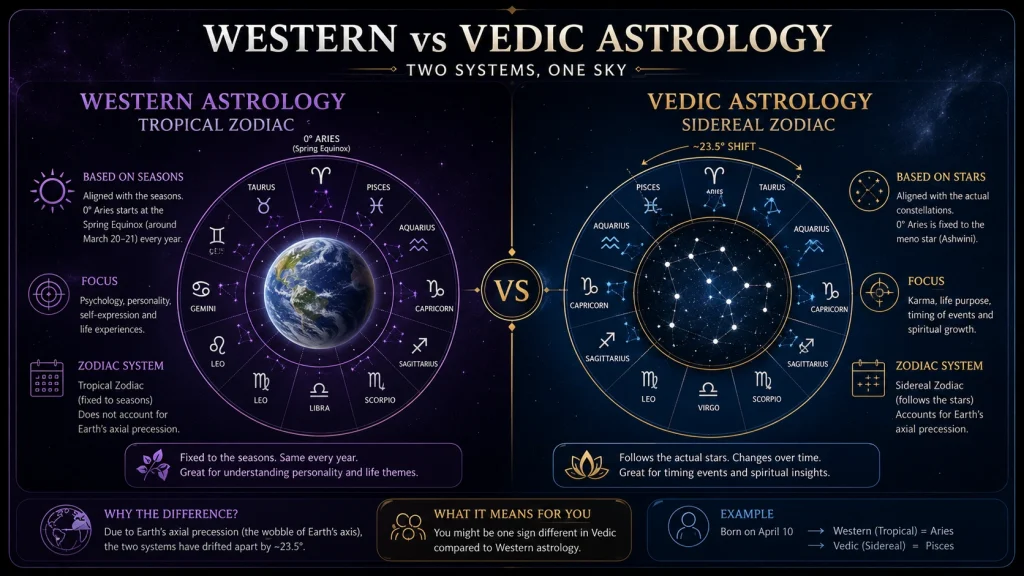
This is one of the most misunderstood areas in astrology, and it matters more than most guides acknowledge.
Western astrology uses the tropical zodiac, aligned with the seasons rather than actual star positions. The spring equinox always marks the start of Aries regardless of where the constellations appear in the sky.
Vedic astrology signs use the sidereal zodiac instead, tracking actual constellation positions in space. Because Earth’s axis has gradually shifted over millennia, the two systems have drifted apart by roughly 23 degrees.
That gap means many people are one sign earlier in Vedic calculations than in Western astrology. Someone who identifies as a Western Aries might be calculated as a Pisces in the Vedic tradition. Neither system is wrong – they’re simply measuring different things.
Which Signs Are Associated With Success?
The idea of astrology signs for success comes up often, and the answer is more nuanced than a ranked list suggests.
Leo, Aries, Capricorn, and Aquarius frequently appear in leadership discussions. Aries initiates. Leo commands attention. Capricorn builds institutions. Aquarius challenges existing systems. But leadership is only one definition of success.
A Pisces might build success through creative work. A Taurus through patient financial accumulation. A Gemini through media or communication ventures. The more useful question is what kind of success each sign is genuinely wired for.
Common Misconceptions Worth Addressing
Your sun sign isn’t your entire chart, and understanding that is the first step. Astrology gives every person ten planets, twelve houses, and dozens of aspects. The sun sign is one layer of a much richer picture.
Compatible signs don’t guarantee great relationships. Compatibility frameworks describe tendencies, not outcomes. Values, effort, and emotional intelligence matter far more.
Astrology doesn’t determine your future – charts are maps of potential, not locked-in destinies. And the same sign doesn’t mean the same person: birth time, location, and the rest of the chart create enormous individual variation.
How to Go Deeper Than Your Sun Sign
Start with your sun sign – determined by birth date alone, it’s the easiest entry point.
Your Moon Sign
Your moon sign reflects your emotional interior. The moon shifts signs every 2.5 days, so you’ll need your birth date and year to find it.
Your Rising Sign
Your rising sign requires your birth time and changes every two hours. It shapes how others perceive you in new situations.
Your Full Birth Chart
Your full birth chart brings it all together. Platforms like Astrolive offer personalized readings that go beyond generic descriptions and reflect your unique chart.
Explore Astrology Signs with Astrolive
While astrology signs provide general personality insights, a complete astrological reading can reveal much more about your relationships, career path, and life journey. Astrolive helps you explore these deeper insights through personalized astrology tools and expert guidance.
Why Choose Astrolive?
- Personalized birth chart analysis
- Daily, weekly, and monthly horoscopes
- Zodiac compatibility insights
- Consultations with professional astrologers
- Easy-to-understand astrology reports
Whether you’re discovering your zodiac sign for the first time or diving deeper into astrology, Astrolive makes personalized astrological guidance more accessible.
The Psychology Behind Why Astrology Feels So Personal
There’s a phenomenon called the Barnum effect – the tendency to accept vague personality descriptions as accurate because they apply broadly to many people. Astrology benefits from this, and it’s worth knowing.
But that doesn’t make it useless. Many people use astrology signs as a structured language for self-reflection. The framework names patterns they’ve already noticed in themselves. That’s pattern recognition using a shared vocabulary, and there’s genuine value in that.
Hold it with curiosity rather than certainty, and astrology stays a useful tool rather than a limiting label.
Final Thoughts
Astrology signs aren’t a rulebook. They’re a framework – one that reflects certain patterns back at you using a structured, centuries-old language. Whether you approach that as ancient wisdom, psychological projection, or pure curiosity, the value lies in what you notice about yourself in the process.
The most useful takeaway isn’t your trait list – it’s the understanding that you’re more complex than a single label. The deeper you explore your full chart, the more specific and actionable the insights become.
Astrology signs are a starting point, not a destination. Explore further when you’re ready.
Frequently Asked Questions
What are the 12 astrology signs in order?
Aries, Taurus, Gemini, Cancer, Leo, Virgo, Libra, Scorpio, Sagittarius, Capricorn, Aquarius, Pisces.
How do I find my sign?
Your sun sign is determined by your birth date. Use the date table above to identify yours.
Why is my Vedic sign different from my Western sign?
Vedic astrology uses the sidereal zodiac (actual star positions), while Western astrology uses the tropical zodiac (seasonal alignment). The two have shifted apart by about 23 degrees over time.
What’s the difference between a sun sign and a rising sign?
Your sun sign reflects core identity. Your rising sign shapes how others perceive you and requires your birth time to calculate.