



What Is a Zodiac Sign, Really?
Most people know their zodiac signs the way they know their blood type; it’s something they remember but don’t fully understand. Your zodiac sign is based on where the sun was in the sky on the day you were born.
The sky is divided into twelve sections, each linked to a constellation. The section where the sun was at your birth becomes your sign.
The system dates back roughly 2,500 years to ancient Babylon, where astronomers meticulously tracked celestial movement and divided the ecliptic – the sun’s annual path – into twelve equal segments. The Greeks inherited and refined it. By the second century BCE, the framework most of us recognize today was already in place. This is essentially the core of zodiac signs’ meaning, a way to interpret personality patterns through symbolic systems.
Here’s something worth knowing upfront: your sun sign is just one layer of a richer picture. It describes your core personality and identity, but it doesn’t capture how you process emotions or how others first experience you. More on that shortly.
The 12 zodiac signs and their dates:
- Aries: March 21 – April 19
- Taurus: April 20 – May 20
- Gemini: May 21 – June 20
- Cancer: June 21 – July 22
- Leo: July 23 – August 22
- Virgo: August 23 – September 22
- Libra: September 23 – October 22
- Scorpio: October 23 – November 21
- Sagittarius: November 22 – December 21
- Capricorn: December 22 – January 19
- Aquarius: January 20 – February 18
- Pisces: February 19 – March 20
The 12 Zodiac Signs at a Glance – Dates, Symbols & Core Personality
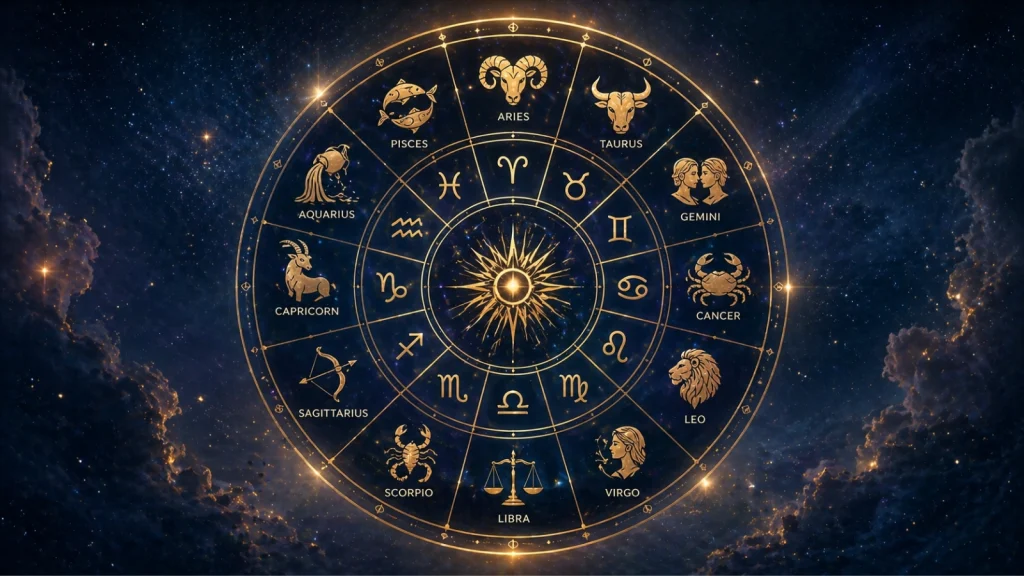
Every sign carries a distinct energy:
Not a stereotype, but a tendency. A way of moving through the world. What follows isn’t a personality quiz. Think of it as a quick character sketch: enough to recognize yourself, and enough to recognize the people around you.
| Sign | Dates | Element | Modality | Ruling Planet | Personality Essence |
| Aries | Mar 21 – Apr 19 | Fire | Cardinal | Mars | Intense and perceptive, Scorpios read people accurately and forgive slowly |
| Taurus | Apr 20 – May 20 | Earth | Fixed | Venus | Steady and sensual, Taurus builds slowly and holds on tight |
| Gemini | May 21 – Jun 20 | Air | Mutable | Mercury | Curious, quick, and endlessly interested – Gemini needs variety the way others need sleep |
| Cancer | Jun 21 – Jul 22 | Water | Cardinal | Moon | Intuitive and fiercely protective, Cancer feels everything and rarely says so |
| Leo | Jul 23 – Aug 22 | Fire | Fixed | Sun | Warm, expressive, and fully aware of the room – Leo doesn’t just enter, Leo arrives |
| Virgo | Aug 23 – Sep 22 | Earth | Mutable | Mercury | Detail-driven and quietly devoted, Virgo fixes things others don’t notice are broken |
| Libra | Sep 23 – Oct 22 | Air | Cardinal | Venus | Charming and deeply fair-minded, Libra will agonize over a decision to get it exactly right |
| Scorpio | Oct 23 – Nov 21 | Water | Fixed | Mars/Pluto | Intense and perceptive, Scorpio reads people accurately and forgives slowly |
| Sagittarius | Nov 22 – Dec 21 | Fire | Mutable | Jupiter | Restless, philosophical, and honestly a little reckless – Sagittarius is always chasing something bigger |
| Capricorn | Dec 22 – Jan 19 | Earth | Cardinal | Saturn | Patient, disciplined, and playing a very long game – Capricorn builds for decades, not days |
| Aquarius | Jan 20 – Feb 18 | Air | Fixed | Saturn/Uranus | Independent and ahead of the curve, Aquarius cares about humanity more than any individual in it |
| Pisces | Feb 19 – Mar 20 | Water | Mutable | Jupiter/Neptune | Dreamy, empathetic, and emotionally porous – Pisces absorbs the world around them |
These zodiac signs traits are starting points.
Your full personality includes far more than a single placement – but knowing your sun sign’s core energy is a genuinely useful lens.
The Hidden Architecture Behind the Signs – Elements and Modalities
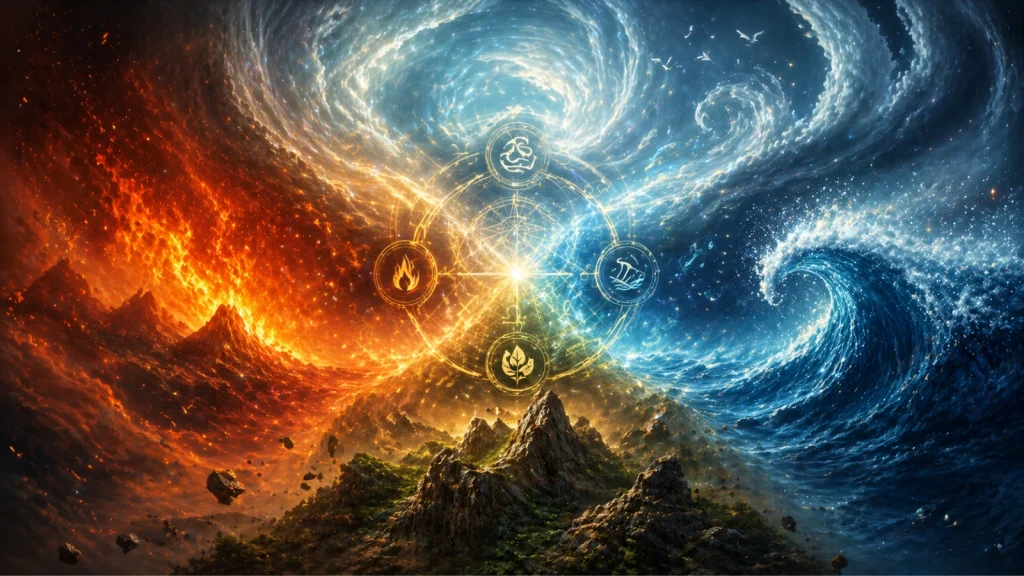
Listing twelve signs only tells you so much. To actually understand why signs behave the way they do – and why some signs feel immediately familiar while others seem like a different species – you need two more pieces: elements and modalities.
This is the system astrologers actually use. It’s not complicated once you see it laid out.
The Four Elements: Why Fire, Earth, Air, and Water Define Your Core Energy
The four zodiac signs’ elements group the signs by their fundamental nature. Not their surface traits, but their orientation – the lens through which they process life.
Fire signs
(Aries, Leo, Sagittarius) lead with energy and instinct. They’re driven by inspiration, often impulsive, and tend to act before they plan. This gives them enormous momentum and occasional wreckage.
Earth signs
(Taurus, Virgo, Capricorn) lead with practicality. They trust what they can see, touch, and measure. Patient by nature, they build things that last – but can struggle when life asks them to leap without a net.
Air signs
(Gemini, Libra, Aquarius) lead with thought. Ideas, conversation, and connection energize them. They’re often the most socially agile of the signs, but they can intellectualize their way around their own feelings.
Water signs
(Cancer, Scorpio, Pisces) lead with feeling. They’re deeply intuitive, emotionally attuned, and perceptive in ways that can feel almost uncanny. Their challenge is that they absorb other people’s energy as readily as their own.
Signs within the same element tend to understand each other instinctively. Two earth signs rarely need to explain why they want a plan before committing. Two fire zodiac signs rarely need to explain why they’d rather figure it out as they go.
How to Actually Read Your Zodiac Signs’ Horoscope (Not Just Skim It)
Reading a horoscope sounds simple until you realize most people do it wrong – not because they’re careless, but because nobody explains what they’re actually looking at. A horoscope isn’t a schedule. It’s closer to a weather report for your energy, your attention, and the themes likely surfacing in your life right now.
Here’s how to read one in a way that’s actually useful.
Step 1 – Know Which Sign You’re Reading For (It’s Not Just Your Sun Sign)
Most people read their sun sign horoscope and wonder why it only half resonates. The answer is usually that they’re missing two other key placements.
Your sun sign represents your core self, your identity, your ego, and how you fundamentally approach the world. It’s the most commonly known placement in zodiac signs, and it’s genuinely important. But it’s not the whole picture.
Your moon sign reflects your emotional inner world. It describes how you process feelings, what makes you feel safe, and how you behave when you drop the performance. For anything emotionally charged, like relationships, stress, or loss, your moon sign is often more accurate than your sun.
Your rising sign, also called the ascendant, is the sign that was on the eastern horizon at the exact moment of your birth. It shapes your first impression on others and influences how people experience you. Many astrologers consider the rising sign the most important placement for day-to-day life.
For daily horoscopes, try reading both your sun and rising sign. You’ll likely find the truth sits somewhere between the two – and occasionally, one will describe your day with startling precision.
Step 2 – Understand What Planets Are Being Discussed
Horoscopes don’t just describe your sign in isolation. They explain what’s happening to different planets within zodiac signs and why that matters to you.
Each planet governs a specific area of life. Mercury rules communication and thought. Venus governs love, beauty, and what you value. Mars drives energy, ambition, and conflict. Jupiter expands whatever it touches. Saturn contracts and disciplines.
When a horoscope says “Venus moves into your fifth house this week,” it points to themes of romance and creative self-expression entering your life with softer, more enjoyable energy. “Mars squares your sun” suggests tension, possible friction, and a need to direct your energy more carefully instead of acting on impulse.
You don’t need to memorize everything at once. Just understanding that planets act while zodiac signs provide the stage helps you interpret horoscope language much faster than relying on definitions alone.
Step 3 – Apply It Like a Framework, Not a Prediction
This is the step most people skip, and it’s the one that makes reading your horoscope worth doing.
Instead of asking “Will this happen to me?” when reading zodiac signs, ask three better questions: What area of life is being highlighted? What is the energy or theme being described? What does this suggest I should pay attention to or act on?
A useful approach is to keep a simple horoscope journal. Not a diary – just a note. “This week: Venus in my sign, themes of connection and creativity.” Then see what actually shows up. Over a month, patterns become visible. You start noticing when a transit genuinely corresponds with something in your experience, and when it doesn’t. That distinction is more valuable than any single horoscope reading.
Zodiac Signs Compatibility – Who Gets Along and Why
Compatibility is probably the most Googled corner of astrology, and it’s also the most misrepresented. Lists of “best matches” are easy to find and not particularly useful on their own. Understanding why certain pairings work – and why others require more effort – is where the real insight lives. The element framework is the clearest starting point.
Same-element pairs
Tend to share fundamental values and energy styles. Two earth signs understand each other’s need for stability and long-term thinking without having to explain it. Two water signs share emotional depth and intuition, though they can also reinforce each other’s sensitivity to the point of overwhelm.
Complementary element pairs create a different kind of harmony in zodiac signs compatibility. Fire and air feed each other; air gives fire ideas and fuel, while fire gives air direction and momentum. Earth and water work in a similar way, where water softens earth’s rigidity and earth gives water something stable to flow around. These pairings often describe relationships where two people balance each other out rather than mirror each other.
Then there are opposite signs, the pairs that sit directly across from each other in the zodiac signs. Aries and Libra, Taurus and Scorpio, Gemini and Sagittarius, and so on. These pairings are polarized, meaning each sign carries something the other lacks. The attraction is strong, but so is the friction. When it works, it’s because both people learn from those differences instead of resisting them.
Modality matters too.
Two fixed signs in a relationship (say, Leo and Scorpio) can lock into incredible loyalty – or a power struggle with no clear exit. Two mutable signs often flow easily together but may struggle to commit or make joint decisions. Cardinal and fixed pairings can feel like one person always initiating and one always resisting.
One caveat worth repeating: Zodiac signs compatibility based purely on sun signs is a starting point, not a conclusion. Moon sign compatibility, in particular, often determines whether emotional intimacy actually develops between two people. Venus placement shapes how love is expressed and received. A “incompatible” sun sign pairing with deeply resonant moon signs can outperform a “perfect match” that lacks that emotional alignment.
Going Deeper – How AstroLive Helps You Explore Your Zodiac Sign Profile
Once you understand your zodiac signs and start reading horoscopes with intention, the next step is exploring your full birth chart. That’s where things often get confusing. Multiple placements, planetary movements, and unfamiliar terms can quickly feel overwhelming.
AstroLive simplifies that process. Instead of trying to piece everything together on your own, it gives you a clear and structured way to explore your zodiac signs personality and patterns in real time.
What makes AstroLive useful is how it turns complex astrology into something practical and easy to apply.
Here’s what you can expect:
- Live personalized horoscope updates based on your zodiac signs, including sun, moon, and rising inputs
- Detailed personality insights that go beyond basic zodiac signs traits and explain how your placements interact
- Real-time compatibility analysis across different zodiac signs compatibility factors, not just surface-level matches
- Daily and weekly guidance tailored to current planetary movements and how they affect your chart
- Simple explanations of astrological terms so you can understand transits, aspects, and patterns without confusion
The goal isn’t to overwhelm you with information. It’s to make zodiac signs feel usable.
Instead of reading something vague and moving on, you begin to see how patterns connect to your actual experiences. AstroLive acts like a guide that helps you interpret those patterns clearly, especially when the language of astrology starts to feel complicated.
Read More!
How to Read Your Janam Kundli: A Step-by-Step Guide
How Birth Chart Interpretation Works: Understanding Your Cosmic Blueprint
The Psychology Behind Why Zodiac Signs Resonate So Deeply
Skeptics often ask a fair question: if astrology has no scientific basis, why does reading your sign so often feel accurate? The answer is genuinely interesting, and it doesn’t require believing in celestial influence to appreciate it.
The Barnum effect
Named after P.T. Barnum’s observation that good showmanship involves giving everyone a little something – describes our tendency to accept vague, general personality statements as uniquely personal. Psychologist Bertram Forer demonstrated this in 1948 when he gave the same generic personality profile to an entire class and asked them to rate its accuracy. Most rated it as highly personal. Zodiac sign descriptions are artfully written to trigger exactly this response.
But that explanation doesn’t fully account for why zodiac signs have remained relevant for so long. Carl Jung, one of the 20th century’s most influential psychologists, explored astrology as a symbolic language rather than a predictive system. He saw the twelve signs as archetypes, universal patterns of human behavior that appear across cultures because they reflect real psychological differences.
What peer-reviewed research shows is limited but still meaningful.
Studies haven’t supported the idea that birth date determines personality. At the same time, they haven’t fully explored astrology as a framework for reflection, instead of a fixed system. Those are very different questions, and the second one aligns more closely with how people actually use it.
The fact that this system has lasted over 2,500 years across different cultures suggests it connects with something deeper in human psychology. Not necessarily cosmic influence, but a strong need for self-understanding, pattern recognition, and a sense that our inner lives follow some structure. Astrology offers that structure, and whether the stars cause it becomes less important than how people use it.
Your Stars, Your Story – A Final Word on Reading Your Horoscope
Zodiac signs are a starting point, not a ceiling. What astrology offers – when you engage with it deliberately – is a language for describing patterns in yourself that you might otherwise struggle to articulate. Not a fate. Not a limitation. A lens.
The most useful thing you can take from this guide isn’t a list of traits. It’s the habit of reading your horoscope as a weekly prompt for reflection rather than a daily forecast to accept or dismiss. Read your sun sign and your rising sign. Notice what resonates and what doesn’t. Note it somewhere. Over time, patterns will emerge that are specific to your life rather than generic to your sign.
If you want to go further, explore your full birth chart – moon sign, planetary placements, the whole picture. GlobusoftAI can walk you through that process in plain language, at whatever pace makes sense for you.
The stars don’t decide your story. But they might help you read it more clearly.
Frequently Asked Questions About Zodiac Signs
What zodiac sign am I?
Your zodiac sign is determined by your birth date. Aries runs from March 21 to April 19, Taurus from April 20 to May 20, and so on through Pisces (February 19 to March 20). The full list with dates appears in the reference table above. If you were born near the boundary between two signs, calculate your sun sign using your exact birth date rather than relying on memory.
What is the difference between a sun sign, a moon sign, and a rising sign?
Your sun sign reveals your core identity and the way you naturally move through life. Meanwhile, the moon sign reflects your emotional world- how you feel, what you need, and how you react when your guard is down. The rising sign, or ascendant, influences your outward behavior and the impression you make on others. Taken together, these three placements create a much fuller and more nuanced picture than any single sign on its own.
Are zodiac signs scientifically proven?
Scientific research has not found evidence that birth date determines personality or life outcomes. Studies testing the predictive claims of astrology have not supported them under controlled conditions. That said, most contemporary astrology practitioners don’t use it as a predictive science – they use it as a symbolic system for self-reflection, which is a different claim and one that hasn’t been as rigorously studied.
Which zodiac signs are the most compatible in relationships?
Same-element signs often share natural compatibility – fire with fire, earth with earth, and so on. Complementary element pairings (fire and air, earth and water) also tend to work well. But sun sign compatibility alone is a limited view. Moon sign alignment often determines the depth of emotional connection, and Venus placements shape how love is expressed and received.
What does it mean if I’m on the cusp of two zodiac signs?
Astrologically, you are not on a cusp – you are one sign or the other, depending on the exact time and location of your birth. The sun moves from one sign to the next at a precise moment. If you were born on a boundary date, calculate your actual sun sign using a birth chart calculator with your exact birth time for accuracy.