




Janam Kundli is often treated like something mysterious, but the real problem is that no one explains it clearly. Most explanations either drown you in Sanskrit terms or reduce everything to vague predictions that don’t actually help you understand anything.
A Janam kundli is not random, and it’s not meant to be interpreted blindly. It follows a structure that maps your personality, decision patterns, strengths, and timing cycles based on planetary positions at birth. Once you understand that structure, the chart stops feeling abstract and starts becoming readable.
The challenge is not complexity, it’s clarity.
This guide focuses on that. Instead of overwhelming you with theory, it breaks the process into a few essential steps: what to look at first, how to connect different parts, and how to interpret them logically. By the end, you won’t be guessing what your Janam kundli says. You’ll know how to read it with intent.
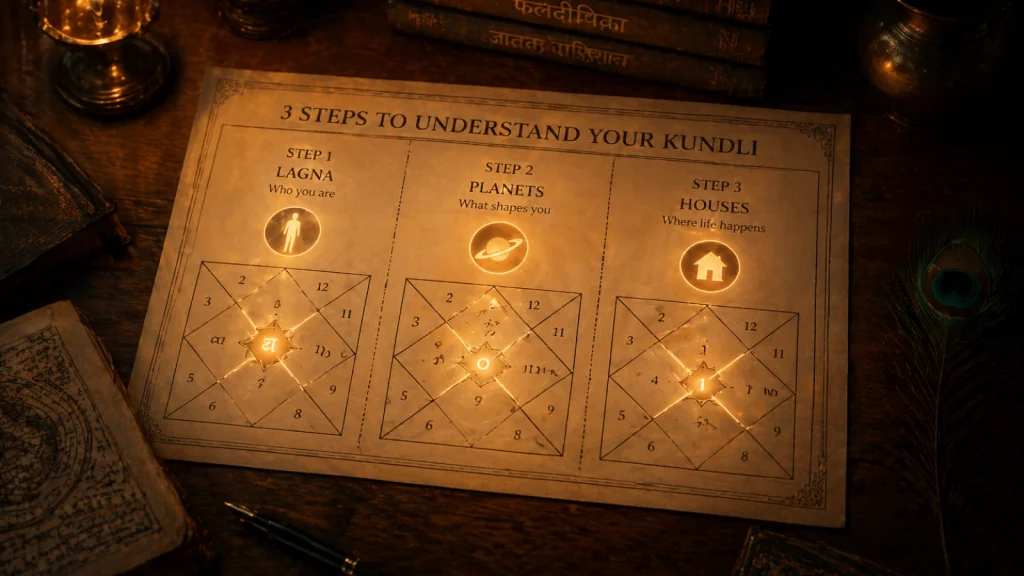
How to Read a Janam Kundli in 3 Steps
- Step 1 – Find your Lagna (Ascendant): The rising sign at the time of your birth shapes your personality and your outer approach to life.
- Step 2 – Read the 12 Houses: Each house governs a specific life area, such as career, relationships, wealth, health, and more.
- Step 3 – Analyse Planets and their placements: Where each planet sits (and which house it rules) tells you how that energy expresses in your life.
These three steps form the skeleton of every chart reading. Everything else, aspects, dashas, and yogas, is built on top of this foundation.
What Is a Kundli (Birth Chart)?
A Janam kundli is a diagram of the solar system as it appeared from your exact birth location, frozen at the precise moment you were born. The sky is divided into twelve segments called houses, and the planets fall into these segments based on their actual positions at that time.
Think of it as a personal map rather than a prescription. No two people born at exactly the same time and place will live identical lives, but they will share certain temperamental patterns, rhythms of timing, and recurring themes. The chart describes the terrain; how you navigate it remains entirely yours.
In India, two main chart styles are used. The North Indian format uses a fixed diamond-shaped grid where houses stay in the same position, and signs rotate. The South Indian format fixes the signs and shows house numbers within each box. The underlying data is identical; only the visual layout differs. Most online janam kundli free tools let you choose which style to display.
How to Create Your Janam Kundli
Generating a birth chart requires three pieces of information, and the accuracy of each one matters differently.
- Date of birth — straightforward; even a day’s error shifts the Moon sign in some cases.
- Exact time of birth — this is the most critical input. A difference of even four minutes shifts the Ascendant by roughly one degree. An error of two hours can change your Lagna entirely, which alters almost every interpretation that follows.
- Place of birth — the city or town is enough; the system converts it to the precise latitude and longitude needed for calculation.
If you do not know your birth time, check your hospital records, ration card, or family documents. Some people use “birth time rectification,” where an astrologer works backwards from major life events to estimate the chart, but that is an advanced process.
Several platforms offer janam kundli online for free generation. You enter the three details above and receive a full chart within seconds. The quality of the calculation is the same across most reputable tools; what differs is the depth of interpretation provided alongside it.
A precise birth time is non-negotiable for accurate readings. An approximate chart can still show planetary signs and some house placements, but the Ascendant and house cusps will remain unreliable.
Step-by-Step Guide to Reading Your Janam Kundli
Identify Your Ascendant (Lagna)
The Lagna is the zodiac sign that was rising on the eastern horizon at the exact moment of your birth. It changes roughly every two hours, which is why birth time matters so much. While your Sun sign describes core identity and your Moon sign reflects emotional nature, the Ascendant is the lens through which everything in the chart is filtered. It shapes physical appearance, default personality, and the way others perceive you before they know you well.
To find it in your chart, look for the sign placed in the first house (marked “1” or labelled “Lagna”). Every other house is numbered sequentially from there in an anti-clockwise direction in the North Indian style.
The interpretation changes significantly depending on which sign occupies Lagna. A few examples:
- Aries Lagna — direct, action-oriented, often physically energetic; prone to impatience
- Cancer Lagna — emotionally perceptive, nurturing, strongly attached to home and family
- Scorpio Lagna — intense, research-driven, drawn to depth and transformation
- Capricorn Lagna — disciplined, strategic, slow to trust but reliable once committed
These are starting points, not final verdicts. The planets placed in the first house and the ruler of Lagna modify all of this considerably.
2 Understand the 12 Houses (Bhavas)
If the Lagna tells you who you are, the houses tell you where life plays out. Each of the twelve houses governs a specific domain of experience. Vedic astrology groups them into four triplicities:
- Dharma houses (1, 5, 9) — purpose, identity, learning, and higher meaning
- Artha houses (2, 6, 10) — material security, work, career, and resources
- Kama houses (3, 7, 11) — desires, communication, relationships, and social life
- Moksha houses (4, 8, 12) — inner life, transformation, spirituality, and liberation
| 1st | Self / Lagna | Identity, appearance, beginnings |
| 2nd | Wealth & Family | Savings, speech, early family |
| 3rd | Courage & Siblings | Communication, short journeys, siblings |
| 4th | Home & Mother | Property, comfort, roots |
| 5th | Intellect & Children | Creativity, education, romance |
| 6th | Enemies & Health | Daily work, illness, debts |
| 7th | Partnerships | Marriage, business partners, contracts |
| 8th | Transformation | Hidden matters, inheritance, longevity |
| 9th | Fortune & Dharma | Luck, teachers, long journeys, philosophy |
| 10th | Career & Status | Profession, authority, public reputation |
| 11th | Gains & Networks | Income, social circles, ambitions |
| 12th | Loss & Liberation | Expenses, foreign lands, spirituality |
When a planet sits in a house, it activates that house’s themes and colours them with the planet’s energy. An empty house is not a bad sign; it simply means that the house is not a primary focus in this life.
3 Understand the Planets and Their Roles
In Vedic astrology, nine celestial bodies are used: the seven traditional planets plus the two lunar nodes, Rahu and Ketu. Each represents a distinct type of energy or desire operating in your life.
| Sun (Surya) | Identity & authority | Soul, father, government |
| Moon (Chandra) | Emotions & mind | Mother, habits, public image |
| Mars (Mangal) | Drive & conflict | Energy, siblings, property |
| Mercury (Budh) | Intellect & speech | Communication, business, detail |
| Jupiter (Guru) | Wisdom & expansion | Children, teachers, wealth, dharma |
| Venus (Shukra) | Love & beauty | Relationships, art, luxury |
| Saturn (Shani) | Discipline & karma | Delays, hard work, longevity |
| Rahu | Worldly ambition | Obsession, foreign influence, illusion |
| Ketu | Detachment & past | Spirituality, loss, liberation |
The logic of “planet + house = meaning” is the core of chart reading. Saturn in the 10th house brings discipline and delayed but solid career achievement. Venus in the 7th house often indicates a harmonious or aesthetically inclined partner. Jupiter in the 1st house tends to produce an optimistic, generous personality and often physical height. The combinations go deep, but this logic is always the starting point.
4. Planetary Combinations and Aspects
No planet operates in isolation, especially in a Janam Kundli. When two or more planets share a house, they form a conjunction, blending their energies in ways that can be productive or complicated, depending on which planets are involved. Venus and Jupiter together often create abundance and charm, while Saturn and Mars in the same house can generate tremendous ambition alongside inner restlessness. These combinations are one of the most important layers to observe in a Janam Kundli, because they show how different energies interact within the same area of life.
Aspects work differently. In Vedic astrology, every planet casts a full aspect (direct influence) on the house directly opposite it, the seventh house from where it sits. Saturn, Jupiter, and Mars have additional special aspects that extend their reach further across the chart, influencing multiple areas at once in a Janam Kundli.
A practical example: if you have Saturn in the 4th house, it aspects the 10th house as well. This means the themes of home life and career are linked; responsibilities at home often shape professional choices, and vice versa. This is why events in one part of life often reflect in another; something a Janam Kundli helps you connect and understand clearly.
5 Understand the Dasha System (Life Timing)
Here is where the Janam Kundli interpretation becomes genuinely predictive rather than purely descriptive. The Vimshottari Dasha system divides your life into planetary periods, where each planet takes centre stage for a specific number of years. The sequence depends on the Moon’s nakshatra (lunar mansion) at birth.
This explains something that puzzles many people: two individuals with similar charts can have very different experiences at age 30 versus age 50. The chart itself does not change, but which planet is active does. A person running a Jupiter Dasha during their thirties will experience very different circumstances than someone running a Saturn Dasha during the same decade, even if their birth charts look broadly similar.
Sub-periods (antardashas) within each main period add further texture. An 18-year Rahu Dasha, for instance, contains nine sub-periods of different planets, each lasting roughly two years. Tracking these is how astrologers time specific events rather than just describing general personality.
A Sample Janam Kundli Walkthrough
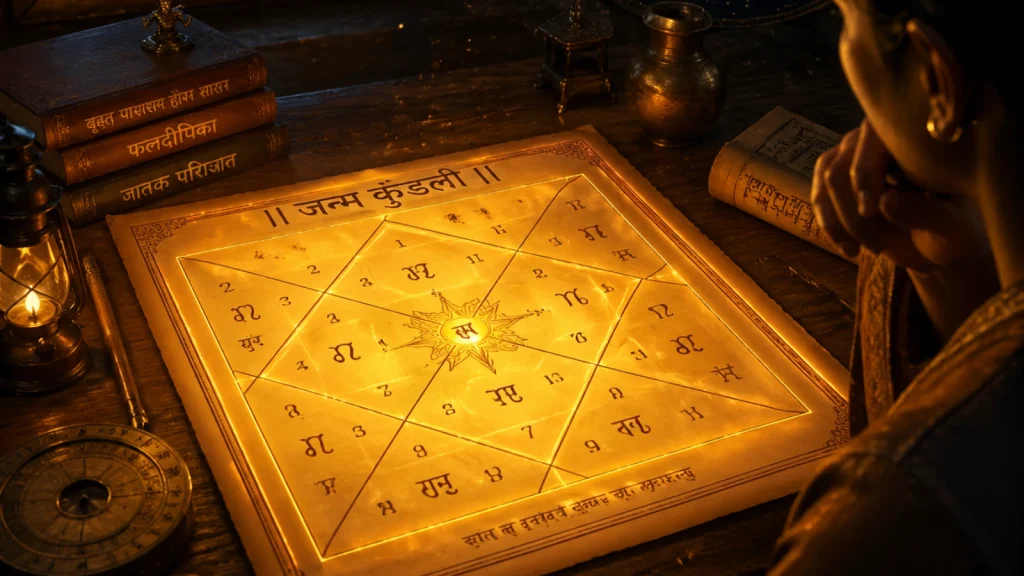
Consider a hypothetical chart with the following placements:
- Lagna: Libra, balanced, relationship-oriented, drawn to aesthetics and fairness
- Sun in 10th house (Cancer): Identity is tied to public role; career may involve nurturing, care, or public service
- Moon in 1st house (Libra): Emotions are visible to others; highly responsive to the social environment
- Saturn in the 7th house (Aries): Partnerships require patience and maturity; marriage may come later in life or bring responsibilities
- Jupiter in 11th house (Leo): Social network is a source of growth; gains come through associations and leadership circles
Reading this together: a person likely to be well-regarded professionally (Sun in 10th), with a visible emotional life and strong interpersonal skills (Moon in 1st, Libra Lagna), who finds close partnerships challenging or delayed (Saturn in 7th), but whose social reach and income grow considerably over time (Jupiter in 11th).
This is not a complete reading, but it demonstrates how the parts speak to each other. None of these placements is simply good or bad; each is a description of energy in a specific area, shaped by context and timing.
Get Expert Help When You Need Clarity

Reading your Janam Kundli on your own builds a strong foundation, but deeper interpretation often needs experience. Subtle factors like dasha timing, aspects, and planetary strength can be easy to miss.
Platforms like Astrolive give you access to astrologers who can read your chart in detail and connect the patterns you might overlook. You can get quick consultations, personalised insights for career or relationships, and guidance based on your current planetary period, not just general predictions.
It’s not about relying on someone else, but about getting clarity faster and avoiding misinterpretation while you’re still learning.
Also Read
जन्म कुंडली कैसे पढ़ें- जानिए 3 आसान चरणों में!
Kundli Matching: A Guide To Finding True Compatibility
How to Use Your Janam Kundli in Real Life

The most practical use of a birth chart is not prediction; it is pattern recognition. Once you understand your chart, recurring themes in your life start to make sense rather than feel random.
Career guidance. The 10th house, its lord, and the placement of Saturn and the Sun reveal what kind of work environment suits you, what professional environments drain you, and where your natural authority lies. Someone with Mercury ruling their 10th house often thrives in communication, analysis, or teaching roles.
Relationship compatibility. Kundali matching, the practice of comparing two birth charts before marriage, looks at Moon sign compatibility, house overlaps, and dasha timing. It is not a simple checklist; it is an analysis of where two people’s life themes intersect.
Decision timing. Rather than asking “should I do this?”, the chart can help answer “when is a supportive period for this?” Launching a business during a strong Jupiter or Venus period versus a challenging Saturn transit produces measurably different starting conditions, at least according to those who use astrology consistently.
Self-awareness. This is perhaps the most underused application. Understanding which houses are strongly activated in your chart, what your Saturn placement demands of you, and what your Rahu-Ketu axis is pushing you toward offers a framework for interpreting your own experiences with more clarity and less self-judgement.
Conclusion
A Janam Kundli does not tell you what will happen. It tells you what you are working with the energies, tendencies, timing patterns, and recurring themes that shape how your life unfolds. That is genuinely useful information, whether or not you believe astrology is literally true.
The mistake most people make is treating the Kundli as a verdict. It is closer to a personalised operating manual, detailed, layered, and far more useful the more deeply you understand it. Start with your Lagna. Learn your house placements. Notice which themes keep appearing in your life and see whether the chart reflects them.
“The more you understand your chart, the more you understand yourself.”
Self-awareness built through a janam kundli is not about waiting for planetary permission to act. It is about knowing yourself clearly enough to act with intention. That is where the real value lies, not in the prediction, but in the understanding.
Frequently Asked Questions
Can I read my Kundli without an astrologer?
Yes, absolutely and starting with your own chart is the most effective way to learn. While a skilled astrologer brings years of pattern recognition and nuance, a basic chart reading is entirely accessible to an informed beginner. Plenty of free resources, books, and online platforms can guide you through the fundamentals.
How important is birth time accuracy?
Critically important. Even a 15-minute error can shift the Ascendant in some cases, which changes house rulerships across the entire chart. If you are unsure of your birth time, mention this to any astrologer you consult; they will adjust their interpretation accordingly or attempt rectification.
Can a Janam Kundli predict marriage or career?
It can indicate patterns, timing, and tendencies related to both. The 7th house and Venus speak to partnership themes; the 10th house, Saturn, and the Sun speak to career. However, prediction is probabilistic, not absolute. Two people with identical marriage indicators in their charts will not necessarily marry at the same age or in the same circumstances.
What if my Janam kundli has doshas like Mangal Dosha or Kaal Sarp Dosha?
First, verify whether the dosha actually exists in your chart. Many people are told they have doshas that their chart does not technically contain. Second, understand that most doshas have cancellation conditions. Third, a dosha describes a challenge pattern, not an inevitable negative event. Many people with Mangal Dosha have stable, happy marriages.
Is Janam Kundli free generation accurate?
The mathematical calculation is highly accurate across all major platforms. Planetary positions are a matter of astronomical computation. What varies is the quality of interpretation provided. The chart itself will be identical regardless of which tool you use, as long as you enter the same birth details.