



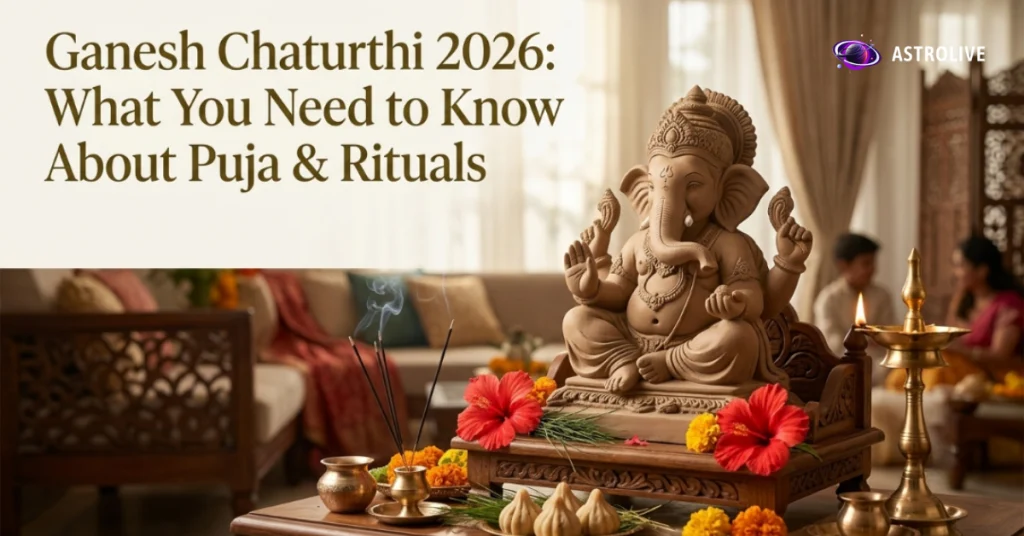
There are some festivals you attend. And then there are festivals that change the feeling of your home.
Ganesh Chaturthi belongs to the second kind.
For a few days every year, a familiar corner of the house becomes a place of prayer. The smell of incense settles into the curtains. Modaks appear in the kitchen. Children wait for the first aarti. Someone is always looking for durva grass at the last minute. And somewhere between the first “Ganpati Bappa Morya” and the final aarti, the festival becomes less about a date on the calendar and more about having Bappa at home.
Ganesh Chaturthi 2026 falls on Monday, September 14. The Chaturthi tithi begins at 7:06 AM on September 14 and ends at 7:44 AM on September 15. The main Ganesh Visarjan falls on Friday, September 25, 2026, on Anant Chaturdashi.
But the date is only the beginning.
If you are bringing Ganpati home this year, the real questions are usually more practical: When should the murti be installed? What should be offered during puja? Is fasting necessary? Why are 21 durva blades offered? What happens if you accidentally see the moon? And how should visarjan be performed?
Here is everything you need to know.
Ganesh Chaturthi 2026: Date, Tithi and Puja Muhurat
Ganesh Chaturthi is observed on Shukla Paksha Chaturthi in the Hindu month of Bhadrapada. The festival marks the birth of Lord Ganesha, who is worshipped as Vighnaharta, the remover of obstacles, and as the deity traditionally invoked before a new beginning.
In 2026, Ganesh Chaturthi falls on Monday, September 14. The auspicious Madhyahna period is especially important because traditional observance associates Ganesha’s birth with midday.
The exact puja window changes from city to city. For example, the 2026 Panchang gives the following approximate Madhyahna timings:
| City | Ganesh Puja Muhurat |
| Pune | 11:16 AM – 1:44 PM |
| Mumbai | 11:20 AM – 1:48 PM |
| New Delhi | 11:02 AM – 1:31 PM |
| Bengaluru | 11:02 AM – 1:28 PM |
| Hyderabad | 10:58 AM – 1:25 PM |
| Kolkata | 10:18 AM – 12:46 PM |
These timings are local to each city, so devotees outside these locations should check their local Panchang rather than copying another city’s muhurat.
Ganesh Chaturthi 2026 at a glance:
- Ganesh Chaturthi: Monday, September 14, 2026
- Chaturthi Tithi begins: 7:06 AM, September 14
- Chaturthi Tithi ends: 7:44 AM, September 15
- Main Ganesh Visarjan: Friday, September 25, 2026
- Festival: Ganeshotsav, culminating on Anant Chaturdashi
The important detail here is that Sthapana is associated with Madhyahna, not simply with sunrise.
Astrology and Ganesh Chaturthi
Ganesh Chaturthi is not only a time for celebration and devotion; it is also a festival closely connected with traditional Hindu practices, auspicious timings and the Panchang. From choosing the right muhurat for Ganesh Sthapana to observing the day’s tithi and other planetary considerations, astrology often becomes part of the way devotees plan their celebrations.
For those who enjoy exploring these traditions beyond the festival, astrology can also offer a more personal perspective. Your birth chart, horoscope and planetary positions are often used to explore questions around career, relationships, marriage, finances and important decisions.
Today, accessing this kind of guidance is also easier than it once was. Online platforms such as AstroLive allow people to explore their horoscope, check the Panchang or connect with an astrologer from wherever they are.

Why Do We Celebrate Ganesh Chaturthi?
The simplest answer is that Ganesh Chaturthi commemorates the birth of Lord Ganesha.
The deeper answer lies in what Ganesha represents.
He is the son of Shiva and Parvati, the elephant-headed deity associated with wisdom, good fortune and the removal of obstacles. That is why his name appears at the beginning of so many Hindu ceremonies and new ventures.
A new business begins with Ganesha.
A wedding begins with Ganesha.
A new home welcomes Ganesha.
Even the first page of a new notebook can begin with his name.
The story of his birth is one of the most familiar in Hindu tradition. Parvati creates Ganesha and appoints him to guard her entrance. When Shiva returns and Ganesha refuses to let him enter, the confrontation ends with Ganesha losing his head. Parvati’s grief and anger follow, and Shiva eventually restores Ganesha with the head of an elephant.
The story explains more than why Ganesha has an elephant head. It establishes his position as a deity who stands at the threshold — between one thing and another, between an ending and a beginning.
That idea fits Ganesh Chaturthi perfectly.
You bring Ganesha home at the beginning of the celebration.
And when the festival ends, you take him to visarjan.
The arrival and departure are part of the same ritual.
The Meaning Behind Bringing Ganesha Home
The most beautiful part of Ganesh Chaturthi is perhaps not the scale of the celebration outside.
It is the intimacy inside.
A family may choose a small clay murti for a two-bedroom apartment. Another may build an elaborate mandap. A child may make a paper decoration for Bappa. Someone may prepare modaks for the first time and get the shape completely wrong.
None of that changes the central act.
You are welcoming Ganesha.
This is why the size of the idol is not the measure of the celebration. The same festival can fill a massive public pandal in Mumbai and a tiny shelf in a family’s home elsewhere.
The ritual changes in scale.
The feeling does not.
Ganesh Sthapana: How to Install the Murti at Home
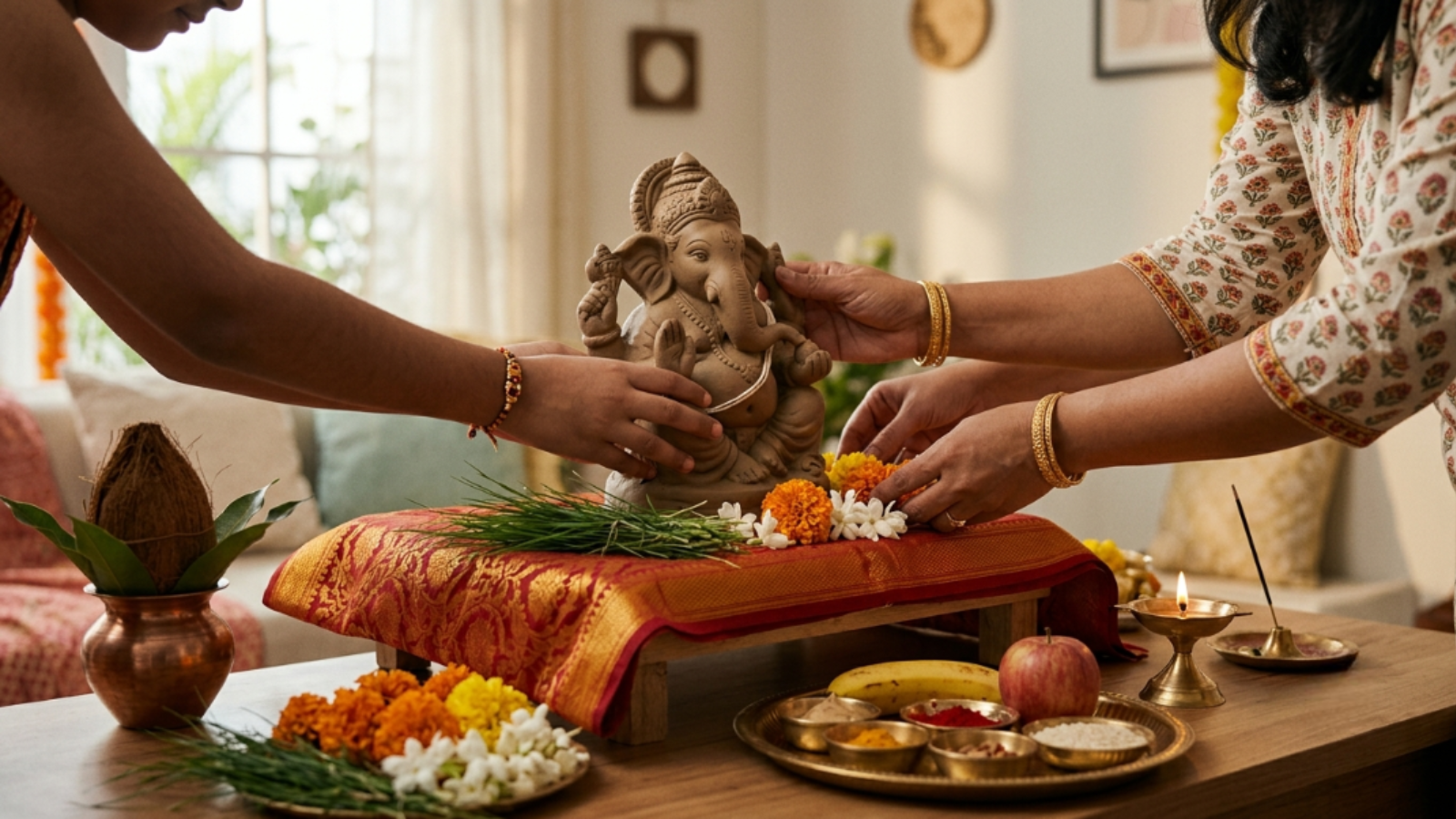
The Sthapana is the moment when the festival truly begins for the household.
Before the murti arrives, prepare the space rather than trying to arrange everything after the fact.
1. Clean the Puja Space
Choose a clean, quiet place for the murti.
A wooden chowki is traditionally used, often covered with a fresh red or yellow cloth. Many families also decorate the area with flowers, torans, rangoli or lights.
The idea is simple: prepare the space as you would prepare for an honoured guest.
2. Place the Murti
Place the Ganesha murti carefully on the decorated chowki.
Clay idols are increasingly preferred by families looking to reduce the environmental impact of visarjan. The material and paint used for an idol can make a significant difference when it is eventually immersed.
3. Perform the Sankalp
Sankalp is the formal statement of your intention to perform the puja.
Depending on your family tradition, it may include your name, place, gotra and the purpose of the worship.
This is not merely an announcement.
It is the moment when the day’s ritual gets its purpose.
4. Perform the Puja
The worship can include traditional offerings such as:
- Chandan
- Kumkum or roli
- Akshat
- Flowers
- Durva grass
- Incense
- Diya
- Fruits
- Modak or other naivedya
The exact sequence can vary according to regional and family traditions, so there is no single universal household checklist that every devotee follows.
Why Is Durva So Important to Ganesha?
Ask someone to name the most recognisable offering to Ganesha and modak will probably come first.
But durva grass has its own special place.
The fresh green blades are traditionally offered to Ganesha, often in sets associated with the number 21.
Why 21?
Different traditions explain the number symbolically, including associations with the five organs of perception, five organs of action, five vital forces, five elements and the mind.
The interpretation varies across traditions, but the ritual detail remains familiar: durva is one of the offerings most closely associated with Ganesha worship.
And there is a practical reason devotees often arrange it beforehand.
On Ganesh Chaturthi morning, almost everything gets busy.
Flowers disappear from local markets. Modaks are being prepared. Families are getting dressed. Someone remembers the missing camphor five minutes before aarti.
Durva is better bought before the rush.
Why Are Modaks Offered to Lord Ganesha?
If Ganesh Chaturthi had a signature sweet, it would be the modak.
The rounded sweet with its distinctive pleated top is traditionally associated with Ganesha, and it appears in many forms across India.
Steamed ukadiche modak is especially associated with Maharashtra, while other regions prepare fried versions or their own local variations.
The symbolism is also part of the appeal. The sweet filling is hidden inside the outer covering — a small reminder that what is valuable is not always visible immediately.
During Ganesh Chaturthi, modaks are offered as naivedya and later distributed as prasad.
And yes, this is one festival where nobody needs much convincing to have one more.
Ganesh Chaturthi Puja Samagri: A Practical Checklist
Before the first aarti, make sure the basics are ready.
| Puja Item | Purpose |
| Ganesha Murti | Main object of worship |
| Chowki | Base for the murti |
| Red or yellow cloth | Covering for the chowki |
| Kalash | Traditional ritual vessel |
| Gangajal | Purification |
| Roli/Kumkum | Tilak |
| Chandan | Offering and tilak |
| Akshat | Ritual offering |
| Durva | Traditional Ganesha offering |
| Flowers | Puja offering |
| Incense/Dhoop | Fragrance during worship |
| Diya/Ghee | Aarti and worship |
| Modak | Naivedya/prasad |
| Fruits | Naivedya |
| Coconut | Traditional puja offering |
| Betel nut | Used in several ritual arrangements |
| Aarti thali | Final worship |
You do not need to turn your home into a temple shop.
If your family follows a specific puja tradition, follow that tradition. If you are performing Ganesh Chaturthi at home for the first time, focus on preparing the essentials correctly rather than buying everything you see in a festival market.
What Happens During the Days of Ganeshotsav?
Ganesh Chaturthi does not necessarily end when the first puja is over.
Families keep Ganesha for different durations.
Some perform visarjan after one and a half days. Others keep the idol for three, five or seven days. Many continue until Anant Chaturdashi.
During the days that Ganesha remains at home, devotees may perform morning and evening aarti, offer food and sweets, invite relatives, organise bhajans and participate in community celebrations.
There is no single household pattern.
The length of the stay depends on family tradition and the vow made at the time of Sthapana.
What remains constant is the sense of hospitality.
Ganesha has been invited home.
So he is treated as a guest.
Why Should You Avoid Looking at the Moon on Ganesh Chaturthi?
This is one of the festival’s strangest stories — and one of the most memorable.
According to the traditional story, Chandra, the moon deity, laughed at Ganesha after seeing him fall from his vehicle. Ganesha became displeased and placed a curse associated with seeing the moon on Chaturthi.
The belief is connected with Mithya Dosha, traditionally described as the possibility of facing false accusations or allegations.
The story becomes even more interesting because Lord Krishna is also connected with it.
After seeing the moon on this tithi, Krishna became associated with an accusation concerning the Syamantaka jewel. The story ultimately led him to prove his innocence and recover the jewel.
That is why the Syamantaka Mani story is traditionally remembered on Ganesh Chaturthi.
In 2026, Panchang calculations also provide specific local periods during which moon sighting is traditionally avoided. For example, Drik Panchang lists an avoidance period for Thane from approximately 9:10 AM to 8:36 PM on September 14.
If the moon is accidentally seen, traditions prescribe remedies such as reciting or hearing the Syamantaka Mani story and worshipping Ganesha.
Is Fasting Necessary on Ganesh Chaturthi?
No single fasting rule applies to every household.
Some devotees observe a fast until the midday puja. Some eat fruits and other permitted foods. Others do not fast at all and instead follow a sattvic diet.
The important distinction is between vrat followed according to a particular tradition and a blanket rule that everyone must follow.
If your family has a long-standing Ganesh Chaturthi vrat, follow its customary procedure.
If you are observing the festival for the first time, there is no need to turn the day into a test of endurance.
The festival is about worship, not about competing with your own hunger.
Ganesh Visarjan 2026: When Does Ganpati Leave?
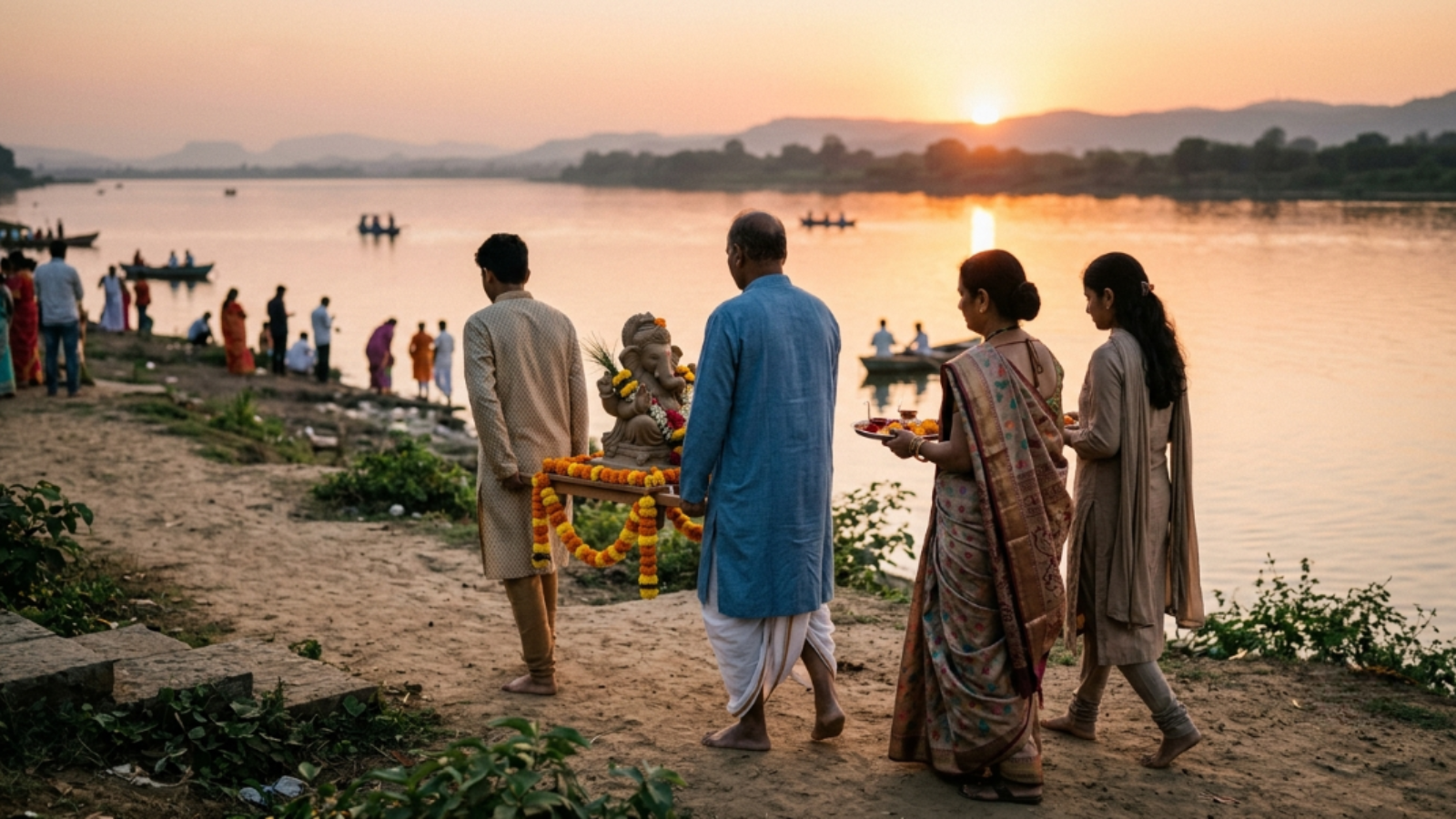
The final day carries a completely different emotion.
The same idol that was welcomed with music and flowers is carried toward immersion.
In 2026, the main Ganesh Visarjan falls on Friday, September 25, Anant Chaturdashi.
Before visarjan, devotees traditionally perform Uttar Puja and a final aarti. The idol is then taken in procession for immersion.
And then comes the familiar call:
Ganpati Bappa Morya!
Pudhchya Varshi Lavkar Ya!
Come back soon next year.
That final line captures something essential about the festival.
Visarjan is not simply goodbye.
It is an acceptance that the form may leave, but devotion continues.
Ganesh Visarjan Dates in 2026
Families observing shorter periods may perform visarjan according to their own tradition.
Common durations include:
| Ganpati Stay | Visarjan |
| 1.5 days | September 15, 2026 |
| 3 days | September 16, 2026 |
| 5 days | September 18, 2026 |
| 7 days | September 20, 2026 |
| 10 days / Anant Chaturdashi | September 25, 2026 |
The exact observance can differ by family and region.
For immersion, many devotees now choose designated artificial tanks or controlled immersion facilities, particularly for environmental reasons. A natural clay idol with appropriate natural colours is also generally easier to dissolve responsibly than an idol made from materials that do not break down easily.
AstroLive: Find Astrological Guidance When You Need It

Festivals like Ganesh Chaturthi often give us a reason to pause and reflect. Beyond the rituals and celebrations, they can also bring personal questions to the surface — about relationships, career, marriage, finances or what the next phase of life may look like.
AstroLive brings live astrology consultations and a range of astrology tools together on one platform. You can explore different astrologers, choose the type of guidance you are looking for and connect with them online.
What Can You Explore on AstroLive?
Chat With an Astrologer
Have a question you want to discuss? AstroLive lets you chat with an astrologer starting at ₹10/min.
Talk to an Astrologer
For a more detailed conversation, you can speak with an astrologer starting at ₹15/min.
Choose Your Area of Astrology
Explore astrologers offering Vedic Astrology, Tarot and Numerology, along with different language options including Hindi, English, Gujarati, Marathi, Bengali, Telugu and Malayalam.
Check Your Horoscope
Explore Daily, Monthly and Yearly Horoscopes to understand what your zodiac sign says about different areas of life.
Explore Today’s Panchang
Check the Indian Calendar, Hora and Choghadiya and stay connected with the traditional astrological calendar.
Create a Free Kundli
Generate your Free Kundli and explore your birth chart before deciding whether you want a more personal consultation.
Check Compatibility
AstroLive also offers Kundli Match and a Love Calculator for people exploring relationship compatibility.
Explore More Than Live Consultations
Beyond astrologer consultations, AstroLive brings together Tarot Reading, Palmistry, Vastu, Numerology, Mantra, Chalisa, Aarti, Nadi Astrology, Nakshatra and several astrology reports. You can also explore healing options such as Reiki, Meditation, Yoga, Crystal Therapy and more.
Continue Your Astrology Journey With AstroLive
Ganesh Chaturthi may come once a year, but the questions we have about our lives do not follow a calendar. If you want to explore your horoscope, understand your Kundli or speak directly with an astrologer, AstroLive gives you a convenient way to do that online.
Chat with astrologers from ₹10/min or talk to astrologers from ₹15/min. Explore astrology, Panchang, Kundli, compatibility and more with AstroLive.
Ganesh Chaturthi Is More Than a Festival Date
You can put all the important information into a calendar:
September 14 — Sthapana.
September 25 — Anant Chaturdashi.
But a calendar cannot explain why the house feels different when the idol arrives.
It cannot explain why children remember the aarti before they remember the date.
It cannot explain why the final “Ganpati Bappa Morya” feels different from the first.
That is the strange beauty of Ganesh Chaturthi.
For a few days, the divine is not somewhere far away.
He sits in the living room.
Flowers are placed before him.
Modaks are offered with the same care as they would be to an honoured guest.
And as the family sings the aarti — sometimes perfectly, sometimes with three different people singing three different lines — the room feels a little more alive.
And eventually, he leaves.
The flowers dry. The mandap comes down. The lights are packed away.
But the household keeps the one thing Ganesh Chaturthi has always asked of it:
Begin again.
And perhaps that is why Ganesha is worshipped first.
Not because every new beginning will be easy.
But because every beginning deserves wisdom, faith and the courage to move forward.
Frequently Asked Questions About Ganesh Chaturthi 2026
1. When is Ganesh Chaturthi 2026?
Ganesh Chaturthi 2026 falls on Monday, September 14. The Chaturthi tithi begins at 7:06 AM on September 14 and ends at 7:44 AM on September 15.
2. What is the Ganesh Chaturthi 2026 puja muhurat?
The Madhyahna puja muhurat depends on location. For example, it is approximately 11:16 AM to 1:44 PM in Pune, while Mumbai’s window is approximately 11:20 AM to 1:48 PM.
3. When is Ganesh Visarjan in 2026?
The main Ganesh Visarjan falls on Friday, September 25, 2026, on Anant Chaturdashi.
4. What should be offered to Lord Ganesha?
Traditional offerings include durva grass, red flowers, chandan, akshat, fruits and modaks. Families may follow different regional puja traditions.
5. Is fasting compulsory on Ganesh Chaturthi?
No. Fasting practices differ between families and traditions. Some devotees fast until the midday puja, while others follow a sattvic diet without fasting.
6. What should I do if I accidentally see the moon on Ganesh Chaturthi?
Traditional practice associates moon sighting on Ganesh Chaturthi with Mithya Dosha. Devotees traditionally respond by worshipping Ganesha and listening to or reciting the Syamantaka Mani katha, according to their family or religious tradition.