



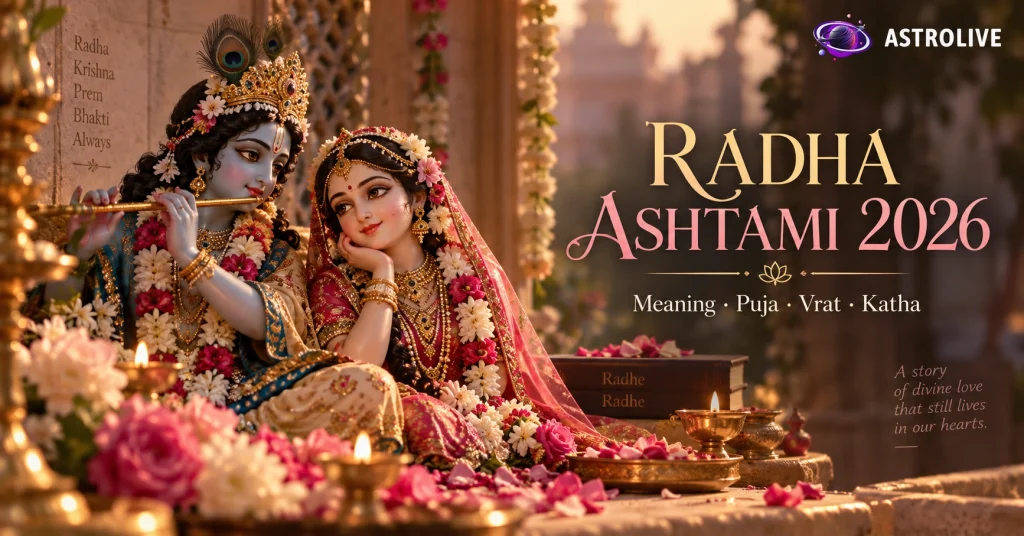
Radha Ashtami is one of those festivals that feels quieter than Janmashtami, yet carries just as much weight for anyone who follows the path of bhakti. It falls fifteen days after Krishna’s birth celebration and marks the appearance of Radha Rani, the figure most closely tied to divine love in Vaishnava tradition. If you’ve ever wondered why this particular day gets its own puja, vrat, and story, you’re not alone.
This piece walks through what the festival means, when it falls in 2026, how it’s traditionally observed, and why it continues to matter to millions of devotees across Braj and beyond.
What Is Radha Ashtami?
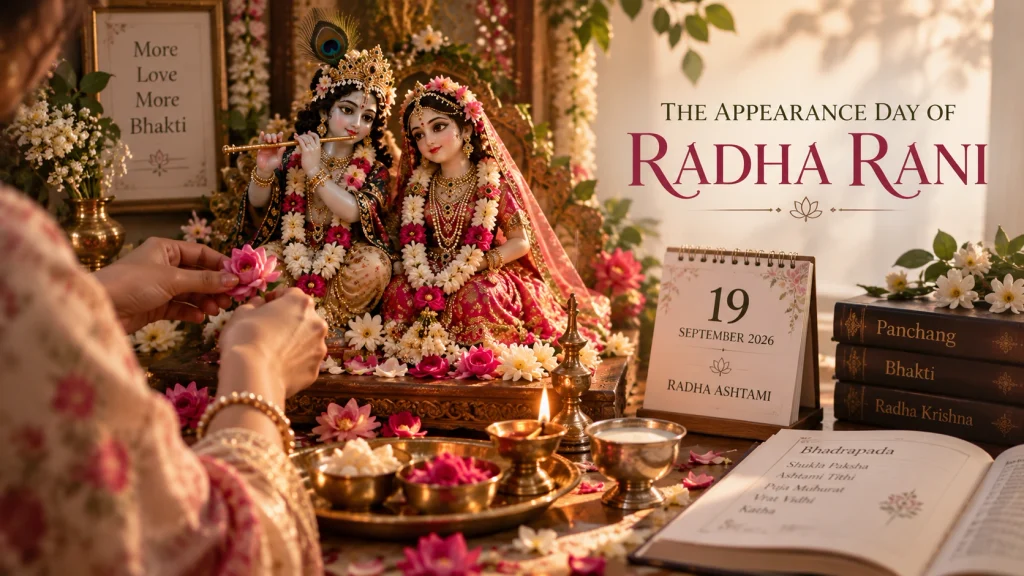
Radha Ashtami is a Hindu festival observed on the Ashtami Tithi of Shukla Paksha in the month of Bhadrapada. It’s traditionally regarded as the appearance day of Radha Rani, sometimes called Radha Jayanti or simply Radhashtami.
The date isn’t random. Devotees believe Radha appeared exactly two weeks after Krishna, and the two are rarely spoken of separately in devotional literature. Where Janmashtami centers on Krishna’s birth, this festival turns attention toward the one considered his eternal counterpart.
A simple way to remember it: Radha Ashtami is the day devotion itself gets celebrated, not just the deity who inspired it.
When Is Radha Ashtami 2026?
Radha Ashtami 2026 falls on Saturday, September 19. According to Panchang calculations, the Ashtami Tithi begins on September 18 at 1:00 PM and runs until September 19 at around 3:26 PM.
That overlap is worth noting. Because the tithi spans two days, some households and regional traditions observe the festival slightly differently depending on local sunrise conventions, which is exactly why checking a location-specific Panchang matters more than relying on a single national timing.
Radha Ashtami 2026 Puja Muhurat
The Madhyahna, or midday, puja window is generally considered the most auspicious time for worship. For many parts of India, this falls roughly between 11:19 AM and 1:45 PM, though the exact window shifts by city.
Rather than treating one clock time as universal, it helps to look up the Radha Ashtami tithi timings for your own location before planning the puja. A few minutes of checking saves the confusion of starting rituals outside the recommended window.
Why Is Radha Ashtami Celebrated?
At its heart, Radha Ashtami celebrates something less tangible than a birthday. It honors a relationship built on surrender, longing, and love without conditions, which is how most bhakti traditions describe Radha’s bond with Krishna.
Devotees don’t just mark her appearance. They reflect on what she represents: a love that asks for nothing in return. That idea shows up again and again in temple discourses around this time of year, and it’s part of why the day resonates so deeply even outside formal ritual.
The Connection Between Radha Rani and Krishna
In Gaudiya Vaishnavism and related traditions, Krishna is considered accessible only through Radha’s grace. She isn’t a secondary figure in the story; she’s often described as the very energy that draws devotees closer to him.
This is why you’ll rarely find a temple that worships Krishna without also placing Radha beside him. The pairing itself is the teaching.
Why Radha Ashtami Is Important in Braj
Nowhere is this festival felt more strongly than in Braj, the region spanning Barsana, Vrindavan, Mathura and Nandgaon. Barsana in particular holds deep significance, since tradition places Radha’s appearance there.
Temples across these towns host elaborate celebrations with bhajan, kirtan and hours of devotional singing. If you ever get the chance to witness Radha Ashtami in Barsana itself, the scale of devotion there is hard to describe secondhand.
What Happens on Radha Ashtami? Puja, Vrat and Katha
Puja Vidhi at Home
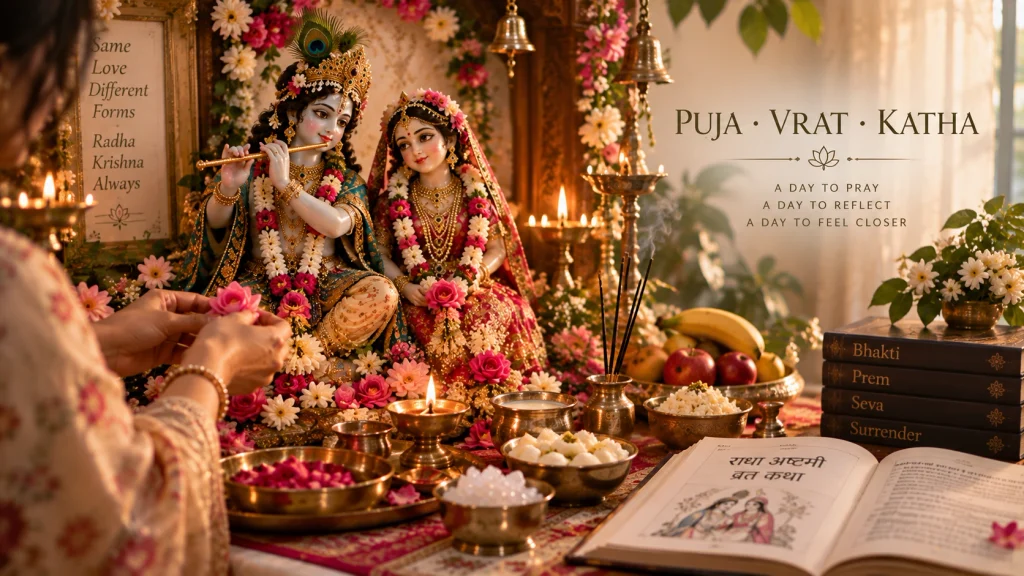
A home puja doesn’t need to be elaborate. Most households follow a simple sequence: clean the puja space, set up an image or idol of Radha or Radha-Krishna together, take a sankalp, perform abhishek where customary, and offer flowers, new clothing and bhog.
After the offerings, devotees recite prayers or mantras and close with aarti. None of this requires special training, just intention and a bit of preparation.
Vrat: How Devotees Observe It
Fasting practices vary considerably. Some devotees keep a full fast, others follow phalahar with fruits and milk-based foods, and some simply focus on prayer without any dietary restriction at all.
There’s no single correct approach here. Family tradition and personal capacity both play a role, and parana, the act of breaking the fast, usually follows local custom.
Radha Astami Vrat Katha
The traditional story behind the day centers on Barsana, where Radha is said to have appeared to Vrishabhanu and his wife Kirti. Many versions describe her arrival as miraculous, tied closely to the timing of Krishna’s own birth nearby.
Devotees read or listen to this Radha Ashtami vrat katha as part of the day’s observance, treating it less as historical record and more as a devotional reminder of why the festival exists at all.
Offerings and a Simple Way to Observe at Home
Typical offerings include flowers, seasonal fruits, milk-based sweets, and where tradition allows, makhhan and mishri. Homemade bhog is just as meaningful as anything elaborate, so there’s no pressure to overproduce the offering.
If you want a straightforward home routine, this covers the basics: check your local tithi and muhurat, prepare a clean puja space, arrange simple offerings, decide your fasting approach, perform the Radha-Krishna puja, read the vrat katha, and finish with aarti. That’s genuinely enough.
Read More!
Ganesh Visarjan: Dates, Muhurat and Rituals
How To Boost Your Career Growth Through Astrology
Do’s, Don’ts and Common Misconceptions
Keep the puja space clean, observe the vrat according to your own family’s practice, and make time for bhajan or quiet prayer if a full puja isn’t possible.
Where people sometimes go wrong is assuming there’s one identical ritual everyone follows. Timings differ by location, fasting isn’t mandatory in every tradition, and claims about specific benefits should be understood as belief rather than guarantee.
How AstroLive Can Help You Plan Radha Ashtami

If you’re trying to pin down the exact Madhyahna window for your city, AstroLive’s daily Panchang and tithi tools can help you check timings without guessing. The platform also covers shubh and ashubh muhurat details around major festivals.
For anyone with a specific question about the day, whether it’s about timing or something more personal, live astrologer consultations and e-Puja services are available too. Think of it as a planning aid rather than a replacement for family tradition.
A Deeper Meaning of Radha Ashtami
Strip away the ritual calendar and what remains is a fairly simple idea: love that doesn’t calculate what it gets back. Radha’s devotion is often held up as the model for how a devotee should approach the divine, not through negotiation but through surrender.
That’s arguably why her story has stayed relevant across centuries of Vaishnava thought, long after the specifics of any single ritual might change.
Why Radha Ashtami Continues to Matter
Underneath the dates, muhurats, and rituals, Radha Ashtami keeps pointing back to one idea: devotion doesn’t need to be complicated to be sincere. A simple puja done with genuine feeling carries as much weight as an elaborate temple ceremony.
Whatever tradition your family follows, checking your local Panchang and taking a little time for prayer is really all this day asks. In that quiet act of remembrance, Radha and Krishna are honored together, as they always have been.
FAQs
When is Radha Ashtami 2026?
Radha Ashtami 2026 falls on Saturday, September 19, though it’s worth confirming exact tithi timing through a local Panchang since the tithi spans parts of two days.
What is Radha Ashtami and why is it celebrated?
It’s the traditional appearance day of Radha Rani, observed through puja, fasting, and devotional worship, celebrating her role as the embodiment of pure love within Radha-Krishna devotion.
What is the puja muhurat?
The Madhyahna period, roughly late morning to early afternoon, is generally considered auspicious, though the precise window varies by city.
What is the significance of Radha Rani Jayanti?
It marks Radha’s appearance and her central place in bhakti traditions, where devotion to Krishna is understood as incomplete without honoring her first.
How is the vrat observed?
Through sankalp, a fasting approach chosen by the individual or family, midday puja, and parana afterward according to personal tradition.
Can the puja be done at home?
Yes. A clean space, simple offerings, prayer, and aarti are enough for a meaningful home observance.
What is the vrat katha?
It’s the traditional story of Radha’s appearance at Barsana to Vrishabhanu and Kirti, read or heard by devotees as part of the day’s devotion.
What should be offered to Radha Rani?
Flowers, fruits, milk-based sweets, and homemade bhog prepared with a sense of devotion rather than elaborate presentation.