




Daily horoscope and panchang in 2026 helps Hindi speakers translate the sky’s signals into confident, everyday action. **Download Free App Today → guiding daily choices: when to start a journey, sign a deal, fix a wedding date, or even keep a low profile. Because the language of the sky lands best in your own language, reading in Hindi makes the cues clearer, the meanings richer, and the actions more grounded.
Moreover, even a small cue, like a shubh muhurat (auspicious window) or a chandra rashi hint, can tilt outcomes. So, this warm, practical guide shows you how to read key panchang elements and rashifal (horoscope) in Hindi, avoid common mistakes, and build a habit you can trust.
What Are Daily Horoscope (Rashifal) and Panchang, and Why Do They Matter?
At its heart, rashifal is daily guidance for your rashi (moon sign), while panchang is the day’s celestial almanac. The two work together: the panchang sets the sky’s “weather,” and the rashifal helps you read that weather for your sign.
In practice, panchang gives the daily framework, like tithi and nakshatra, so you can plan your day. Rashifal adds a sign-wise, human layer. Together, they point to shubh (auspicious) and ashubh (inauspicious) timings for tasks, from money moves to meetings, and note mindful periods to pause or reflect.
For background, the traditional almanac known as “Panchangam” has a deep history in Hindu timekeeping. You can read a concise overview on Wikipedia at https://en.wikipedia.org/wiki/Panchangam. While scholars debate details, the practical use remains the same: plan with respect to time’s quality, not only the clock.
Core Panchang Elements in Daily Life
Tithi (lunar day) is the mood of the moon, and it shapes the tone of starts, talks, and vows. Dwitiya and Tritiya often suit gentle beginnings, trial runs, and soft outreach where rapport matters more than speed. Ekadashi feels inward and is ideal for fasting, reflection, and simplifying your schedule. Chaturdashi can be intense, which makes it useful for focused, necessary work that benefits from decisive effort.
Var (weekday) adds a sun-ruled flavor to the day. Somvar, Mangalvar, Budhvar, and so on, each carrying a traditional association. Many people observe Monday for Shiva-related vows and calm commitments, while Thursday is favored for learning, counsel, and blessings from gurus. Friday can uplift beauty, relationship tasks, and hospitality, whereas Saturday supports discipline, repairs, and patient, steady progress. When paired with the right tithi, your weekday choice becomes even more effective.
- Weekday quick cues at a glance:
- Somvar (Mon): calm starts, family matters, Shiva puja, healing routines.
- Mangalvar (Tue): courage, assertive tasks, repairs; be measured with conflicts.
- Budhvar (Wed): study, communication, short travel, documentation.
- Guruvaar (Thu): teaching, counsel, investments after due diligence.
- Shukravar (Fri): hospitality, aesthetics, relationships, fine arts.
- Shanivar (Sat): discipline, maintenance, long-term planning, charity.
- Ravivar (Sun): leadership, visibility, authority meetings; avoid ego spikes.
Nakshatra (lunar mansion) is the star backdrop that shapes style, sensitivity, and how events “feel.” Mrigashira favors exploration, research, and scouting options before a decision. Rohini supports growth, creativity, nourishment, and anything that needs consistent care. Pushya is highly auspicious for learning and initiation, especially if you wish to set up a routine that lasts. Ashlesha, by contrast, may ask for care with words and agreements, so review terms twice and keep boundaries healthy.
Yog (sun–moon angle) blends forces that can smooth or strain work, like a subtle current beneath the day. Shubha yogas such as Siddhi and Shubha tend to ease starts, reduce friction, and reward initiative. Challenging yogas like Vyatipata or Vaidhriti invite patience, backup plans, and extra verification before you commit resources. When a tense yog appears, you can still move ahead, just use smaller steps and confirm details.
Karan (half-tithi) offers fine-grain timing, so you can pick the right hour within the right day. Bava and Balava are handy for general starts and everyday errands that still matter. Taitila can favor trade, negotiation, and practical exchanges. Vishti (Bhadra) is often avoided for new ventures but can be excellent for clearing backlogs, returning items, and completing pending closures.
| Karan (करण) | Best for (उपयोग) | Use with care (सावधानी) |
|---|---|---|
| Bava, Balava | Everyday starts, errands, friendly outreach | Avoid hard deadlines if overall yog is tense |
| Kaulava, Taitila | Trade, negotiation, practical exchanges | Double-check figures and terms |
| Garaja, Vanija | Purchases, project milestones, inventory | Keep receipts and audit trails |
| Vishti (Bhadra) | Closures, returns, backlog clearing | Traditionally avoided for new beginnings |
Rashi (moon sign) is your chandra rashi, and it underpins how you read the daily rashifal and many muhurats. Daily horoscopes are typically read from the moon sign because it tracks your shifting moods and everyday experience. For event muhurats, astrologers also check lagna (ascendant) at the chosen time to ensure the moment itself is favorable. Knowing both helps you translate the sky’s language into precise, personal decisions.
 " with a calendar icon and on the right "Moon Sign (Chandra Rashi)" with a moon icon; arrows pointing to "Read daily rashifal from Moon Sign" with Hindi labels)
In addition, daily panchang entries highlight auspicious and inauspicious timings for various activities. And daily horoscopes for all zodiac signs turn this sky-map into friendly pointers you can act on.
Why Reading in Hindi and Location Accuracy Matter
Why Hindi? Because meaning lives in nuance. For Hindi speakers, reading terms like “tithi,” “yog,” or “Rahu Kaal” in your mother tongue aligns brain and belief. As a result, you move from vague ideas to clear choices, without translation gaps. If you are traveling or living abroad in 2026, prefer platforms that let you switch interface language to Hindi while still using your current location for accurate sun–moon calculations.
Also confirm the technical basics behind the scenes: your app’s ayanamsa (e. g., Lahiri), timezone and DST handling, and whether sunrise is topocentric (observer-based). A 1–2 minute check prevents avoidable errors like reading Rahu Kaal for the wrong city, or missing a tithi shift that happens just after local sunrise.
Extra Timing Helpers (Simple and Effective)
Daily readers often add a few more cues to sharpen timing without over-complicating plans. Abhijit Muhurat, the mid-day auspicious period around local solar noon, offers a reliable fallback for quick initiations when nothing else aligns. Rahu Kaal and Gulika Kaal are regular windows to avoid for brand-new starts; while their lengths are fixed, the start times vary by weekday and city, so location accuracy matters. You can also use Hora (planetary hour) to match your task. Mercury hora for communication, Jupiter hora for study and advice, especially helpful when the day is mixed but you still want a narrow, supportive slot.
- Extra helpers at a glance:
- Abhijit Muhurat: quick green light near local solar noon for short initiations.
- Rahu Kaal: avoid fresh starts; use for reviews, internal planning.
- Gulika Kaal: neutral to cautious; avoid first launches, do maintenance.
- Yamaganda: travel caution window in some traditions; plan departures outside it.
- Hora: choose Mercury (talks), Venus (relationships/design), Mars (assertive tasks), Jupiter (learning/legal), Saturn (repairs), Sun (leadership), Moon (care/home).
“Time is not only quantity; in the panchang, it is quality. When you respect quality, outcomes tend to align with intent.”
Also Read!
Best Daily Horoscope and Panchang for Hindi in 2026
How to Use Daily Horoscope and Panchang for Marriage Compatibility
How to Read and Use Daily Horoscope and Panchang in Hindi — Step-by-Step
Before you start, remember: panchang tells the day’s climate; rashifal makes it personal. The steps below help you link both, in Hindi, with ease.
Step-by-step method you can use today
- Step 1: Identify your rashi (moon sign vs sun sign)
- Your rashi is based on the moon at your birth, not the sun sign from Western columns.
- Use a Janam Kundli (birth chart) to find your chandra rashi. Free and instant Janam Kundli generation using date, time, and place of birth is widely available in trusted apps.
- Example: If your Western sun sign is Leo but your moon was in Taurus at birth, you will read daily rashifal for Vrishabha (Taurus), not Simha (Leo).
- Step 2: Read the panchang elements
- Note tithi, var, nakshatra, yog, and karan.
- For example, a steady nakshatra may favor finance tasks; a tense yog may ask for calm.
- Also glance at sunrise, sunset, moonrise, and moonset, as these affect duration of tithis and the feel of evening rituals.
- Step 3: Check shubh muhurat and avoid ashubh windows
- Look for auspicious and inauspicious timings for various activities like travel, deals, puja, and surgery prep.
- Mark Rahu Kaal and Gulika Kaal to avoid key starts in those slots.
- If you must proceed in a tight schedule, try Abhijit Muhurat or pick a supportive hora aligned with your task.
- Step 4: Read your rashifal for guidance
- Personalized insights are based on planetary alignments and your rashi.
- Match rashifal hints with the panchang’s tone: if both warn “go slow,” listen.
- If rashifal suggests “networking” but the day’s yog is tense, keep the meeting but manage expectations—aim for a first touch, not a final decision.
- Step 5: Apply insights to daily decisions
- Start key tasks in shubh slots; schedule tough talks when the nakshatra supports clear speech.
- Keep a small journal to note what worked; refine your sense of timing each week.
- Over two weeks, tag your notes with three markers: Start Time, Task Type, Result. Patterns will emerge about which weekdays or nakshatras favor you.
Helpful tips as you read
Prefer platforms with multiple language support including Hindi so the terms match what you’ve heard at home and in family rituals. Always cross-check the panchang if your region follows a different school, as small differences in tithi boundaries can change festival and fasting observances. If your rashifal feels too generic, refer back to your Janam Kundli for planetary context or ask a professional to interpret one knot you can’t untie. Set your precise location; in 2026, most apps auto-detect GPS, but you should still verify the city and timezone for correct Rahu Kaal and sunrise-based calculations.
If you commute across cities, save a “home” and “work” location in your app, because the difference can shift muhurat windows by minutes that actually matter for short tasks. Learn your family’s tradition (Amanta vs Purnimanta lunar months) to reduce confusion on vrat and festival dates. When abroad, note daylight saving changes, since local clock time of muhurats shifts even when their durations remain constant. These careful, two-minute checks make the daily horoscope and panchang a trustworthy ally rather than a vague suggestion.
Mini Case Study: Two Days Compared
-
Day A (Calm build): Tritiya tithi, Rohini nakshatra, Siddhi yog, Bava karan; Rahu Kaal 1:30–3:00 pm; Abhijit 12:10–12:55 pm.
-
Plan: Start a client onboarding in the morning, make a soft pitch in Abhijit, and send paperwork during Mercury hora.
-
Outcome: Quick approvals and minimal back-and-forth. Journal note: “Rohini + Siddhi favored nurturing tasks.
-
Day B (Mixed, proceed with care): Chaturdashi tithi, Ashlesha nakshatra, Vaidhriti yog, Taitila karan; Rahu Kaal 10:30–12:00 pm.
-
Plan: Avoid new launches; schedule a vendor renegotiation with a clear checklist; use Jupiter hora for counsel.
-
Outcome: Firm but respectful discussion; decision postponed to a neutral slot next day. Journal note: “Tense yog manageable with smaller steps.
By pairing the daily horoscope and panchang, you move from guesswork to a rhythm. Moreover, you learn which patterns serve you best, like which weekdays lift your focus or which nakshatras suit family plans. Over time, you’ll also notice when to rest, often the most productive choice is a mindful pause in a low-energy tithi.
Common Mistakes Hindi Users Make with Horoscope and Panchang
Even sincere readers slip on a few points. The good news: each pitfall has a fix you can apply right away.
Basics that often get mixed up
First, many people mix up sun sign with moon sign (rashi). Western columns use sun signs; Vedic daily guidance usually uses chandra rashi. Therefore, base your rashifal reading on the moon sign from your Janam Kundli.
Second, regional panchang variations matter. North Indian and South Indian schools may count tithis or sunrise differently. As a result, using a local or region-aware panchang avoids confusion, especially on festival and ekadashi dates.
Third, relying on generic horoscopes without birth chart context can mislead. A rashifal is a public note; your Kundli is your private map. Advanced Kundli software calculates planetary positions, houses, doshas, and yogas, which explain why a “good day” may still feel mixed for you.

Planning errors you can fix in minutes
Fourth, not checking the tithi before big moves, like property token money or travel, can cause friction. Even a 30-minute shift into a better slot can make talks smoother and waits shorter.
Fifth, mixing Western and Vedic systems in one decision, say, using a Western sun-sign love tip with a Vedic muhurat, creates mismatched signals. Pick one method for a given call and follow it through.
Sixth, ignoring your task’s nature. Some actions need “Mridu” (soft) energy, family healing talks, apologies, first lessons, while others need “Tikshna” (sharp) energy, surgery prep, cutting losses. Match the day to the deed.
Seventh, assuming one bad yog cancels the day. In practice, you can often find a narrow shubh window, or at least a neutral slot, especially using hora or Abhijit Muhurat.
Taken together, the most frequent pitfalls are confusing sun sign with moon sign, ignoring regional panchang differences, relying on generic columns without Kundli context, skipping a tithi check before events, mixing Western and Vedic rules in the same decision, not matching the task type with the day’s energy, and treating an ashubh yog as a total block rather than planning around it. When you watch for these seven items and correct them once, your daily horoscope and panchang start “clicking” with your real-world schedule.
"The astrologers are very knowledgeable and provide insightful guidance. The Live Chat feature is particularly helpful." — Ananya Sharma, Mumbai, Maharashtra
If you feel stuck, generate your free and instant Janam Kundli and ask a pro to interpret one tricky part. One clear note can save a whole week of guesswork. Also, track just one decision per day for seven days; that small, consistent test beats reading for hours without action.
Also Read!
How to Make and Match Kundli for Marriage Compatibility: A Complete Guide for Couples
Best Tools and Apps for Daily Hindi Horoscope and Panchang
You have several ways to access the day’s cues. Each has strengths. The key is to match your need, quick glance, deep dive, or live guidance, with the right source in 2026.
Traditional sources still serve well. Hindi panchang printed calendars, newspaper columns, and temple-published panchangs are time-tested. They feel personal and local. However, they may lack live updates or personalized sign-wise notes.
On the web, Drik Panchang and similar sites provide detailed tithi, nakshatra, yog, and karan, plus sunrise/sunset. These are great for planners. On the other hand, they may feel dense if you’re new, and not every page is in Hindi.
Apps bring both worlds together. Tools like Astrolive offer a multilingual platform with support for Hindi, daily panchang with details on tithi, nakshatra, yog, and karan, and daily horoscopes for all zodiac signs. In addition, you can chat with an astrologer at ₹10/min when a reading feels unclear. Trusted by millions for accurate astrology tools, these platforms also show ratings so you can choose with confidence.
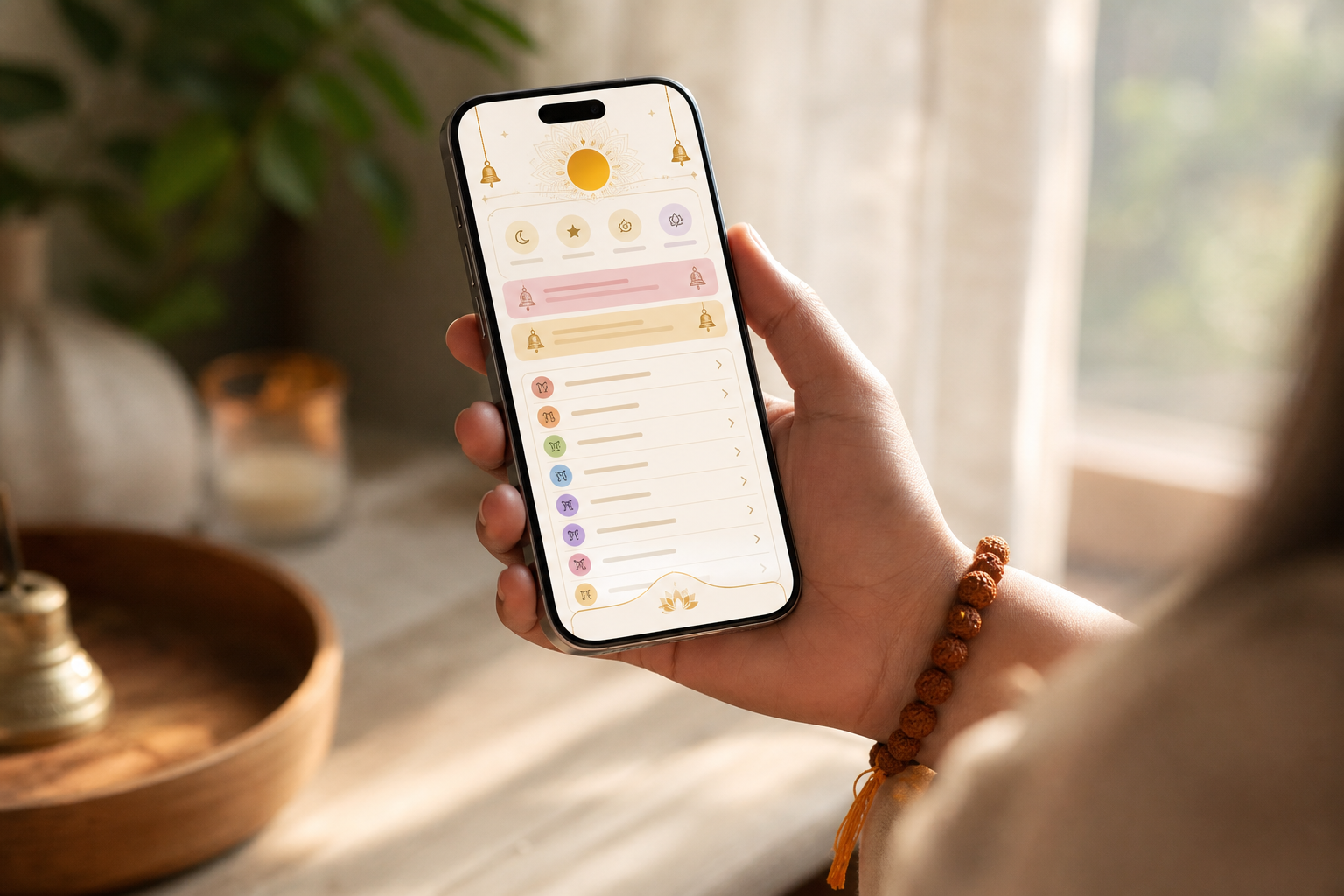
Features that matter in 2026
Look for location-aware panchang that auto-detects your city and still allows a manual override, because a few kilometers can shift Rahu Kaal or moonrise by enough minutes to matter. A clear display of Rahu Kaal, Gulika Kaal, and Abhijit Muhurat on the home screen saves you from tapping through multiple menus when you’re in a hurry. If the interface is Hindi-first with glossary popups for tithi, yog, and karan, new readers onboard faster and seasoned users confirm meanings without breaking focus.
Private notes or a journal section built into the app helps you log outcomes and compare what the daily horoscope and panchang predicted against what happened. Data transparency also matters: check which ayanamsa is used and the time standard (IST vs local time vs UTC offset) so you can cross-verify with other sources. Finally, offline access to the day’s data once fetched is a quiet lifesaver during travel or poor connectivity, no more guessing when the signal drops.
- 2026 checklist for choosing an app:
- Hindi-first UI with glossary tooltips for key terms.
- Accurate GPS + manual city override; DST-aware calculations.
- One-tap view of Rahu Kaal, Gulika, Yamaganda, Abhijit.
- Built-in journal and exportable notes.
- Transparent ayanamsa and timebase selection.
- Live chat/call with vetted astrologers and ratings.
Quick comparison at a glance
| Source/Tool | Hindi Support | Panchang Details | Rashifal | Extras |
|---|---|---|---|---|
| Drik Panchang (web) | Partial | Full tithi/nakshatra/yog/karan | Limited | Rich calendars |
| Hindi printed calendars | Yes | Core details | No/brief | Fest dates, vrat notes |
| Newspaper columns | Yes | Basic (var/tithi) | Short sign notes | Local flavor |
| Temple-published panchangs | Yes (local) | Local tithi/muhurats | No | Community calendar |
| Apps like Astrolive | Yes (multilingual) | Full daily panchang | All 12 rashis | Live chat/call, Kundli |
Moreover, if you want action in minutes, an app with shubh/ashubh slots, rashifal, and live guidance in Hindi saves time. You can plan a call, pick a muhurat, and log notes in one place.
Get Instant Hindi Guidance → Choose a slot, ask a focused question, and tie one shubh window to one key event, then record the result. Try this simple 14-day experiment: each morning, mark one shubh slot, tie it to one key event, and record the result the same evening. By day 8, you’ll begin to see which weekdays, nakshatras, or yogs cooperate with you most. By day 14, you’ll likely shortlist two or three personal “green flags” you can reuse every month.
Fourth, for complex calls, marriage talks, job shifts, property, consult in Hindi with a Vedic astrologer. Experienced astrologers are available for live chat and calls with ratings provided, so you can choose who fits your style.
When you book, prepare three things: your question (one-line focus), your birth details (date, time, place), and your preferred decision window (e. g., “signing between Wed–Fri”). This keeps the guidance sharp and actionable.
- Morning: read tithi/nakshatra + pick one shubh slot
- Midday: act on one rashifal cue
- Evening: jot 2 lines in your journal
- Weekly: review and adjust
If a reading feels mixed, ask one focused question: “Is Wednesday’s shubh slot better than Friday for signing?” Clear, narrow questions bring clear, useful answers.
Key Takeaways
- Read daily horoscope and panchang together: the day’s sky and your sign’s lens.
- Base rashifal on your moon sign (rashi), not your sun sign.
- Note tithi, nakshatra, yog, and karan, then pick a shubh slot for key tasks.
- Avoid mixing Western and Vedic systems in one decision; stay consistent.
- In 2026, apps with Hindi support and live guidance make daily practice simple.
- Keep a brief journal to confirm what works for you; patterns beat opinions.
What to Do This Week
Pick one app or calendar, confirm your rashi from your Janam Kundli, and follow the 5-step method for seven straight days. Mark one shubh slot each morning and act on a single rashifal cue. On day eight, review your notes and lock the parts that worked best for you.
Call for Instant Guidance → Combine both: rashifal for direction, Kundli for depth.
-
I’m abroad and my family is in India. Which panchang should I follow?
-
For local activities, use your current location’s panchang. For shared family rituals coordinated with India, note Indian timings as well and adapt to your timezone.
-
Can I use daily horoscope and panchang for health or legal matters?
-
Use them for timing support only. For medical, legal, or financial decisions, consult qualified professionals; then pick a suitable muhurat to execute the plan.
-
What if two sources show slightly different tithi or muhurat?
-
Prefer a region-aware source aligned with your family tradition (Amanta/Purnimanta) and check the app’s ayanamsa and city setting. If still unsure, choose the overlapping shubh window or consult a pro for tie-breaker guidance.
To make these decisions even smoother, consider a quick alignment each Sunday night. Open your chosen app in Hindi, set your current city (or the city you’ll visit), and glance at the week’s key tithis, nakshatras, and any prominent yogs. Note two likely shubh windows and one potential caution window and copy them to your calendar. This five-minute ritual ensures that by Monday morning, your daily horoscope and panchang aren’t just readings, they’re already integrated into your plan.
Quick Hindi Glossary (Everyday Use)
- Tithi: चंद्र दिवस; काम शुरू करने का स्वभाव बताता है.
- Nakshatra: नक्षत्र; व्यवहार और संवेदनशीलता का अंदाज़.
- Yog: योग; दिन की समग्र ऊर्जा का मिश्रण.
- Karan: करण; सही घंटे/मुहूर्त चुनने का सूक्ष्म पैमाना.
- Rahu Kaal: राहु काल; नई शुरुआत से बचें.
- Abhijit Muhurat: अभिजीत; दोपहर के आसपास छोटा शुभ अवसर.
- Rashi: राशि; चंद्र राशि, जिसे रोज़ाना राशिफल के लिए पढ़ा जाता है.
- Lagna: लग्न; किसी विशेष समय का उदित राशि, मुहूर्त के लिए ज़रूरी.
- Gulika Kaal: गुलिका काल; प्रायः नई शुरुआत से बचना, रख-रखाव कार्य ठीक.
- Hora: होरा; घंटे-घंटे की ग्रह ऊर्जा, कार्य के अनुसार चुनें.
- Ayanamsa: अयनांश; गणना का मानक, स्रोतों में अंतर यहीं से आता है.
By staying consistent through 2026, reading in Hindi, respecting your location and tradition, and testing one action per day, you’ll turn daily horoscope and panchang from abstract ideas into a practical, confidence-boosting habit. With small, steady steps, accurate location, clear rashi, and thoughtful shubh windows, you’ll find that your calendar and the cosmos can cooperate more often than not. And when they don’t, you’ll know how to pivot: wait for a friendlier tithi, shift into a neutral hora, or simply conserve energy for tomorrow’s stronger tide.